
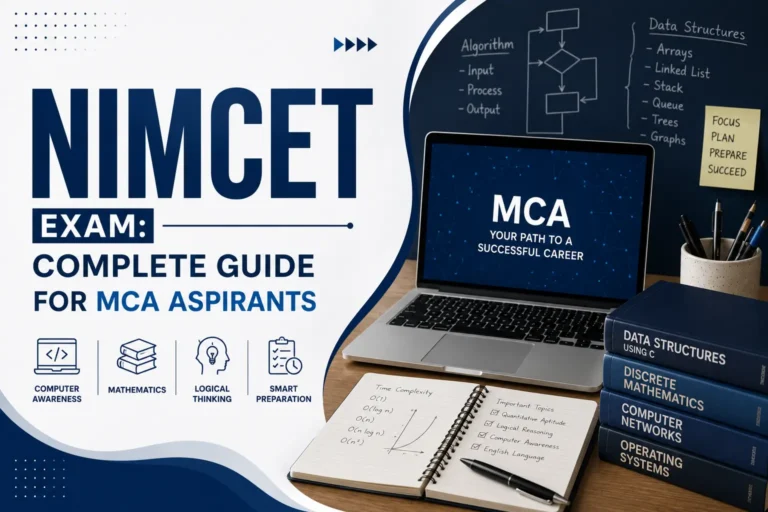
NIMCET is the national-level entrance exam that decides admission into the Master of Computer Applications program at India’s National Institutes of Technology. For thousands of students across the country, NIMCET is the single most important step between a bachelor’s degree and a career in technology built on an NIT campus. Cracking NIMCET is not just about clearing a cutoff, it is about positioning yourself for better placements, stronger peer networks, and a curriculum respected across the IT industry.
This guide walks you through everything a serious MCA aspirant needs to know about NIMCET, including eligibility, exam pattern, syllabus, preparation strategy, common mistakes, cutoff trends, participating institutes, and how NIMCET compares with other MCA entrance exams in India. Whether you are just starting your preparation or fine-tuning it in the final weeks, this guide will help you approach NIMCET with clarity.
What is NIMCET?
NIMCET stands for NIT MCA Common Entrance Test. It is a national-level, computer-based entrance exam conducted for admission to the MCA program offered by participating National Institutes of Technology across India.
The exam is organized on a rotational basis, meaning a different NIT takes responsibility for conducting NIMCET each year. Despite the rotating host, the exam format, difficulty level, and overall purpose remain consistent year after year, which is what makes NIMCET a dependable benchmark for MCA aspirants.
The core purpose of NIMCET is simple: to identify candidates with strong quantitative aptitude, logical reasoning ability, computer fundamentals, and English comprehension skills, since these are the exact competencies an MCA program at an NIT expects incoming students to already possess. NIMCET does not test programming languages directly. Instead, it tests the underlying aptitude that makes someone a fast learner of programming and computer science concepts once they join the program.
Why NIMCET Matters: NIT MCA Admissions Explained
NIMCET matters because it is the primary gateway into NIT MCA programs, and NITs occupy a distinct tier in Indian technical education. Unlike most postgraduate computer application programs offered by state universities or private colleges, an MCA from an NIT carries an institutional brand that recruiters recognize immediately during campus placements.
The value of an NIT tag comes down to a few consistent factors. NITs maintain rigorous academic standards, they attract a highly competitive peer group since only a fraction of NIMCET applicants secure seats, and they run structured placement drives with reputed IT and product companies visiting every year. A private or state-level MCA program may offer similar coursework on paper, but it rarely matches the same access to internships, faculty research exposure, or campus recruitment quality.
There are eleven NITs that currently participate in NIMCET counselling, spread across states including Jharkhand, Uttar Pradesh, Madhya Pradesh, Delhi, Tamil Nadu, Tripura, Haryana, Chhattisgarh, Telangana, Bihar, and Meghalaya. Each of these institutes has its own placement record, faculty strength, and campus culture, but all of them share the common NIT ecosystem of research infrastructure, industry partnerships, and alumni networks. This is precisely why NIMCET preparation deserves the same seriousness that students bring to exams like JEE or GATE. A good NIMCET rank is not just a number, it is the difference between an NIT MCA seat and a considerably less competitive alternative.
NIMCET Eligibility Criteria
Before you start preparing, it is worth confirming that you meet the basic eligibility requirements for NIMCET, since these determine whether your application will even be considered valid.
- Educational qualification: Candidates must hold a Bachelor’s degree of at least three years’ duration with Mathematics or Statistics as one of the subjects, or a B.E./B.Tech degree from a recognized university or institution. The minimum aggregate score generally required is around 60 percent marks or an equivalent CGPA, though candidates from reserved categories are usually given a relaxed threshold.
- Age limit: NIMCET typically does not enforce a strict upper age limit for general candidates, though it is always advisable to verify the current notification for any updates, since eligibility rules are reviewed periodically by the conducting authority.
- Reservation categories: Like most national-level Indian entrance exams, NIMCET follows the government’s reservation policy. Relaxation in marks and reserved seats are typically available for SC, ST, OBC (non-creamy layer), EWS, and PwD candidates. The exact percentage of relaxation in qualifying marks tends to be lower for these categories compared to the general category requirement.
| Category | Minimum Aggregate Marks | Additional Notes |
|---|---|---|
| General / OBC / EWS | Around 60% or 6.5 CGPA | Mathematics or Statistics must have been studied as a subject. |
| SC / ST / PwD | Around 55% or 6.0 CGPA | Relaxed eligibility threshold applies. |
| Final-Year Students | Provisional eligibility | Must submit proof of completing the qualifying degree within the prescribed timeline. |
NIMCET Exam Pattern
Understanding the NIMCET exam pattern in detail is the foundation of any serious preparation strategy, since it tells you exactly how your time and effort should be allocated.
NIMCET is conducted in Computer-Based Test mode, meaning the entire exam is taken on a computer at a designated test center rather than on paper. The exam duration is typically two hours, and the question paper is set entirely in English. The format consists of multiple-choice questions divided across four distinct sections, with each section carrying a different weightage based on its importance to the MCA curriculum.
Negative marking is applicable for incorrect answers, so guesswork should be approached carefully. Unattempted questions usually do not attract any penalty, which means it is generally safer to skip a question you are completely unsure about rather than risk a wrong guess.
| Section | Approximate Weightage | Skill Tested |
|---|---|---|
| Mathematics | Highest weightage | Quantitative aptitude and analytical problem-solving |
| Analytical Ability & Logical Reasoning | Second highest | Pattern recognition, logical thinking, and reasoning skills |
| Computer Awareness | Moderate weightage | Basic computer science concepts and general computer awareness |
| General English | Lowest weightage | Grammar, vocabulary, and reading comprehension |
NIMCET Syllabus: Subject-Wise Breakdown
The NIMCET syllabus is fairly consistent year to year, which makes it easier to build a long-term preparation plan around it.
- Mathematics – Mathematics is the backbone of NIMCET and typically covers Algebra, Trigonometry, Coordinate Geometry, Calculus, Vectors, Probability, Statistics, Set Theory, and Differential Equations. This section rewards depth over breadth, so building strong fundamentals in each topic matters more than rushing through the syllabus superficially.
- Analytical Ability and Logical Reasoning – This section evaluates how quickly and accurately you can identify patterns, solve puzzles, work through seating arrangements, interpret data, and apply logical deduction. Unlike Mathematics, this section rewards practice and pattern familiarity, since the underlying question types repeat across years even though the specific problems change.
- Computer Awareness – This section tests basic computer science concepts such as computer fundamentals, number systems, data representation, basic programming logic, operating systems, and general awareness of hardware and software. It does not require prior coding experience, but a working understanding of core computer science concepts taught at the undergraduate level is expected.
- General English – The English section evaluates grammar, vocabulary, comprehension, and sentence correction. Although it carries the lowest weightage among the four sections, it is often the easiest section to secure quick, low-effort marks in, especially for candidates who read regularly.
How to Prepare for NIMCET
A structured approach to NIMCET preparation makes the difference between random studying and focused, result-oriented effort.
Best Books for NIMCET Preparation
Choosing the right study material for each section can save significant time. Below is a general subject-wise reference table that most NIMCET toppers rely on.
| Subject | Recommended Focus Area | Type of Resource |
|---|---|---|
| Mathematics | Class 11 & 12 NCERT syllabus along with advanced problem sets | Conceptual textbooks and practice workbooks |
| Reasoning | Verbal and non-verbal reasoning | Standard competitive exam reasoning books |
| Computer Awareness | Computer fundamentals and basic programming logic | Undergraduate-level computer science reference books |
| General English | Grammar, vocabulary, and reading comprehension | Standard English proficiency and vocabulary books |
NIMCET Preparation Strategy: Month-by-Month Plan
Your preparation timeline should adapt to how much time you actually have, but here are two practical tracks.
- If you have six months: Spend the first two months building strong fundamentals across all four subjects, focusing heavily on Mathematics. Use months three and four to solve topic-wise practice questions and gradually introduce timed mock tests. In the final two months, shift almost entirely to full-length mock tests, error analysis, and revision of weak areas.
- If you have three months: Prioritize high-weightage topics first, particularly in Mathematics and Reasoning. Dedicate the first month to concept clarity, the second month to intensive practice combined with regular mock tests, and the final month to revision, speed-building, and identifying recurring mistakes from your mock test performance.
Regardless of which track you follow, consistency matters more than intensity. Studying for shorter, focused sessions every day tends to outperform occasional long study marathons.
How to Prepare Without Coaching
Many successful NIMCET candidates prepare entirely through self-study. This is entirely feasible if you follow a disciplined routine, use quality books, and take mock tests seriously. Self-study preparation typically works best when you set weekly targets, track your accuracy in each subject separately, and revisit previous years’ question papers to understand the actual difficulty level and question style rather than relying purely on assumptions.
NIMCET Mock Tests and Practice Resources
Mock tests are arguably the single most important tool in NIMCET preparation, since they simulate the real exam environment and help you build speed and accuracy under time pressure. Practicing with full-length, timed mock tests at least once or twice a week in the final preparation phase helps you identify weak sections, manage exam-day anxiety, and refine your section-wise time allocation.
Beyond mock tests, previous years’ question papers are extremely valuable, since NIMCET tends to repeat certain question patterns and difficulty trends across years. Solving these papers under timed conditions gives you a realistic sense of where you stand.
Common Mistakes NIMCET Aspirants Make
Even well-prepared candidates sometimes underperform in NIMCET due to avoidable mistakes. A few common ones include spending too much time on Mathematics at the cost of Computer Awareness and English, which are comparatively easier to score in with less effort. Many aspirants also start mock tests too late in their preparation, leaving little time to correct recurring errors.
Ignoring negative marking strategy is another frequent issue, where candidates guess aggressively on questions they are unsure about instead of skipping them. Poor time management during the actual exam, such as spending excessive time on a single difficult question, is also a common reason for underperformance despite strong preparation. Finally, many aspirants neglect revision entirely, assuming that solving new questions is always more valuable than revisiting concepts they have already studied.
NIMCET Cutoff Trends: What They Tell You
NIMCET cutoffs vary considerably depending on the category, the specific NIT, and occasionally the branch or specialization within the MCA program. General category cutoffs tend to be higher at NITs with stronger placement records and legacy reputation, while relatively newer NITs may have comparatively lower cutoffs for the same category.
Reserved category cutoffs are naturally lower than general category cutoffs, reflecting the reservation policy applied during counselling. It is also common to see cutoffs fluctuate from year to year based on the overall difficulty level of that year’s paper and the total number of applicants, so a single year’s cutoff should never be treated as a fixed benchmark.
The most useful way to use cutoff trends is not to fixate on exact numbers from a specific year, but to understand the general pattern: which NITs tend to have higher demand, how much of a gap typically exists between general and reserved category cutoffs, and how your target score compares to historical ranges rather than a single data point. For the latest year’s actual cutoff figures and NIT-wise seat matrix, always refer to the official NIMCET counselling website, since these numbers are updated after every admission cycle.
Top NITs Accepting NIMCET Scores
Several NITs across India accept NIMCET scores for MCA admission. While the exact list and seat matrix should always be verified on the official website closer to counselling, the following NITs have traditionally participated in NIMCET admissions.
| NIT | State | Known For |
|---|---|---|
| NIT Jamshedpur | Jharkhand | Strong core placement record |
| NIT Allahabad (Prayagraj) | Uttar Pradesh | One of the oldest MCA programs among NITs |
| NIT Bhopal | Madhya Pradesh | Solid academic infrastructure |
| NIT Delhi | Delhi | Location advantage for internships and industry exposure |
| NIT Tiruchirappalli | Tamil Nadu | Consistently high demand and competitive cutoffs |
| NIT Kurukshetra | Haryana | Strong industry connections |
| NIT Warangal | Telangana | Widely regarded as one of the top choices for MCA |
| NIT Agartala | Tripura | Growing placement network |
| NIT Raipur | Chhattisgarh | Expanding academic and campus infrastructure |
| NIT Patna | Bihar | Improving admission cutoffs and placement performance year after year |
| NIT Meghalaya | Meghalaya | Newer campus with a growing academic reputation |
NIMCET vs Other MCA Entrance Exams in India
NIMCET is not the only route into an MCA program in India. Depending on your target institutes, you may also need to consider other national or state-level exams.
| Exam | Conducting Body | Primary Institutes Covered |
|---|---|---|
| NIMCET | Participating NITs (on a rotational basis) | National Institutes of Technology (NITs) offering MCA |
| CUET PG | National Testing Agency (NTA) | Central universities offering MCA programmes |
| TANCET | Anna University | Tamil Nadu state engineering colleges and universities |
| State-Level MCA Entrance Exams | Respective state examination authorities | State government universities and affiliated colleges |
Career Scope After MCA from NITs
An MCA from an NIT opens up a wide range of career paths in the Indian and global technology industry. Placement trends at most NITs show strong participation from IT services companies, product-based technology firms, banking and finance sector recruiters, and consulting firms, with many students securing roles as software developers, data analysts, systems engineers, and IT consultants.
Salary ranges after an MCA from an NIT vary depending on the institute, the recruiting company, and the specific role, but graduates typically see competitive starting packages that compare favorably with many engineering postgraduate programs, particularly for roles in product-based companies and specialized technology domains.
Beyond immediate placements, an MCA from an NIT also opens pathways into higher studies, including further specialization through certifications or a PhD for those inclined toward research and academia. Several graduates also choose to prepare for government sector exams or public sector undertaking recruitment drives, where an NIT postgraduate degree is viewed favorably. Overall, the career scope after an MCA from an NIT remains broad and adaptable, whether a candidate’s long-term interest lies in the private tech industry, research, or public sector opportunities.
Frequently Asked Questions About NIMCET
- Is NIMCET a tough exam?
NIMCET is considered one of the more challenging MCA entrance exams in India, primarily because of its strong emphasis on Mathematics and the highly competitive applicant pool. With structured preparation, however, it is entirely achievable. - Can I crack NIMCET without coaching?
Yes, many successful candidates prepare for NIMCET entirely through self-study using quality books, previous years’ question papers, and regular mock tests. - Is Mathematics compulsory for NIMCET eligibility?
Yes, candidates must have studied Mathematics or Statistics as one of their subjects during their bachelor’s degree, unless they hold a B.E./B.Tech qualification. - How many attempts are allowed for NIMCET?
NIMCET eligibility is generally tied to academic qualification rather than a fixed number of attempts, but candidates should verify the latest official notification for any specific restrictions. - Is NIMCET compulsory for all MCA admissions in India?
No, NIMCET is specifically required for admission into NIT MCA programs. Other universities and colleges may use different entrance exams or their own admission criteria. - How is the NIMCET score used for admission?
NIMCET scores are used to generate an all-India rank, which then determines seat allotment during centralized counselling based on category, preference of NIT, and seat availability. - Which section should I focus on the most while preparing for NIMCET?
Since Mathematics carries the highest weightage in NIMCET, most aspirants prioritize it, though a balanced preparation across all four sections generally yields the best overall rank. - Do NIMCET cutoffs remain the same every year?
No, NIMCET cutoffs fluctuate each year based on the difficulty level of the paper, the total number of applicants, and category-wise seat availability.
Conclusion
NIMCET is more than just an entrance exam, it is the deciding factor between an average MCA experience and one built on the reputation, infrastructure, and placement strength of India’s National Institutes of Technology. By understanding the NIMCET eligibility criteria, exam pattern, syllabus, and building a structured preparation strategy around mock tests and consistent revision, aspirants can approach this exam with genuine confidence rather than guesswork. Bookmark this guide as a reference through your preparation journey, and always cross-check the latest official NIMCET notification for any updates to dates, eligibility, or exam pattern before you apply.