
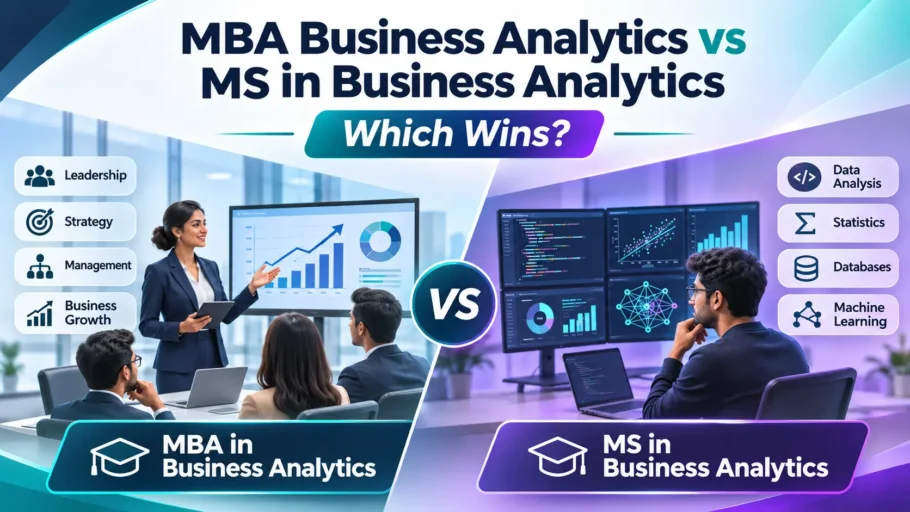
Choosing the right postgraduate degree can significantly influence your career in the growing field of business analytics. However, students often find themselves confused between an MBA in Business Analytics and an MS in Business Analytics. Both programmes involve working with data to solve business problems, but their approaches, learning outcomes, and career opportunities differ.
An MBA in Business Analytics generally combines management education with analytical skills, while an MS in Business Analytics focuses more extensively on specialised analytical techniques. Universities across different countries also use terms such as MS, MSc, and MSBA, creating further confusion.
Understanding the differences in curriculum, eligibility, fees, career prospects, and return on investment can help you determine which qualification better matches your professional ambitions.
What Is the Difference Between an MBA and MS in Business Analytics?
An MBA in Business Analytics is a Master of Business Administration degree that focuses on applying analytical techniques to management and business decision-making. It combines subjects such as marketing, finance, operations, business strategy, and leadership with statistical analysis and business intelligence.
An MS in Business Analytics, or Master of Science in Business Analytics, is generally a more specialised postgraduate qualification. It places greater emphasis on quantitative methods, programming, predictive modelling, and advanced analytical applications.
The main distinction lies in how students are trained to use data. An MBA in Business Analytics prepares students to interpret analytical findings and apply them to business decisions. An MS in Business Analytics often provides deeper preparation for developing analytical models and investigating complex datasets.
However, the exact difference depends on the university. Some MBA programmes offer substantial technical training, while certain MS programmes include management and consulting projects.
MBA in Business Analytics vs MS in Business Analytics: Key Differences
| Comparison Factor | MBA in Business Analytics | MS in Business Analytics |
|---|---|---|
| Full form | Master of Business Administration in Business Analytics | Master of Science in Business Analytics |
| Academic focus | Business management and analytical decision-making | Specialised analytical and technical expertise |
| Curriculum | Management, leadership, strategy, and analytics | Statistics, programming, and analytical modelling |
| Technical depth | Varies, often less specialised | Generally more technically focused |
| Management orientation | Stronger emphasis on leadership and strategy | Greater emphasis on analytical applications |
| Suitable for | Business-oriented and management-focused students | Students interested in specialist analytics careers |
| Career direction | Consulting, business analysis, and management | Data analytics, business intelligence, and specialist roles |
What Are MBA, MS, MSc and MSBA Called in India and Abroad?
Students researching postgraduate business analytics programmes may encounter different degree names depending on the country and university.
MBA stands for Master of Business Administration, while MS and MSc both stand for Master of Science. MSBA is commonly used as an abbreviation for Master of Science in Business Analytics.
In India, MBA in Business Analytics is a familiar programme name among management institutions. Students may also encounter MSc Business Analytics, postgraduate diplomas, and other specialised analytics qualifications.
Universities in the United States frequently use MS in Business Analytics or MSBA. In the United Kingdom, MSc Business Analytics is a commonly used title. Canadian and Australian universities may offer qualifications such as Master of Business Analytics or Master of Management Analytics.
Although naming conventions differ, MS and MSc generally refer to the same broad degree level. However, their curricula and admission requirements are not necessarily identical.
Business Analytics Degree Names Across Countries
| Country | Common Degree Names | Important Consideration |
|---|---|---|
| India | MBA in Business Analytics, MSc Business Analytics, postgraduate analytics programmes | Verify university recognition and degree title |
| USA | MS in Business Analytics, MSBA, MBA with analytics concentration | MSBA commonly indicates a specialised master’s degree |
| UK | MSc Business Analytics, MBA with analytics modules | MSc is a common Master of Science designation |
| Canada | MSc, Master of Business Analytics, Master of Management Analytics | Programme titles vary across universities |
| Australia | Master of Business Analytics, Master of Analytics, MBA specialisations | The official qualification may use different terminology |
MBA vs MS in Business Analytics: Curriculum and Skills Comparison
The curriculum is one of the most important factors when comparing an MBA in Business Analytics with an MS in Business Analytics.
An MBA in Business Analytics typically combines core management subjects with analytical applications. Students may study financial management, marketing strategy, organisational behaviour, operations management, business statistics, and data visualisation.
An MS in Business Analytics often provides more extensive training in statistics, programming, machine learning, predictive modelling, database systems, and quantitative analysis. Some programmes also include optimisation techniques and advanced computational methods.
The difference becomes clearer when considering practical applications. MBA students might use customer data to recommend changes in marketing strategy, while MS students may spend more time developing and evaluating the predictive models supporting those recommendations.
Both degrees can include industry projects, business case studies, and practical experience with analytical tools. The depth of technical instruction and management training varies according to the institution.
Curriculum and Skills Comparison
| Learning Area | MBA in Business Analytics | MS in Business Analytics |
|---|---|---|
| Business management | Core management subjects | Usually more limited |
| Statistics | Applied business statistics | Often more extensive quantitative methods |
| Programming | Depends on programme structure | Frequently a major component |
| Machine learning | Focus on business applications | Greater technical and modelling depth |
| Leadership | Emphasis on managerial development | Varies by institution |
| Data visualisation | Business reports and decision support | Analytical reporting and visualisation |
| Business strategy | Major curriculum component | Usually taught through applied business problems |
Eligibility and Admission Requirements: Which Degree Is Easier to Enter?
Admission requirements for an MBA in Business Analytics and an MS in Business Analytics vary across universities.
MBA programmes commonly accept graduates from different academic backgrounds, including commerce, management, science, engineering, and humanities. Depending on the institution, admissions may involve entrance examinations such as CAT, XAT, GMAT, or other accepted assessments, along with academic records and interviews.
MS programmes may place greater emphasis on mathematics, statistics, quantitative aptitude, and programming readiness. Some universities accept students from diverse disciplines, while others require specific academic prerequisites.
Professional experience is another consideration. Certain MBA programmes prefer experienced applicants, although many accept fresh graduates. Several specialised MS programmes are designed for early-career students, but this is not a universal requirement.
Neither degree is automatically easier to enter. Applicants should examine university-specific eligibility conditions, prerequisite subjects, entrance tests, and selection criteria before applying.
MBA vs MS in Business Analytics: Fees, Duration and ROI
The cost of an MBA in Business Analytics compared with an MS in Business Analytics depends on the university, country, programme duration, and learning format.
Both qualifications commonly take one to two years of full-time study, although shorter, longer, part-time, and online formats are available.
For students considering international education, the total investment may include tuition fees, accommodation, travel, insurance, study materials, and other living expenses. Students pursuing either qualification in India should also evaluate institutional fees, scholarships, and financing options.
Return on investment, or ROI, should not be calculated using tuition fees alone. Students need to consider the complete educational expenditure, potential income after graduation, employment opportunities, and earnings forgone while studying.
An MBA in Business Analytics may offer value for individuals pursuing management-focused career progression, while an MS in Business Analytics may support careers requiring specialised analytical expertise.
Fees, Duration and ROI Comparison
| Financial Factor | MBA in Business Analytics | MS in Business Analytics |
|---|---|---|
| Tuition fees | Vary by institution and location | Vary by institution and country |
| Programme duration | Often 1 to 2 years full-time | Often 1 to 2 years full-time |
| Living expenses | Depend on study location and format | Depend on study destination |
| Scholarships | Based on institutional policies | Based on university funding opportunities |
| Opportunity cost | Depends on employment status and duration | Depends on employment status and duration |
| Potential ROI | Influenced by management career outcomes | Influenced by specialist analytics career outcomes |
Career Opportunities and Salary Potential: MBA vs MS in Business Analytics
Career opportunities are a major consideration when evaluating an MBA in Business Analytics against an MS in Business Analytics.
An MBA in Business Analytics can prepare students for business-oriented positions in consulting, financial services, marketing, operations, and corporate strategy. Graduates may pursue roles such as Business Analyst, Operations Analyst, Strategy Analyst, or Analytics Consultant, depending on their capabilities and experience.
An MS in Business Analytics may provide stronger preparation for specialised positions involving statistical analysis, predictive modelling, business intelligence, and analytical problem-solving. Potential opportunities include Data Analyst, Business Intelligence Analyst, and Predictive Analytics Specialist.
There is considerable overlap between the two qualifications. For example, both MBA and MS graduates may become business analysts or analytics consultants when they possess the required skills.
Salary potential also depends on multiple factors, including the university, geographical location, employer, professional experience, technical proficiency, and responsibilities associated with the position.
Neither qualification guarantees a higher salary. A specialised analyst with strong technical skills may earn more than an MBA graduate in an entry-level management position, while an experienced manager may earn more than an early-career technical specialist.
Career Opportunities Comparison
| Career Factor | MBA in Business Analytics | MS in Business Analytics |
|---|---|---|
| Common roles | Business Analyst, Operations Analyst | Data Analyst, Business Intelligence Analyst |
| Additional opportunities | Analytics Consultant, Strategy Analyst | Predictive Analytics Specialist, Analytics Consultant |
| Technical preparation | Depends on specialisation and projects | Generally more specialised |
| Management preparation | Greater emphasis on management skills | Developed through experience and selected coursework |
| Salary potential | Depends on role, experience, and employer | Depends on skills, role, and employer |
| Career progression | Analytics management, consulting, business leadership | Specialist analytics, technical leadership, analytics management |
MBA vs MS in Business Analytics: Which Is Better for Non-Technical Students?
Students without engineering or computer science backgrounds may wonder whether they can pursue an MBA in Business Analytics or an MS in Business Analytics.
An MBA in Business Analytics may appeal to commerce, arts, humanities, and management graduates who want to develop analytical skills while studying business management. Many programmes introduce analytics through business statistics, Excel, data interpretation, and visualisation.
An MS in Business Analytics may require more extensive preparation in mathematics, statistics, or programming. However, eligibility requirements vary, and some programmes welcome students from non-technical backgrounds.
Previous coding knowledge is not necessarily compulsory for either degree, although it can be beneficial. Students can strengthen their preparation by learning introductory statistics, SQL, Excel, and Python.
The best choice depends on whether the student prefers interpreting analytical insights for business decisions or developing more specialised technical expertise.
Which Degree Has Better Long-Term Career Scope in the AI Era?
Artificial intelligence is transforming how organisations analyse information, forecast outcomes, and make decisions. Consequently, both an MBA in Business Analytics and an MS in Business Analytics can remain relevant, although the skills required for success are evolving.
AI-powered tools can automate repetitive reporting, assist with data preparation, and support predictive analysis. However, businesses still require professionals who can assess the reliability of results, understand organisational requirements, and make informed decisions.
Graduates of an MBA in Business Analytics may contribute through business strategy, stakeholder management, and organisational transformation. MS graduates may work more extensively with analytical models, machine learning applications, and specialised data solutions.
These responsibilities can overlap as professionals gain experience.
Long-term career prospects depend less on the degree title alone and more on continuous learning, practical expertise, communication skills, and adaptability. Students from both programmes should develop AI literacy and understand the limitations of automated analytical systems.
MBA in Business Analytics or MS in Business Analytics: Which Should You Choose?
Choosing between an MBA in Business Analytics and an MS in Business Analytics requires evaluating your interests, existing qualifications, technical abilities, and career objectives.
If you are interested in business strategy, consulting, organisational management, and applying analytical findings to business decisions, an MBA in Business Analytics may be the more suitable option.
If you enjoy statistics, programming, predictive modelling, and solving complex analytical problems, an MS in Business Analytics may offer more relevant specialised preparation.
Your academic background also matters. Students from non-technical disciplines should compare admission prerequisites and curriculum difficulty, while working professionals should consider how each qualification aligns with their existing experience.
Financial considerations are equally important. Evaluate tuition fees, living costs, scholarships, programme duration, and realistic employment outcomes before making a commitment.
Which Degree Fits Your Career Goals?
| Student Profile or Goal | Degree to Consider | Main Reason |
|---|---|---|
| Interested in business management | MBA in Business Analytics | Greater management and strategy focus |
| Interested in statistical modelling | MS in Business Analytics | More specialised quantitative preparation |
| Commerce or non-technical graduate | Either, depending on requirements | Eligibility and technical preparation vary |
| Working professional pursuing management responsibilities | MBA in Business Analytics | Focus on management and decision-making |
| Interested in specialist analytics positions | MS in Business Analytics | Often provides deeper technical training |
| Interested in business consulting | MBA in Business Analytics | Combines management and analytical skills |
Final Verdict: MBA or MS in Business Analytics, Which Wins?
There is no universal winner between an MBA in Business Analytics and an MS in Business Analytics because both qualifications serve different professional objectives.
An MBA in Business Analytics generally offers stronger preparation for students interested in combining data analysis with management, business strategy, and leadership. An MS in Business Analytics is often better suited to individuals seeking specialised technical and analytical expertise.
Both programmes can lead to rewarding careers, but employment outcomes depend on university quality, relevant skills, professional experience, and market conditions.
Before making a decision, compare curriculum content, institutional recognition, practical learning opportunities, total programme costs, and verified career outcomes. The degree that best matches your interests and long-term goals is ultimately the one worth choosing.
Frequently Asked Questions About MBA vs MS in Business Analytics
1. Is an MBA in Business Analytics better than an MS in Business Analytics?
Neither qualification is universally better. An MBA in Business Analytics may be more suitable for management and business-oriented roles, while an MS in Business Analytics may provide stronger preparation for specialised analytical positions. The right choice depends on individual career goals and programme quality.
2. Are MS and MSc in Business Analytics the same degree?
MS and MSc both stand for Master of Science. MS is commonly used in the United States, while MSc is frequently used in the United Kingdom and other countries. However, programmes with these titles can differ in curriculum, duration, admission requirements, and academic structure.
3. Which is better for Indian students, an MBA or MS in Business Analytics?
Indian students should choose according to their career goals, academic preparation, financial resources, and preferred study destination. An MBA in Business Analytics may suit management-oriented ambitions, while an MS may appeal to students interested in specialised analytics. University quality and employment outcomes should guide the final decision.
4. Can commerce students pursue an MS in Business Analytics?
Yes, commerce graduates may be eligible for an MS in Business Analytics at universities that accept their academic qualifications. Some programmes require prior coursework in statistics, mathematics, or programming. Students should check admission requirements and develop the necessary quantitative skills before applying.
5. Which degree offers better salary potential, an MBA or MS in Business Analytics?
Neither degree automatically guarantees higher earnings. Salary potential depends on the employer, location, experience, technical expertise, and job responsibilities. Students should compare verified placement reports and employment outcomes from specific universities rather than relying on general salary assumptions.
6. Is an MS in Business Analytics more technical than an MBA?
Generally, an MS in Business Analytics places greater emphasis on statistics, programming, data modelling, and analytical techniques. An MBA in Business Analytics typically combines analytics with broader management subjects. However, technical depth varies between institutions, so reviewing individual course curricula is important.