
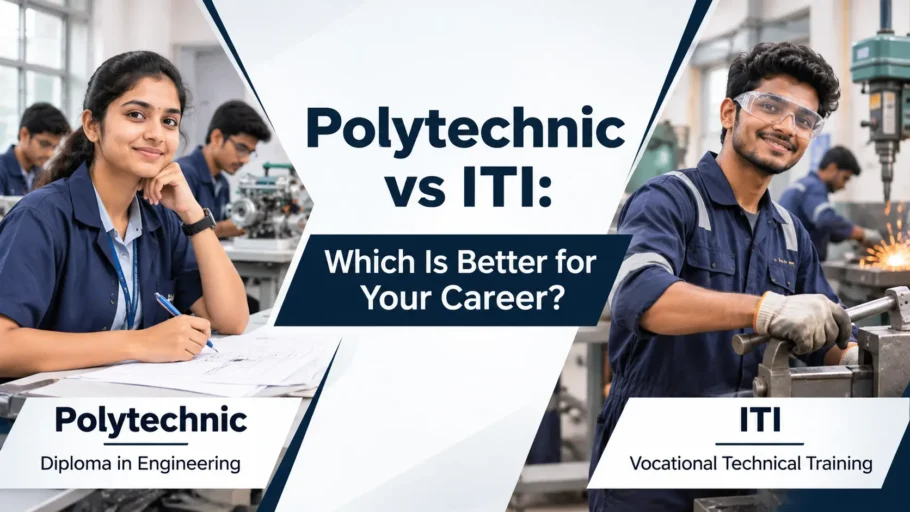
Choosing the right educational pathway after Class 10 is an important decision that can influence your professional future. Many students in India prefer technical education over traditional schooling because it allows them to develop industry-relevant skills and explore employment opportunities. Among the most popular options, Polytechnic and Industrial Training Institute (ITI) programmes offer different approaches to technical education and career development.
While both qualifications focus on practical learning, they differ in course duration, academic depth, educational expenses, employment prospects and higher education opportunities. The growing importance of technical education and vocational skills has made studying at a Polytechnic in India an attractive option for students interested in engineering and industrial careers.
However, the right choice depends on your financial circumstances, academic interests and professional ambitions. This article compares both qualifications to help you make an informed career decision.
What Is Polytechnic?
Polytechnic is a diploma-level technical education programme that provides students with engineering knowledge, practical skills and industry-oriented training. Engineering diploma programmes generally take three years to complete after Class 10 and combine classroom learning with laboratory sessions, workshops, technical projects and practical assignments.
Students can specialise in mechanical engineering, civil engineering, electrical engineering, computer engineering, automobile engineering and several other technical disciplines. These programmes prepare students for employment in industries that require technical knowledge, problem-solving abilities and practical expertise.
One of the significant advantages of Polytechnic in India is its combination of employment and academic progression opportunities. Diploma holders can apply for relevant technical positions or continue their education through eligible lateral-entry BTech or BE programmes.
What Is ITI?
Industrial Training Institute, commonly known as ITI, provides vocational education designed to develop specialised occupational skills. These institutions focus on preparing students for specific trades through practical training, technical instruction and hands-on experience. Depending on the selected trade, courses generally last between six months and two years.
Popular ITI trades include Electrician, Fitter, Welder, Machinist, Electronics Mechanic, Motor Vehicle Mechanic and Computer Operator and Programming Assistant. These programmes prepare students for employment in manufacturing, automotive services, construction, electrical maintenance and other industrial sectors.
Unlike diploma-level engineering education, ITI concentrates more heavily on specific occupational competencies. Its shorter duration makes it particularly suitable for students who want to develop employable skills and begin working without spending several years in formal technical education.
Polytechnic vs ITI: Key Differences
The primary difference between these qualifications lies in their educational approach and professional objectives. While diploma programmes provide broader technical knowledge across an engineering discipline, ITI courses develop specialised skills required for particular occupations. Understanding these differences is essential before choosing either qualification.
| Comparison Factor | Polytechnic | ITI |
|---|---|---|
| Type of education | Technical diploma education | Vocational education |
| Qualification | Diploma | Trade certificate |
| Course duration | Generally 3 years | 6 months to 2 years |
| Minimum eligibility | Generally Class 10 | Class 8 or 10, depending on trade |
| Learning approach | Theory and practical training | Trade-specific practical training |
| Technical knowledge | Broader engineering concepts | Specialised occupational skills |
| Employment focus | Diploma-level technical roles | Skilled trade occupations |
| Higher education | Lateral-entry engineering opportunities | Further vocational and diploma education |
| Educational expenses | Generally higher | Generally lower |
| Career progression | Technical and supervisory roles | Skilled trade and specialist roles |
Polytechnic vs ITI: Eligibility and Admission Process
Admission requirements for technical and vocational programmes in India vary depending on the state, institution and selected specialisation. Engineering diploma programmes generally require students to complete Class 10 from a recognised educational board, while certain ITI trades accept students who have completed Class 8.
Admissions may be conducted through entrance examinations, academic merit or state-level counselling. Students should review the official admission notification before applying.
| Admission Criteria | Polytechnic | ITI |
|---|---|---|
| Educational qualification | Generally Class 10 | Class 8 or 10 |
| Admission method | Entrance examination or merit | Merit or entrance examination |
| Admission authority | State technical education authorities | State vocational training authorities |
| Subject requirements | Mathematics and Science may be required | Depends on the trade |
| Counselling process | State or institution-specific | State or institution-specific |
Polytechnic vs ITI: Courses and Specialisations
Both qualifications offer courses that serve important industrial sectors in India. However, engineering diploma programmes provide broader knowledge of technical systems, design principles and industrial processes, whereas ITI courses concentrate on developing the practical competencies needed for specific occupations.
Students should select a course based on their interests, technical abilities and employment objectives rather than simply choosing the most popular specialisation.
| Technical Field | Polytechnic Courses | Related ITI Trades |
|---|---|---|
| Mechanical | Diploma in Mechanical Engineering | Fitter, Machinist |
| Electrical | Diploma in Electrical Engineering | Electrician, Wireman |
| Civil | Diploma in Civil Engineering | Draughtsman Civil, Surveyor |
| Automobile | Diploma in Automobile Engineering | Mechanic Motor Vehicle |
| Computer | Diploma in Computer Engineering | Computer Operator and Programming Assistant |
| Electronics | Diploma in Electronics Engineering | Electronics Mechanic |
| Manufacturing | Diploma in Production Engineering | Turner, Welder |
Polytechnic vs ITI: Course Duration and Fees
Course duration and educational expenses are important considerations, particularly for students from financially constrained households. Studying at a Polytechnic in India generally requires a three-year commitment, while vocational programmes allow students to complete their training within a shorter period.
Government institutions usually offer more affordable education than private institutions. However, actual expenses depend on the course, location, admission category and applicable scholarships.
| Cost and Duration Factor | Polytechnic | ITI |
|---|---|---|
| Typical course duration | 3 years | 6 months to 2 years |
| Government institution fee example | ₹6,000 annual tuition in Maharashtra | ₹700 to ₹3,100 in first-year charges at a Delhi government ITI |
| Private institution fee examples | Around ₹40,000 annually at a selected institution | ₹18,000 to ₹26,000 annually at selected institutions |
| Time before employment | Generally longer | Generally shorter |
| Overall educational investment | Usually higher | Usually lower |
Students should also consider transportation, accommodation, equipment and study material expenses. Vocational training can reduce the financial burden and allow earlier employment, while diploma education may offer greater academic flexibility and broader technical career opportunities.
Polytechnic vs ITI: Job Opportunities in India
India’s manufacturing, infrastructure, automotive, construction and energy industries require workers with different levels of technical expertise. Both qualifications can provide employment opportunities in these sectors, although job responsibilities and eligibility requirements vary.
Diploma holders can explore technical positions involving equipment maintenance, production management, quality control, engineering support and industrial operations. ITI graduates generally pursue specialised occupations that require practical expertise in installation, machinery operation, repair and maintenance.
| Employment Sector | Polytechnic Job Roles | ITI Job Roles |
|---|---|---|
| Manufacturing | Production Technician, Quality Technician | Fitter, Machine Operator |
| Construction | Site Supervisor, Civil Technician | Draughtsman, Surveyor |
| Electrical | Electrical Technician, Maintenance Technician | Electrician, Wireman |
| Automobile | Service Technician, Technical Supervisor | Motor Vehicle Mechanic |
| Railways | Eligible diploma-level technical posts | Eligible trade-based technical posts |
| Electronics | Electronics Technician | Electronics Mechanic |
| Industrial maintenance | Maintenance Technician | Skilled Maintenance Worker |
Students from both educational backgrounds can benefit from apprenticeship programmes that provide workplace exposure and practical experience. However, eligibility for government positions depends on individual recruitment notifications, relevant qualifications, age requirements and selection examinations.
Polytechnic vs ITI: Salary and Career Growth
Salary potential is one of the most important factors students consider when selecting technical education. Earnings depend on the selected discipline, employer, industry, geographical location, professional experience and technical expertise. Diploma holders may have access to broader technical and supervisory responsibilities, while experienced ITI professionals can achieve competitive earnings through specialised trade skills.
The following table provides indicative monthly salary estimates for selected technical and vocational occupations in India.
| Experience Level | Polytechnic Monthly Salary | ITI Monthly Salary |
|---|---|---|
| Fresher (0 to 1 year) | ₹12,000 to ₹25,000 | ₹12,000 to ₹18,000 |
| Early career (1 to 3 years) | ₹18,000 to ₹30,000 | ₹15,000 to ₹25,000 |
| Experienced (3 to 5 years) | ₹25,000 to ₹45,000 | ₹18,000 to ₹28,000 |
| Senior and specialised roles | ₹35,000 to ₹60,000 or more | ₹28,000 to ₹40,000 or more |
Polytechnic graduates may progress towards technical supervision, quality management and production coordination as they gain professional experience. Meanwhile, skilled ITI professionals can increase their earning potential through advanced trade certifications, specialised equipment training and industrial experience.
Self-employment can also create additional earning opportunities, particularly for electricians, automotive mechanics and maintenance professionals. Ultimately, professional competence and continuous skill development can influence salary growth more significantly than the initial qualification alone.
Polytechnic vs ITI: Higher Education Opportunities
Higher education opportunities represent a significant difference between technical diploma programmes and vocational training. Students who complete an eligible engineering diploma can apply for lateral-entry admission into the second year of BTech or BE programmes, subject to applicable academic and institutional requirements.
ITI graduates also have opportunities to continue their education through advanced vocational programmes, apprenticeships, industry certifications and eligible diploma admission pathways.
| Higher Education Pathway | After Polytechnic | After ITI |
|---|---|---|
| BTech or BE | Eligible lateral-entry admission | Generally requires additional qualifications |
| Engineering diploma | Already holds a diploma | Eligible further diploma admission |
| Apprenticeships | Available | Available |
| Advanced technical certifications | Available | Available |
| Skill development programmes | Available | Available |
Therefore, students planning to pursue an engineering degree may find diploma education a more direct academic route. Nevertheless, vocational education does not prevent students from pursuing further technical qualifications later in their careers.
Polytechnic vs ITI: Which Has Better Future Scope in India?
India’s evolving industrial landscape is creating demand for technically skilled professionals across traditional and emerging industries. Developments in electric vehicles, renewable energy, industrial automation, advanced manufacturing and infrastructure are changing the nature of technical occupations.
The future scope of Polytechnic in India is closely connected to the growing need for professionals capable of understanding technical systems, industrial equipment and modern engineering processes. Diploma holders who develop additional expertise in automation, computer-aided design and digital manufacturing may improve their long-term employment prospects.
Similarly, ITI graduates remain important for occupations involving equipment installation, electrical maintenance, machinery repair and industrial operations. Many of these responsibilities require practical expertise that complements technological advancements.
Both qualifications can remain valuable when supported by continuous learning, industry-relevant certifications, digital literacy and practical experience. Students should focus on developing adaptable technical skills rather than relying entirely on their initial qualification.
Polytechnic vs ITI: Which Should You Choose After 10th?
Selecting the right qualification after Class 10 requires careful consideration of academic interests, financial circumstances, professional ambitions and preferred learning approaches. Students who enjoy engineering concepts and want to pursue higher education may benefit from diploma programmes, while those interested in practical occupations and earlier employment may prefer ITI.
The following comparison can help students identify the pathway that best matches their objectives.
| Career Objective | Recommended Option | Reason |
|---|---|---|
| Enter employment sooner | ITI | Shorter training duration |
| Pursue an engineering degree | Polytechnic | More direct academic pathway |
| Learn a specific industrial trade | ITI | Specialised vocational training |
| Develop broader technical knowledge | Polytechnic | Comprehensive technical curriculum |
| Reduce educational expenses | ITI | Generally lower overall costs |
| Pursue technical supervisory roles | Polytechnic | Broader engineering foundation |
| Start a trade-based business | ITI | Occupation-specific practical skills |
| Keep higher education options open | Polytechnic | Greater academic flexibility |
Conclusion
Both technical diploma education and vocational training provide valuable opportunities for students seeking careers in India’s industrial and technical sectors. However, their suitability depends on individual career goals, educational preferences and financial circumstances.
Polytechnic is generally a better option for students interested in broader engineering knowledge, technical career progression and higher education opportunities. ITI may be more suitable for individuals seeking specialised practical skills, affordable education and faster entry into employment.
Rather than choosing a qualification based solely on salary expectations or popularity, students should consider their long-term ambitions and personal interests. The right educational pathway, combined with continuous learning and practical experience, can support sustainable professional growth.
Frequently Asked Questions
1. Is Polytechnic better than ITI after 10th?
A diploma is generally more suitable for students interested in engineering education and broader technical careers. ITI may be better for students who want to learn a specialised trade, complete their education sooner and begin working earlier.
2. Which has a higher salary, Polytechnic or ITI?
Diploma holders may have access to higher-paying technical and supervisory positions. However, experienced ITI professionals with specialised industrial skills can also earn competitive salaries. Actual earnings depend on the employer, industry, location and professional experience.
3. Can I pursue Polytechnic after completing ITI?
Yes, students who complete Class 10 and an eligible two-year ITI programme may apply for lateral-entry admission into the second year of an engineering diploma, subject to state admission rules and institutional eligibility requirements.
4. Can I pursue BTech after completing Polytechnic?
Yes, eligible engineering diploma holders can apply for lateral-entry admission into the second year of BTech or BE programmes. Students must satisfy the applicable academic requirements, admission procedures and institutional eligibility criteria.
5. Which is better for government jobs, Polytechnic or ITI?
Both qualifications offer government employment opportunities. Diploma holders can apply for eligible diploma-level technical positions, while ITI graduates can pursue trade-based vacancies. The better option depends on the specific government position and its recruitment requirements.
6. Which course is better for getting a job quickly, Polytechnic or ITI?
ITI generally provides a faster route to employment because of its shorter course duration and trade-specific training. However, securing a job also depends on practical competence, institutional training quality, apprenticeship experience and local employment opportunities.