
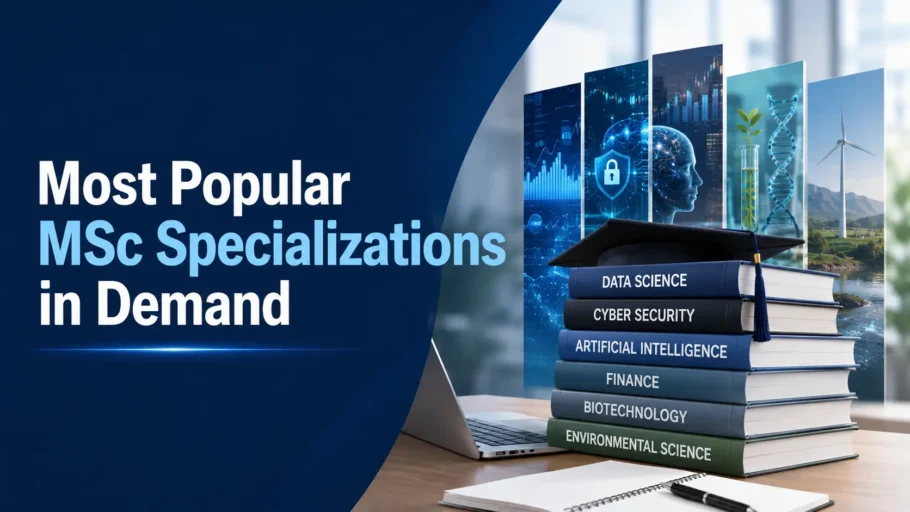
If you are exploring postgraduate study options, you have likely noticed that some MSc specializations attract far more attention than others. This guide breaks down the 10 most popular MSc specializations in demand across industries and countries, explaining what each one actually involves, who it suits, and why employers continue to value these degrees. Whether you are an undergraduate planning your next step or a working professional considering a career shift, this list will help you understand which specialization genuinely fits your goals rather than just following a trend.
What Makes an MSc Specialization “In Demand”?
An MSc specialization earns its “in demand” status through a combination of factors, not just popularity. Industry growth plays a major role, since specializations tied to expanding sectors naturally produce more job openings. Employability matters just as much, as employers consistently look for graduates who bring practical, applicable skills rather than purely theoretical knowledge. Global recognition is the third piece of the puzzle, since a specialization that holds value across multiple countries gives graduates far more flexibility in where and how they build their careers. With that context in mind, here is a closer look at the specializations that consistently meet these criteria.
10 Most Popular MSc Specializations in Demand
MSc Data Science
MSc Data Science focuses on extracting insights from large volumes of information using statistics, programming, and machine learning techniques. Coursework typically includes data mining, predictive modeling, database management, and programming languages such as Python and R, alongside modules on data visualization and applied statistics. This specialization suits students who enjoy working with numbers, patterns, and logical problem-solving, and it welcomes candidates from mathematics, engineering, economics, or computer science backgrounds.
Demand for this MSc specialization remains high because nearly every industry, from retail to healthcare to finance, now relies on data to guide decisions. Companies need professionals who can turn raw data into actionable strategy, and that need has only grown as more business processes become digitized. Graduates typically move into roles such as data analyst, data scientist, business intelligence specialist, or machine learning engineer, working across technology firms, consulting agencies, banks, and healthcare organizations.
MSc Computer Science
MSc Computer Science covers the fundamentals and advanced concepts of computing, including algorithms, software development, systems architecture, and programming paradigms. Depending on the program, students may also study distributed systems, computer networks, database design, and software engineering practices. This specialization suits students who already have some technical foundation, often from an undergraduate degree in computing, engineering, or a related field, though some programs accept students from adjacent quantitative disciplines.
This MSc specialization stays consistently in demand because software and digital systems now underpin almost every industry, not just the technology sector itself. Banks, hospitals, manufacturers, and retailers all depend on custom software and digital infrastructure, which keeps demand for skilled computer scientists strong across sectors. Graduates commonly work as software engineers, systems architects, backend developers, or technical consultants, with opportunities spanning tech companies, financial institutions, and government agencies.
MSc Artificial Intelligence and Machine Learning
This specialization dives deep into the algorithms and systems that allow machines to learn from data and make predictions or decisions. Typical coursework includes neural networks, natural language processing, computer vision, and reinforcement learning, often paired with strong mathematical foundations in linear algebra, calculus, and probability. Students who thrive here usually come from computer science, mathematics, physics, or engineering backgrounds and enjoy both theoretical depth and hands-on experimentation.
The demand for this specialization has grown rapidly as organizations across every sector look to automate processes, improve decision-making, and build intelligent products. While specific tools and models will continue to evolve, the underlying need for professionals who understand how to design, train, and deploy machine learning systems is expected to remain strong for years to come. Career paths include machine learning engineer, AI researcher, applied scientist, and roles in robotics or automation, with opportunities across technology, automotive, healthcare, and finance industries.
MSc Cybersecurity
MSc Cybersecurity focuses on protecting systems, networks, and data from unauthorized access, attacks, and breaches. Coursework typically covers network security, cryptography, ethical hacking, risk assessment, and security governance, often including hands-on labs where students simulate real attacks and defenses. This specialization suits students with an interest in problem-solving under pressure and a strong technical foundation, though many programs also welcome candidates from IT, computer science, or engineering backgrounds looking to specialize further.
Demand for cybersecurity professionals continues to rise as organizations face increasingly sophisticated digital threats and stricter data protection regulations. Every industry that handles sensitive information, which today means nearly all of them, needs professionals who can identify vulnerabilities and build stronger defenses. Graduates often become security analysts, penetration testers, security consultants, or chief information security officers over time, working across banking, healthcare, government, and technology sectors.
MSc Finance
MSc Finance covers financial analysis, investment strategy, corporate finance, and risk management, often supplemented with coursework in financial modeling, valuation, and economic theory. Some programs allow further specialization within finance, such as quantitative finance or financial technology. This specialization suits students who enjoy analytical thinking and quantitative reasoning, and it typically draws candidates from economics, business, mathematics, or engineering backgrounds.
This MSc specialization remains consistently in demand because financial systems, whether in established or emerging economies, always require skilled professionals to manage risk, allocate capital, and guide investment decisions. As financial markets grow more complex and globally interconnected, the need for well-trained finance professionals has stayed steady. Graduates typically pursue roles such as financial analyst, investment banker, risk manager, or portfolio manager, working within banks, investment firms, insurance companies, and corporate finance departments.
MSc International Business
MSc International Business explores how companies operate, compete, and expand across global markets, covering topics such as international trade, cross-cultural management, global marketing strategy, and international finance. Coursework often includes case studies on multinational corporations and may involve group projects with international collaboration. This specialization suits students interested in global affairs and business strategy, and it appeals to candidates from diverse undergraduate backgrounds, including business, economics, and political science.
Demand for this specialization has grown alongside increasing globalization, as more companies expand operations across borders and need professionals who understand international markets, regulations, and cultural dynamics. Businesses of nearly every size now compete or operate internationally in some capacity, keeping this skill set relevant across industries. Graduates often move into roles such as international business consultant, global marketing manager, trade analyst, or business development manager, working in multinational corporations, consulting firms, and export-focused businesses.
MSc Supply Chain and Logistics Management
This specialization focuses on the movement of goods, services, and information from origin to end consumer, covering procurement, inventory management, logistics planning, and operations strategy. Coursework often includes supply chain analytics, vendor management, and increasingly, sustainability considerations within logistics networks. This specialization suits students who enjoy systems thinking and process optimization, and it attracts candidates from engineering, business, and operations-related backgrounds.
Demand for supply chain professionals has increased significantly as global trade has become more complex and businesses face growing pressure to manage costs, efficiency, and disruptions effectively. Recent global events have only reinforced how critical strong supply chain management is to business continuity, keeping this specialization firmly in demand. Graduates typically pursue roles such as supply chain analyst, logistics manager, procurement specialist, or operations manager, working across manufacturing, retail, e-commerce, and shipping industries.
MSc Public Health
MSc Public Health focuses on improving health outcomes at the population level, covering epidemiology, biostatistics, health policy, and healthcare systems management. Many programs also offer tracks in global health, health promotion, or environmental health. This specialization suits students interested in healthcare beyond direct clinical care, and it welcomes candidates from biology, healthcare, social sciences, or policy-related backgrounds.
This MSc specialization remains in strong demand as healthcare systems worldwide expand and governments increasingly prioritize public health infrastructure, particularly following recent global health challenges. Aging populations and growing healthcare needs in many regions have further strengthened demand for professionals who can design and manage health programs at scale. Graduates commonly work as public health analysts, epidemiologists, health policy advisors, or program managers within government agencies, non-profit organizations, and international health bodies.
MSc Environmental Science and Sustainability
This specialization examines environmental systems, climate change, resource management, and sustainable development practices, often combining scientific coursework with policy and business-oriented modules. Students may study environmental impact assessment, renewable energy systems, or sustainable business practices depending on the program’s focus. This specialization suits students passionate about environmental issues, and it draws candidates from environmental science, engineering, geography, and policy backgrounds.
Demand for this specialization has grown rapidly as governments, businesses, and organizations worldwide prioritize sustainability and climate action in response to environmental challenges. Regulatory pressure and public expectations around corporate environmental responsibility continue to increase, creating steady demand for professionals who understand both the science and the policy side of sustainability. Graduates often work as sustainability consultants, environmental policy analysts, or corporate sustainability managers, across government, non-profit, and private sector organizations.
MSc Economics
MSc Economics covers advanced economic theory, econometrics, and applied economic analysis, with coursework spanning microeconomics, macroeconomics, and quantitative research methods. Many programs allow specialization within tracks like development economics, financial economics, or behavioral economics. This specialization suits students who enjoy analytical and quantitative reasoning, typically drawing candidates from economics, mathematics, or related quantitative backgrounds.
This MSc specialization has maintained consistent demand because economic analysis underpins decision-making across government, business, and finance. Organizations of all types need professionals who can interpret economic trends, forecast outcomes, and guide policy or business strategy accordingly. Graduates frequently pursue roles such as economic analyst, policy advisor, financial consultant, or researcher, working within government bodies, financial institutions, consulting firms, and international organizations.
Here is a quick comparison of the 10 specializations covered above.
| Specialization | Core Focus Areas | Typical Career Paths |
|---|---|---|
| MSc Data Science | Statistics, machine learning, data visualization | Data analyst, data scientist, BI specialist |
| MSc Computer Science | Algorithms, software systems, programming | Software engineer, systems architect |
| MSc AI & Machine Learning | Neural networks, NLP, computer vision | ML engineer, AI researcher |
| MSc Cybersecurity | Network security, ethical hacking, risk assessment | Security analyst, penetration tester |
| MSc Finance | Financial modelling, valuation, risk management | Financial analyst, investment banker |
| MSc International Business | Global strategy, trade, cross-cultural management | Business consultant, trade analyst |
| MSc Supply Chain & Logistics | Procurement, operations, logistics planning | Supply chain analyst, logistics manager |
| MSc Public Health | Epidemiology, health policy, biostatistics | Public health analyst, epidemiologist |
| MSc Environmental Science & Sustainability | Climate systems, sustainable development | Sustainability consultant, policy analyst |
| MSc Economics | Economic theory, econometrics, policy analysis | Economic analyst, policy advisor |
How to Choose the Right Specialization for You
Knowing which MSc specializations are in demand is only useful if you can match that information to your own strengths and goals. Start by considering genuine interest, since a specialization you find engaging will be far easier to commit to through the more demanding parts of the program. Career demand matters, but sustained interest is often what carries students through difficult coursework and keeps them motivated in the years that follow.
Your academic background also plays a significant role. Some specializations, like MSc Computer Science or MSc Data Science, build directly on quantitative or technical undergraduate degrees, making the transition smoother. Others, such as MSc Public Health or MSc International Business, are more accessible to students from a wider range of academic backgrounds, since they often value analytical thinking and communication skills over a specific technical foundation.
Career goals should guide your decision as much as current demand does. If you already know you want to work in finance, MSc Finance or MSc Economics offers a direct path. If you are drawn to global mobility and flexibility across industries, specializations like MSc International Business or MSc Data Science tend to offer broader applicability across sectors and countries.
Finally, consider return on investment, which includes tuition costs, time commitment, and expected career trajectory. A highly ranked specialization from a program with weak industry connections may offer less practical value than a moderately known program with strong internship placements and employer partnerships. Weighing all of these factors together, rather than focusing on demand alone, will help you choose an MSc specialization that serves you well beyond your first job.
Common Questions About MSc Specializations
- Is an MSc specialization better than a general MSc?
Neither is universally better. A specialization offers focused, in-depth expertise that can make you more competitive for specific roles, while a general MSc offers broader flexibility across industries and functions. The right choice depends on whether you already have a clear career direction or prefer to keep your options open longer. - Can you switch specializations later?
In many cases, yes, particularly if your specialization builds transferable skills such as analytical thinking, programming, or research methods. Switching between closely related fields, such as moving from MSc Computer Science into MSc Data Science, tends to be easier than switching between highly unrelated disciplines. - Do specializations limit your career options?
Not necessarily. Most MSc specializations, even highly technical ones, build broadly applicable skills like problem-solving, research, and communication that remain valuable across industries. Choosing a specialization built on strong foundational skills rather than an extremely narrow niche helps preserve flexibility for the future. - Are MSc specializations recognized globally?
Recognition varies by field, institution, and country, but specializations tied to widely applicable skills, such as data, finance, computer science, or public health, tend to be recognized consistently across borders. If international mobility matters to you, prioritize specializations with broadly transferable skill sets and strong institutional reputations.
Conclusion
The 10 MSc specializations covered in this guide, spanning data science, computer science, artificial intelligence, cybersecurity, finance, international business, supply chain management, public health, environmental science, and economics, remain popular because they are tied to lasting industry needs rather than short-term trends. Each one offers a distinct path, distinct skill set, and distinct set of career outcomes, which means the “best” specialization ultimately depends on your interests, background, and long-term goals rather than demand alone.
Demand is an important signal, but it should guide your decision rather than dictate it entirely. A specialization that fits your strengths and genuinely interests you is far more likely to lead to a fulfilling and sustainable career than one chosen purely because it appeared on a popularity list. Use the criteria and comparisons in this guide as a starting point, then dig deeper into specific programs, curricula, and outcomes to find the MSc specialization that fits you best, not just for your first job, but for the career you want to build over time.