
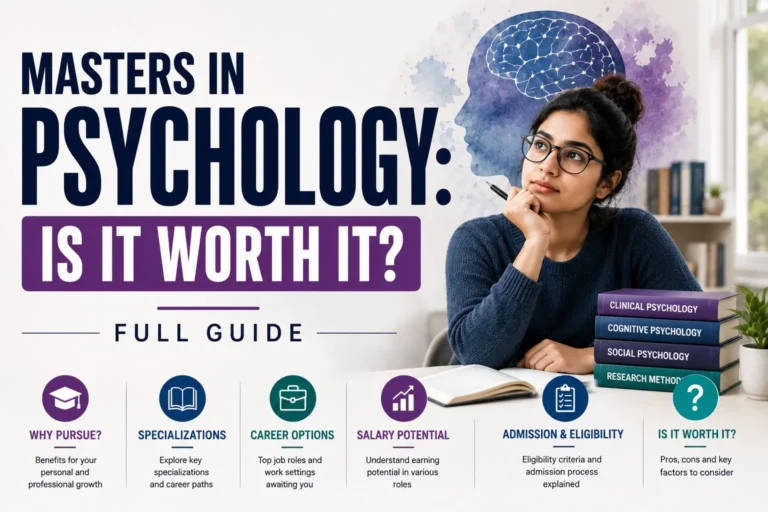
Tuition for graduate programs keeps climbing, yet demand for mental health professionals, HR specialists, and behavioral researchers keeps growing right along with it. That tension sits at the heart of one question many prospective students ask before applying: is a Masters in Psychology actually worth it?
The honest answer depends on your goals, your budget, and the career path you’re aiming for. This guide walks through what a psychology master’s degree involves, what it costs, what it can lead to, and how an Online Masters in Psychology compares to a traditional program. By the end, you should have a clear framework for making this decision for yourself, wherever in the world you’re applying from.
What Is a Masters in Psychology?
A Masters in Psychology is a graduate degree that builds on undergraduate psychology knowledge with advanced coursework, research training, and often supervised clinical or applied experience. Most programs take two years of full time study, though part time and online formats can stretch that timeline out.
Unlike a bachelor’s degree, which tends to cover psychology broadly, a master’s program usually asks students to specialize, whether that’s clinical practice, counseling, organizational behavior, or research methods. Some programs are designed as a terminal degree, meaning graduates go straight into the workforce. Others function as a stepping stone toward a doctoral degree and eventual licensure as a psychologist.
Why Pursue a Masters in Psychology?
There are a handful of common reasons people choose to pursue this degree, and understanding your own motivation is the first step in figuring out whether it’s worth it for you.
- Career Advancement and Specialization – A bachelor’s degree in psychology qualifies graduates for entry level roles, but many higher level positions, particularly in counseling, human resources, and applied research, require a graduate credential. A master’s degree signals a deeper level of expertise and often opens doors that a bachelor’s simply cannot.
- Higher Earning Potential – In most countries, professionals with a graduate degree in psychology earn noticeably more than those with only a bachelor’s degree. The gap varies by specialization and region, but the general trend holds across the field.
- A Stepping Stone to Licensure or a PhD – For students who eventually want to become licensed psychologists, a master’s degree is often a required or recommended step before doctoral study. Even for those not pursuing a PhD, a master’s can fulfill licensure requirements for roles like licensed professional counselor or marriage and family therapist, depending on the country and state.
Types of Masters in Psychology Degrees
Not all psychology master’s programs look the same. Choosing the right specialization has a major impact on career outcomes, so it’s worth understanding the main options before applying.
Clinical Psychology
Clinical psychology programs prepare students to assess and treat mental health conditions. This path often requires supervised clinical hours and can lead toward licensure as a therapist or, with further study, a licensed psychologist.
Counseling Psychology
Counseling programs focus on helping individuals navigate life challenges, relationships, and everyday mental health concerns. Graduates commonly work in schools, private practice, or community health settings.
Industrial-Organizational (I/O) Psychology
I/O psychology applies psychological principles to workplace settings, covering topics like employee performance, organizational behavior, and leadership development. This specialization is popular among students interested in corporate or HR careers rather than clinical work.
Forensic Psychology
Forensic psychology sits at the intersection of psychology and the legal system. Graduates may work with courts, law enforcement agencies, or correctional facilities, applying psychological expertise to legal and criminal justice contexts.
Educational Psychology
This specialization focuses on how people learn and develops strategies to improve educational outcomes. Career paths include school psychologist, educational consultant, or curriculum specialist.
Other Specializations
Beyond the major categories above, students can pursue niche paths including sports psychology, health psychology, and developmental psychology, each tailored to a specific population or setting.
Masters in Psychology: Admission Requirements
Requirements vary by country and institution, but most programs share a common set of expectations. Applicants typically need a bachelor’s degree, ideally with some psychology coursework, along with a competitive GPA. Many programs also request letters of recommendation, a statement of purpose, and in some cases, standardized test scores such as the GRE, although a growing number of schools have dropped this requirement.
Some specialized tracks, particularly clinical and counseling programs, may also require relevant volunteer or work experience, such as time spent in a mental health or community service setting. It’s worth checking individual program pages closely, since requirements can differ significantly even within the same country.
How Long Does a Masters in Psychology Take?
Most full time psychology master’s programs take about two years to complete. Part time students, including many who choose an Online Masters in Psychology to work around a job or family commitments, often take three to four years.
Accelerated programs do exist, particularly online, and can sometimes be completed in as little as twelve to eighteen months. However, faster timelines usually mean a heavier course load each term, so it’s worth weighing pace against your other commitments before enrolling.
Masters in Psychology Curriculum: What You’ll Study
While curriculum varies by specialization, most Masters in Psychology programs share a common academic core. Below is a general breakdown of what students typically encounter.
| Course Area | What It Covers | Typical Format |
|---|---|---|
| Research Methods | Study design, data collection, and interpretation of psychological research | Lecture and lab |
| Statistics | Quantitative analysis used in psychological research | Lecture with coursework |
| Theories of Psychology | Foundational and contemporary psychological theories | Seminar |
| Ethics in Psychology | Professional standards and ethical decision-making | Seminar or workshop |
| Specialization Courses | Topic-specific training, such as clinical assessment or organizational behavior | Varies by specialization |
| Practicum or Internship | Supervised hands-on experience in a real-world setting | Fieldwork |
The Real Cost of a Masters in Psychology
Cost is often the deciding factor in whether a Masters in Psychology feels worth it, so it deserves a close look.
Tuition Ranges Globally
Tuition varies enormously depending on the country and institution.
| Region | Typical Annual Tuition Range | Notes |
|---|---|---|
| United States | USD 15,000–50,000 | Public universities generally cost less than private institutions. |
| United Kingdom | GBP 9,000–20,000 | One-year master’s programs are common. |
| Europe (excluding the UK) | EUR 1,000–15,000 | Public universities in countries such as Germany may have significantly lower tuition fees. |
| Asia | USD 2,000–15,000 | Tuition costs vary widely depending on the country and type of institution. |
Hidden Costs
Tuition is rarely the full picture. Textbooks, licensing exam fees, supervised practicum hours, and professional membership dues can add up over the course of a program. Students pursuing clinical licensure should budget for exam and application fees that continue even after graduation.
Cost of Online Masters in Psychology vs On-Campus
An Online Masters in Psychology is often, though not always, less expensive than an equivalent on-campus program. Savings typically come from reduced commuting, housing, and campus fee costs rather than from lower tuition itself, since many universities charge similar tuition rates regardless of format.
Online Masters in Psychology vs On-Campus: Which Is Right for You?
Choosing between an online and on-campus format comes down to your learning style, schedule, and career goals.
| Factor | Online Master’s in Psychology | On-Campus Program |
|---|---|---|
| Flexibility | High, well suited for working students | Lower, with fixed class schedules |
| Networking | Primarily virtual interaction with faculty and peers | In-person access to faculty, classmates, and campus events |
| Cost | Often lower due to reduced housing and commuting expenses | May include additional housing, commuting, and campus-related costs |
| Clinical Hours | Usually arranged locally through approved partnerships or placements | Typically coordinated directly by the university |
Is an Online Masters in Psychology Respected by Employers?
This is one of the most common concerns among prospective students, and the good news is that perceptions have shifted considerably. Employers today are far more familiar with online education than they were a decade ago, particularly as more institutions offer accredited online programs identical in content to their on-campus counterparts.
What matters most to employers is accreditation, not delivery format. A degree from an accredited university, whether earned online or on campus, generally carries the same weight. The exception is licensure boards, which sometimes have specific requirements around supervised, in person clinical hours regardless of how coursework was delivered.
Best Countries/Universities to Study Masters in Psychology
Psychology education standards and reputations vary by country, and where you study can shape both cost and career opportunities.
| Country | Known For | Considerations |
|---|---|---|
| United States | Strong clinical and research programs with a wide range of specializations | Higher tuition costs; licensure requirements vary by state |
| United Kingdom | One-year master’s programs and a strong research reputation | Shorter duration but academically intensive |
| Canada | Good balance of affordability and quality, with growing online study options | Fewer program seats compared to the United States |
| Netherlands | Affordable tuition and many English-taught programs | Smaller international alumni network than some larger study destinations |
| Australia | Strong applied psychology and industrial/organizational (I/O) psychology programs | Greater geographic distance from many major global job markets |
Masters in Psychology Career Paths and Salary Outlook
Career outcomes vary significantly by specialization, so it helps to separate roles by how directly they depend on the degree.
- Roles That Require a Masters in Psychology – Positions like licensed professional counselor, marriage and family therapist, and school psychologist typically require a master’s degree at minimum, often alongside supervised hours and licensure exams.
- Roles Where It Helps But Isn’t Mandatory – Human resources management, market research, and organizational consulting are fields where a psychology master’s degree strengthens a resume without being strictly required.
Salary Ranges by Specialization
| Specialization | Typical Entry-Level Salary Range | Typical Experienced Salary Range |
|---|---|---|
| Clinical / Counseling Psychology | USD 45,000–60,000 | USD 65,000–90,000 |
| Industrial-Organizational (I/O) Psychology | USD 55,000–75,000 | USD 90,000–130,000 |
| Forensic Psychology | USD 45,000–65,000 | USD 70,000–95,000 |
| Educational Psychology | USD 50,000–65,000 | USD 70,000–90,000 |
Do You Need a Masters in Psychology to Become a Psychologist?
In most countries, becoming a licensed psychologist requires a doctoral degree, either a PhD or PsyD, not just a master’s. However, a Masters in Psychology is often a required step along the way, either as a standalone credential before doctoral study or built into the early years of a combined program.
That said, you don’t necessarily need a master’s degree to work in psychology related fields more broadly. Roles like counselor, therapist, or HR specialist, depending on your country’s regulations, may be accessible with a master’s alone, without pursuing a doctorate at all.
Masters in Psychology vs PhD: Key Differences
Understanding how these two degrees differ helps clarify whether a master’s alone will meet your goals.
| Factor | Master’s in Psychology | PhD in Psychology |
|---|---|---|
| Duration | 1 to 3 years | 4 to 7 years |
| Focus | Applied knowledge and professional practice | Original research and academic contribution |
| Career Outcome | Counseling, human resources, and other applied psychology roles | Licensed psychologist (where applicable), academia, and research leadership |
| Cost | Lower overall investment | Higher overall cost, though many programs offer funding through assistantships or fellowships |
Skills You’ll Gain from a Masters in Psychology
Beyond subject specific knowledge, a psychology master’s degree builds a set of transferable skills. These include critical thinking and analytical reasoning, developed through research methods coursework, and strong communication skills, sharpened through client interaction or academic writing. Students also build data literacy from statistics training, ethical decision making from case based coursework, and, in clinical tracks, direct interpersonal and counseling skills through supervised practice.
These skills transfer well beyond traditional psychology roles, which is part of why graduates often find opportunities in HR, user research, and consulting even without pursuing licensure.
Common Challenges Students Face (and How to Overcome Them)
Graduate psychology programs come with real challenges worth preparing for. Balancing coursework with supervised clinical hours can be demanding, especially for students working part time. Building a study routine and communicating early with supervisors about scheduling constraints tends to ease this pressure.
Financial strain is another common issue, particularly for unfunded master’s programs. Researching assistantships, part time work compatible with an Online Masters in Psychology, or employer tuition assistance can help offset costs.
Finally, many students underestimate the emotional demands of clinical training, particularly in counseling and clinical tracks. Programs with strong peer support systems and access to supervision tend to help students manage this more effectively.
Who Should (and Shouldn’t) Pursue This Degree
A Masters in Psychology tends to make sense for people who have a clear career target in mind, whether that’s counseling, HR, research, or a path toward doctoral study, and who are prepared for the time and financial investment involved.
It may be less worth it for those who are unsure whether they want a psychology career at all, or who could achieve their goals through a shorter certificate program or direct industry experience instead. Being honest about your end goal before applying can save significant time and money.
Alternatives to Consider
A master’s degree isn’t the only path forward, and it’s worth weighing lighter alternatives before committing.
- Certificate Programs – Graduate certificates in areas like applied behavior analysis or organizational psychology offer focused training in a fraction of the time and cost of a full master’s degree.
- Direct Entry into Related Fields – Roles in HR, UX research, and coaching sometimes value a bachelor’s degree plus relevant experience over a graduate credential, particularly in industries that prioritize practical skills.
- Going Straight for a PhD/PsyD – Some students, particularly those certain about a research or clinical psychologist career, choose combined programs that fold master’s level coursework into a longer doctoral track, skipping a standalone master’s degree entirely.
How to Choose the Right Online Masters in Psychology Program
If you’ve decided an online format fits your life, a few factors matter most when comparing programs. Accreditation should come first, since it affects both employer recognition and eligibility for licensure exams. Next, check how the program handles supervised clinical hours, since this varies widely between online providers.
It’s also worth comparing faculty access and support, since some online programs offer live sessions and regular faculty contact while others are largely self paced. Finally, look closely at total cost, including any technology or proctoring fees that aren’t always listed alongside tuition.
How to Decide If It’s Worth It For You
Before committing to a Masters in Psychology, ask yourself a few honest questions. Do you have a specific career goal that clearly requires this degree, rather than a general interest in the subject? Can you realistically afford the tuition and hidden costs without significant financial strain? Are you prepared for the time commitment, particularly if balancing work or family responsibilities alongside an Online Masters in Psychology?
If you answered yes to most of these, the degree is likely worth pursuing. If you’re uncertain, a certificate program or informational interviews with professionals in your target field can help clarify your direction before you commit to a full graduate program.
FAQs About Masters in Psychology
- Is a Masters in Psychology worth it today?
For students with a clear career goal in counseling, HR, research, or a path toward doctoral study, it generally is. For those still exploring their interests, a smaller commitment like a certificate program may make more sense first. - Can I become a psychologist with just a Masters in Psychology?
In most countries, licensure as a psychologist requires a doctoral degree. A master’s alone can, however, qualify graduates for related roles like counselor or therapist, depending on local regulations. - Is an Online Masters in Psychology respected by employers?
Yes, provided the program is properly accredited. Employers generally focus on accreditation and outcomes rather than delivery format. - How long does it take to complete?
Most full time programs take about two years, while part time and online students often take three to four years. - Masters in Psychology vs PhD, which should I choose?
Choose a master’s if you want applied, practice focused work sooner. Choose a PhD if your goal is independent clinical practice, academic research, or full psychologist licensure.
Conclusion
Whether a Masters in Psychology is worth it comes down to matching the degree to your specific goals. If you’re aiming for a career in counseling, HR, organizational psychology, or a path toward doctoral study, the investment of time and money tends to pay off. If your interest is more general, exploring a certificate program or gaining direct experience first might be the smarter starting point.
Take time to compare accredited programs, including Online Masters in Psychology options, and weigh cost against your specific career target before applying. The right decision depends entirely on where you want this degree to take you.