
Last updated: 30 September 2026. Data is taken from official JEE Advanced result press releases (2025, 2026) and official IIT JEE reports. Please cross-check with jeeadv.ac.in and josaa.nic.in before making decisions.
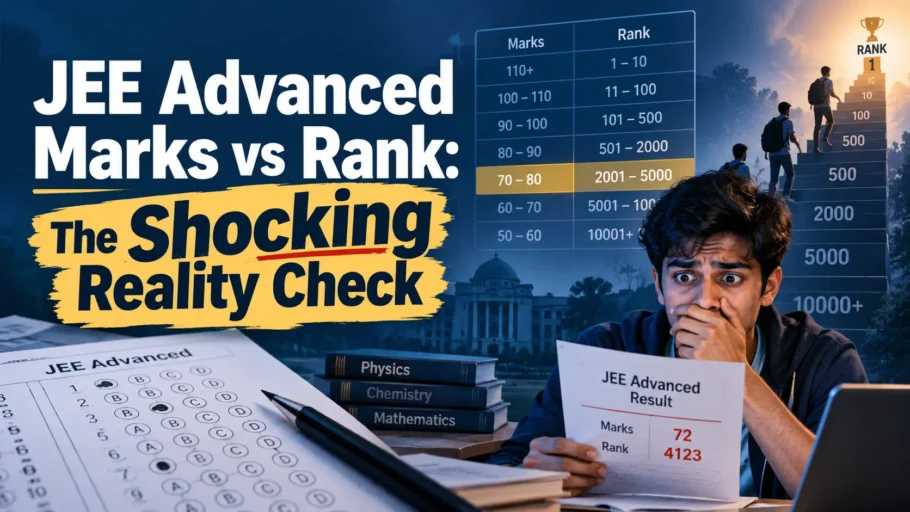
Two students finish the exam with almost the same score, yet their ranks can sit hundreds of places apart. Even more surprising, the same marks can mean a completely different rank from one year to the next. That is the reality of JEE Advanced marks vs rank. In 2024, you needed 233 marks to reach rank 1,001. In 2022, rank 1,000 needed only 173 marks. Same rank, sixty marks apart.
This guide relies on official result documents and IIT reports instead of guesswork. You will find year-wise data, category-wise numbers, what to expect in JEE Advanced 2027, the closing ranks that decide branches at top IITs, and practical ways to estimate and lift your own rank.
Why JEE Advanced Marks vs Rank Is Never a Fixed Formula
JEE Advanced is held on a single day with no percentile and no normalisation. Your rank is simply your position in a list sorted by aggregate marks out of 360, and that list looks different every year. Three forces reshape it.
- The first is the paper itself, because the organising IIT changes the difficulty every cycle, which moves the marks needed for any given rank.
- The second is the crowd: in 2026, 1,79,694 candidates appeared and 56,880 qualified, while in 2025, 1,80,422 appeared and 54,378 qualified. How many strong candidates sit around your score matters as much as the score.
- The third is the ranking rule, since you must clear both the subject-wise and the aggregate qualifying marks, and category rank lists are separate from the Common Rank List (CRL).
There is no official JEE Advanced marks vs rank conversion formula, and no IIT publishes a fixed table in advance. What exists are result reports that list the marks scored at particular ranks after the results are out. Every table you see online, including the ones below, is built from those reports for past years or estimated for the future, and the two should never be confused.
JEE Advanced Exam Pattern and Total Marks: Quick Recap
JEE Advanced has two compulsory papers of 180 marks each, so the total is 360. Physics, Chemistry and Mathematics carry 120 marks each, which is 60 in each paper. Negative marking applies to some questions, and the exact marking scheme is published in the official brochure every year, so always read the current one.
Your rank is based on the sum of both papers, and you must appear in both. To enter the CRL in 2026, you needed at least 92 marks in aggregate and 8 marks in each subject, which is 25.56% and 7.30% respectively. Missing either bar means no rank, even if the other number looks healthy.
JEE Advanced Marks vs Rank: Last 5 Years’ Data
Year-wise snapshot (2022 to 2026)
The topper’s score stays in a narrow band, but the qualifying cutoff swings widely. That swing is the first sign of how differently each paper behaves.
| Year | Topper’s marks (out of 360) | CRL qualifying aggregate | Students in the CRL |
|---|---|---|---|
| 2022 | 314 | 55 | 28,978 |
| 2023 | 341 | 86 | 26,321 |
| 2024 | 355 | 109 | 25,946 |
| 2025 | 332 | 74 | 33,859 |
| 2026 | 330 | 92 | Not verified |
The shocking part: same rank, very different marks
Now compare the marks needed for the same CRL rank across four official reports. The differences are far larger than most students expect.
| Approximate CRL rank | 2022 | 2023 | 2024 | 2025 |
|---|---|---|---|---|
| Rank 500 | 199 | 242 | 258 | 234 |
| Rank 1,000 | 173 | 219 | 233 | 208 |
| Rank 5,000 | 115 | 153 | 172 | 145 |
A full official ladder: 2025 marks vs rank
The 2025 report gives the most detailed recent picture. Notice how the marks lost per row shrink as you move down. The curve flattens, so a few marks cost many more ranks in the middle of the list than at the top.
| CRL rank | Marks | Marks dropped since previous row |
|---|---|---|
| 1 | 332 | Not applicable |
| 101 | 278 | 54 |
| 501 | 234 | 44 |
| 1,001 | 208 | 26 |
| 2,001 | 181 | 27 |
| 3,001 | 165 | 16 |
| 5,001 | 145 | 20 |
| 10,001 | 120 | 25 |
| 15,001 | 104 | 16 |
| 20,001 | 94 | 10 |
| 33,859 (last CRL rank) | 74 | 20 |
Data sources
Use the official results press releases on jeeadv.ac.in for qualifying marks and toppers, the official IIT JEE report for marks at ranks, and josaa.nic.in for closing ranks. This post was last verified on 30 September 2026.
JEE Advanced 2027 Marks vs Rank: What to Expect
Expected marks vs rank range (based on past trends)
Nobody can publish official JEE Advanced 2027 numbers before the exam. What we can do is show the range that official data has produced across the years with published figures. The table below is not a forecast of one number. It shows the spread you should plan around.
| Target CRL rank | Lowest marks needed (2022 to 2025) | Highest marks needed (2022 to 2025) |
|---|---|---|
| About rank 100 | 278 (2025) | 300 (2024) |
| About rank 500 | 199 (2022) | 258 (2024) |
| About rank 1,000 | 173 (2022) | 233 (2024) |
| About rank 5,000 | 115 (2022) | 172 (2024) |
Factors that will shape 2027 marks vs rank
Paper difficulty will again be the biggest factor. The number of candidates matters too: current rules make the top 2,50,000 JEE Main qualifiers eligible, and the organising IIT can change eligibility, marking or attempts in the brochure. For example, over 12,000 aspirants petitioned the Education Ministry for a third attempt in September 2026, but I found no confirmed change. Seat matrix and category rules can also shift how ranks turn into seats.
Easy paper vs tough paper scenarios
| Scenario | Effect on marks for the same rank | Evidence in official data |
|---|---|---|
| Tougher paper | Marks needed fall | 2022: rank 1,000 needed 173 marks, topper scored 314 |
| Middle paper | Marks stay close to recent averages | 2025: rank 1,001 needed 208 marks, topper scored 332 |
| Easier paper | Marks needed rise | 2024: rank 1,000 needed 233 marks, topper scored 355 |
Key JEE Advanced 2027 dates to watch
As of 30 September 2026, official dates are not announced. Trackers expect IIT Delhi as the organising institute, registration in April 2027, the exam in May 2027 and results in June 2027, followed by JoSAA counselling. JEE Main 2027 Session 1 is listed for 22 to 24 January 2027. Confirm everything on jeeadv.ac.in and add your own “last verified” date.
How this section will be updated
Once the 2027 results and the official report are out, the estimated table above will be replaced with real numbers. Bookmark this page if you want the update.
Category-Wise Marks vs Rank: OBC-NCL, EWS, SC, ST, PwD
Your rank card shows a CRL rank and a category rank, and they are separate numbers. Category ranks come from separate lists, so rank 100 in the SC list does not sit near rank 100 in the CRL. Every category-wise JEE Advanced marks vs rank table looks very different for that reason, and JoSAA uses the category rank for reserved seats.
Qualifying marks differ as well. In 2026, the OBC-NCL and GEN-EWS lists both required 82 aggregate and 7 per subject, while SC, ST and every PwD list required 46 aggregate and 4 per subject. The table below pairs those 2026 qualifying marks with the 2025 official marks at two category ranks.
| Rank list | 2026 qualifying aggregate (per subject) | 2025 marks at category rank 101 | 2025 marks at category rank 1,001 |
|---|---|---|---|
| CRL (General) | 92 (8) | 278 | 208 |
| OBC-NCL | 82 (7) | 225 | 144 |
| GEN-EWS | 82 (7) | 199 | 126 |
| SC | 46 (4) | 148 | 79 |
| ST | 46 (4) | 107 | 52 |
What Rank Do You Need for Top IITs and Branches?
Marks matter only because they produce a rank, and the rank decides your branch at JoSAA. Computer Science at the oldest IITs closes at the smallest ranks. The figures below are closing ranks for the General open pool from trackers of JoSAA data, and I have marked where sources disagree. Please confirm the exact numbers on josaa.nic.in.
| IIT and branch | Closing rank (General, open) | Year and round |
|---|---|---|
| IIT Bombay, CSE | 68 | 2024 |
| IIT Bombay, CSE | 66 | 2025 final round |
| IIT Bombay, CSE | About 67 | 2026 Round 5 (trackers show 65 to 70) |
| IIT Delhi, CSE | 102 | 2025 final round |
| IIT Delhi, CSE | 96 to 128 | 2026 Round 5 (trackers differ) |
| IIT Madras, CSE | 171 | 2025 |
| IIT Madras, CSE | 149 to 151 | 2026 (Round 1 and Round 5) |
| IIT Bombay, Electrical | 411 | 2026 last round |
| IIT Bombay, Aerospace | 2,638 | 2026 last round |
Low Marks, Good Rank? How to Read the Rank Shifts
After a tough paper, a modest raw score can hide a strong rank. The 2022 data shows this clearly: rank 5,000 needed only 115 marks, about 57 marks fewer than the 172 needed in 2024. The qualifying cutoff moves the same way, from 109 in 2024 to 74 in 2025 to 92 in 2026. If you feel the paper was brutal, do not judge yourself on marks alone. Read JEE Advanced marks vs rank from the year whose difficulty feels closest, then expect a better position than the raw score suggests.
After an easy paper, the reverse happens. Marks pile up near the top, and the same score buys a worse rank than it would in a tough year. In both cases the number that decides your options is your rank, not your marks.
5 Reasons Your Rank Can Be Worse Than Your Marks Suggest
- Paper toughness – An easier paper raises the marks needed for every rank. Rank 1,000 needed 233 marks in 2024 compared with 173 in 2022, so the same score can slide down the list by a wide margin.
- Competitors in your score range – In 2025, five marks separated rank 4,401 (150 marks) from rank 5,001 (145 marks), so each mark was worth about 120 ranks. In the crowded middle of the list, one careless mistake costs hundreds of places.
- Negative marking losses – Some questions carry negative marking, and wrong attempts subtract marks. A few reckless guesses can drop you across several hundred ranks in the dense part of the list.
- Category and gender-based seat rules – Reserved categories and female candidates are ranked in separate lists and seat pools. In 2026, the top female candidate had CRL rank 77 with 280 marks while the overall topper scored 330, so your CRL rank alone does not tell the full story.
- Tie-breaking rules – When two candidates have the same aggregate, the one with more positive marks ranks higher, then higher Mathematics marks, then higher Physics marks. If they are still tied, they share a rank.
How to Estimate Your Rank Before the Result
Use past-year data
Start by judging how hard your paper was, using the topper’s score and the qualifying cutoff as signals from earlier years. Then use the official marks-at-rank table for the year that feels closest. If your paper felt like 2025, use the 2025 ladder above. If it felt like 2022, expect ranks to be much better for the same marks.
Use a rank predictor tool
A rank predictor can speed things up, especially a JEE Advanced 2027 rank predictor after the exam. Use two or three tools and compare, because they rarely agree. A sensible method is to calculate your marks from the official answer key, locate them in the closest year’s table, then add a buffer of a few hundred ranks on both sides. Every prediction is an estimate. Only the official rank card gives your real rank.
How to Improve Your Score and Rank: Actionable Tips
The most reliable gains come from mock test analysis. After every mock, keep an error log that tags each lost mark as a concept gap, a calculation slip, a misread question or a time problem. Patterns appear within a few weeks, and most students find that a handful of repeated errors cost more than any single hard chapter.
Attempt strategy is the second lever. Solve sure questions first, then moderate ones, and leave the doubtful ones for last so you never sink twenty minutes into one negatively marked question. Because you must clear subject-wise minimums as well as the aggregate, a weak subject can wipe out a good total. Use your error log to decide where the next ten hours of study should go, and treat every mock as a rehearsal of the real exam.
What If Your Rank Isn’t Good Enough for IIT?
A weaker rank does not close the road. Through JoSAA, your JEE Main rank gives access to NITs, IIITs and other government funded institutes, and your JEE Advanced rank applies to IIT seats. A strong branch at a good NIT can be a smarter choice than a weak branch at a newer IIT, depending on your goals.
Some students consider a drop year. Sources still describe a limit of two attempts, and a third attempt is only a petition for now, so check the 2027 brochure before planning around it. A drop year costs time, money and energy without guaranteeing a better rank, and 2022 to 2025 show how much the paper can help or hurt. A balanced approach is to complete JoSAA counselling, secure a seat you can live with, and then decide. Keep documents ready and track closing ranks round by round.
FAQs
- What marks are needed for a rank under 1,000 in JEE Advanced?
Rank 1,000 needed 173 marks in 2022, 219 in 2023, 233 in 2024 and 208 in 2025. The requirement depends heavily on the paper. - What marks are expected for a top-1000 rank in JEE Advanced 2027?
Based on 2022 to 2025 official data, the observed range is 173 to 233 marks. To plan safely, aim near the upper end of that range. This is an estimate, not an official figure. - What is a good score in JEE Advanced?
In 2025, 208 marks gave rank 1,001, 181 marks gave rank 2,001 and 145 marks gave rank 5,001. A good score depends on the branch you want and the year’s paper. - Can I get an IIT with 100 marks?
In 2025, 100 marks corresponded to about rank 16,600 in the CRL, so most General category IIT branches are out of reach. Reserved category ranks and female-only pools can open limited options at newer IITs, so check JoSAA closing ranks for your category. - Is there an official JEE Advanced marks vs rank list?
There is no fixed conversion published in advance. The organising IIT publishes results and the official report lists marks at specific ranks, and online tables are built from that data. - How many marks are needed for IIT Bombay CSE?
In 2025, rank 101 needed 278 marks, and in 2026, rank 77 needed 280 marks. IIT Bombay CSE closes around rank 66 to 68, so plan for a score comfortably above 280, though the exact figure changes with the paper.
Conclusion
The biggest lesson about JEE Advanced marks vs rank is that marks are only half the story. Your rank depends on the paper, the crowd around your score and your category list, and the official data shows swings of 50 to 60 marks for the same rank across years. Use the past tables to set targets, and rely on your official rank card and JoSAA data for final decisions.
If you are preparing for the next attempt, build an error log, track your mocks against the marks bands above and revisit this page. We will update this post with official JEE Advanced 2027 marks vs rank data as soon as results and the official report are available.