
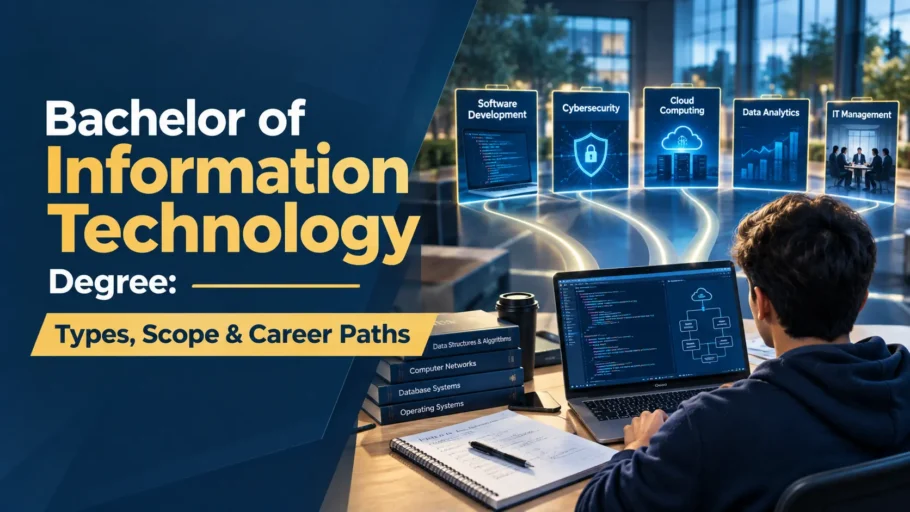
Technology now touches nearly every industry on the planet, and the demand for skilled professionals has never been higher. If you are exploring higher education options in computing, the Bachelor of Information Technology degree is one of the most practical and career-focused paths available today. This degree prepares students to work with real-world systems, networks, and software, making it a popular choice for students across the United States, United Kingdom, Australia, Canada, India, and beyond.
Unlike some computing degrees that lean heavily into theory, a Bachelor of Information Technology program focuses on applied skills that employers actually look for. Whether you are a high school graduate deciding on your future or someone considering a career switch into tech, understanding this degree properly will help you make an informed choice.
In this guide, we will walk through what a Bachelor of Information Technology actually involves, the different types of IT degrees available worldwide, eligibility requirements, curriculum, specializations, career paths, salary expectations, and whether this degree is still worth pursuing in 2026. By the end, you should have a clear picture of whether this path fits your goals.
What Is a Bachelor of Information Technology Degree?
A Bachelor of Information Technology degree, often shortened to BIT, is an undergraduate program that trains students in the practical application of computing systems. It typically covers areas such as computer networks, database management, software development, systems administration, and information security. The degree is designed to produce graduates who can walk into a workplace and manage or build the technology infrastructure that businesses rely on daily.
This is different from a general “computer degree,” a term often used loosely to describe any tech-related qualification. Computer Science degrees, for instance, tend to focus more on theoretical foundations such as algorithms, computational theory, and software architecture at a deeper mathematical level. A Bachelor of Information Technology, on the other hand, leans toward implementation, systems management, and applying technology to solve business problems.
Students pursuing a Bachelor of Information Technology often work on hands-on projects involving real servers, networks, and applications rather than purely theoretical coursework. This applied approach makes the degree especially attractive to students who want to enter the workforce with job-ready skills immediately after graduation.
Because technology needs are universal, the structure and reputation of a Bachelor of Information Technology degree can vary from country to country, but its core purpose remains consistent everywhere: preparing students to manage, build, and secure the digital systems that modern organizations depend on.
Types of Bachelor of Information Technology Degrees
One of the most confusing parts of choosing a tech degree is realizing there is not just one single path. Depending on your country and university, a Bachelor of Information Technology can appear under several different names and formats. Here is a breakdown of the most common types.
BIT (Bachelor of Information Technology) – The Standard Track
This is the most direct and widely recognized version of the degree. A standard BIT program usually spans three to four years and includes core subjects like networking, databases, programming, and systems analysis. It is designed to be broad enough to prepare students for multiple IT roles rather than a single narrow specialization.
BSc IT (Bachelor of Science in Information Technology)
A BSc in Information Technology is essentially a science-track version of the same degree. It often includes a slightly stronger emphasis on scientific and mathematical foundations compared to a standard BIT, while still covering practical IT skills. This version is common in countries like India, Australia, and several European nations.
BTech IT (Bachelor of Technology in Information Technology)
Popular primarily in India and some parts of Asia, a BTech in IT is an engineering-focused version of the degree. It usually involves a more rigorous four-year curriculum with heavier emphasis on engineering principles, mathematics, and technical problem solving compared to a standard BIT or BSc IT.
BCA (Bachelor of Computer Applications)
While technically a separate degree title, BCA programs are often grouped with Information Technology degrees because of significant curriculum overlap. BCA tends to focus more on application development and software programming, making it a popular alternative for students interested in coding-heavy careers.
BSc (Hons) Information Technology – UK Style
In the United Kingdom and countries following the British education system, students often pursue a BSc (Hons) in Information Technology. The “Hons” designation refers to an honors degree, which typically involves a more in-depth final year project or dissertation compared to an ordinary degree.
Online and Distance Bachelor of IT Programs
With the rise of digital learning, many universities now offer a Bachelor of Information Technology through online or distance formats. These programs are particularly attractive to working professionals or students in regions without easy access to a physical campus. While the core curriculum is often similar to on-campus programs, flexibility in scheduling is the biggest advantage.
Regional Naming Differences Around the World
| Region | Common Degree Name | Typical Duration |
|---|---|---|
| United States | Bachelor of Science in Information Technology | 4 years |
| United Kingdom | BSc (Hons) Information Technology | 3 years |
| India | BCA, BSc IT, or BTech IT | 3 to 4 years |
| Australia | Bachelor of Information Technology | 3 years |
| Canada | Bachelor of Information Technology | 3 to 4 years |
BIT vs Computer Science vs BCA vs BTech: Which One Should You Choose?
Choosing between these similar-sounding degrees can feel overwhelming, especially since they all fall under the broader information technology umbrella. Here is a simplified comparison to help clarify the differences.
| Degree Type | Primary Focus | Best Suited For |
|---|---|---|
| Bachelor of Information Technology | Applied IT systems, networking, databases | Students who want job-ready practical skills |
| Computer Science | Theoretical computing, algorithms, software design | Students interested in research or deep software engineering |
| BCA | Application development, programming | Students who want to focus heavily on coding |
| BTech IT | Engineering principles applied to IT | Students who prefer a rigorous technical and mathematical approach |
There is no universally “better” option among these, only the option that aligns best with your career interests and learning style.
Eligibility Criteria for a Bachelor of Information Technology
Eligibility requirements for a Bachelor of Information Technology vary by country and institution, but there are common threads across most programs.
Generally, students need to have completed secondary or high school education with a reasonable grasp of mathematics and, in many cases, basic science subjects. Some universities, particularly in India and parts of Asia, require students to have studied mathematics or computer science specifically at the high school level.
In countries like the United States, Canada, and Australia, admission often depends on a combination of high school grades, standardized test scores where applicable, and sometimes a personal statement. In the UK, entry typically depends on A-level results or equivalent qualifications, with specific grade requirements varying by university.
For international students applying to a Bachelor of Information Technology program abroad, English language proficiency tests such as IELTS or TOEFL are commonly required unless the student has studied in an English-medium institution previously. Some universities may also require entrance exams, particularly for more competitive programs or engineering-focused variants like BTech IT.
It’s worth noting that many online and distance BIT programs have more flexible eligibility criteria, often accepting mature students or those returning to education after a career break, sometimes with alternative entry pathways based on work experience.
Duration and Structure of a BIT Degree Worldwide
The duration of a Bachelor of Information Technology degree typically ranges between three and four years, depending on the country and educational system.
In the United States, a standard bachelor’s degree, including IT programs, usually takes four years to complete, structured around a credit system with a mix of core IT courses, general education requirements, and electives. In the UK and Australia, most Bachelor of Information Technology programs are completed in three years, following a more focused curriculum without the broader general education requirements common in the US system.
In India, the duration depends on the specific degree type. A BCA or BSc IT typically takes three years, while a BTech IT usually takes four years due to its engineering curriculum.
Most programs are divided into semesters, typically two per academic year, though some universities use a trimester system. Students usually progress from foundational subjects in the first year to more specialized and advanced coursework in later years. Many Bachelor of Information Technology programs also include a final year project, capstone assignment, or dissertation, particularly in honors-level programs, where students apply their accumulated knowledge to a substantial practical or research-based project.
Some universities also offer sandwich or co-op programs, where students complete a period of industry placement as part of their degree, effectively extending the duration by six months to a year but significantly boosting employability upon graduation.
Core Curriculum and Subjects in a BIT Program
While specific course names vary between universities, most Bachelor of Information Technology programs share a common core curriculum designed to build both foundational and applied skills. Here are the subjects you can typically expect.
- Programming Fundamentals: Introduction to coding languages such as Python, Java, or C++, forming the basis for further technical coursework.
- Database Management Systems: Learning how to design, manage, and query databases using tools like SQL and understanding relational database concepts.
- Computer Networking: Understanding how networks are designed, configured, and maintained, including protocols, hardware, and network security basics.
- Systems Analysis and Design: Learning how to analyze business requirements and design appropriate technology solutions.
- Cybersecurity Fundamentals: Covering the basics of protecting systems and data from threats, a growing priority in nearly every IT curriculum today.
- Cloud Computing: Introduction to cloud platforms and services, an increasingly essential skill as businesses migrate infrastructure to the cloud.
- Software Engineering Principles: Understanding the software development lifecycle, testing methodologies, and project management within a tech context.
- Web Development: Building and maintaining websites and web applications using modern frameworks and tools.
- Operating Systems: Understanding how operating systems function and are managed across different platforms.
- IT Project Management: Learning how to plan, execute, and manage technology projects within organizational constraints.
Most Bachelor of Information Technology programs balance theoretical instruction with hands-on lab work, group projects, and sometimes industry placements, ensuring graduates leave with practical, applicable skills rather than purely academic knowledge.
Specializations Within a Bachelor of Information Technology
As technology fields have grown more complex, many universities now offer specialization tracks within their Bachelor of Information Technology programs, allowing students to tailor their education toward specific career goals.
- Cybersecurity has become one of the most sought-after specializations, given the rising number of global cyber threats. Students in this track focus on network defense, ethical hacking, risk assessment, and security compliance.
- Data Science and Analytics is another popular specialization, teaching students how to collect, process, and interpret large datasets to support business decision-making, often incorporating tools like Python, R, and data visualization software.
- Cloud Computing specializations prepare students to design and manage cloud-based infrastructure using platforms such as AWS, Microsoft Azure, or Google Cloud, a skill set in high demand as organizations continue shifting away from on-premise systems.
- Artificial Intelligence and Machine Learning tracks are becoming more common within Bachelor of Information Technology programs, giving students exposure to the algorithms and systems powering modern AI applications.
- Networking specializations dive deeper into designing, configuring, and maintaining complex network infrastructures, often preparing students for industry certifications alongside their degree.
- Software Development tracks focus heavily on programming, application design, and building deployable software products.
- Information Systems Management specializations blend technical knowledge with business strategy, preparing graduates for roles that bridge IT departments and organizational leadership.
Choosing a specialization, where available, can help align your Bachelor of Information Technology degree more closely with your intended career path and make you more competitive for specific roles after graduation.
Skills You Gain During a Bachelor of Information Technology
A Bachelor of Information Technology degree builds a combination of technical and soft skills that together prepare graduates for the realities of modern workplaces.
On the technical side, students typically develop strong programming abilities, database management skills, network configuration knowledge, and an understanding of cybersecurity principles. Many programs also build competency in cloud platforms, systems troubleshooting, and software testing, all of which are directly applicable to entry-level IT roles.
Equally important are the soft skills developed throughout the degree. Problem-solving is central to nearly every IT role, and coursework is often structured around identifying issues and designing practical solutions. Systems thinking, the ability to understand how different components of a technology ecosystem interact, is another skill heavily emphasized throughout a typical curriculum.
Group projects and collaborative assignments help build teamwork and communication skills, both essential when working in cross-functional teams that include non-technical stakeholders. Time management and project coordination skills also develop naturally through coursework deadlines and capstone projects, mirroring the demands of real workplace environments.
Together, these technical and interpersonal skills make Bachelor of Information Technology graduates well-rounded candidates capable of contributing meaningfully from day one in most entry-level tech roles.
Scope of a Bachelor of Information Technology Degree
The scope of a Bachelor of Information Technology degree continues to expand as digital transformation accelerates across nearly every industry worldwide. Businesses in finance, healthcare, retail, manufacturing, and government sectors all depend on robust IT infrastructure, creating consistent demand for skilled graduates.
Fintech companies rely heavily on IT professionals to build secure, scalable digital banking and payment systems. Healthtech organizations need IT graduates to manage patient data systems, telemedicine platforms, and healthcare software compliance. E-commerce businesses depend on IT professionals to maintain websites, manage databases, and ensure smooth digital transactions at scale. Government agencies increasingly invest in IT infrastructure for public services, cybersecurity, and digital record management.
Beyond specific industries, the rise of remote work has significantly broadened opportunities for Bachelor of Information Technology graduates. Many IT roles, particularly in software development, systems administration, and cybersecurity, can now be performed remotely, opening up global job markets rather than limiting graduates to local opportunities.
This expanding scope means a Bachelor of Information Technology is not tied to a single industry or geography. Graduates have the flexibility to work across sectors and, in many cases, across countries, making it one of the more globally adaptable degree choices available today.
Career Paths After a Bachelor of Information Technology
One of the biggest advantages of a Bachelor of Information Technology degree is the breadth of career paths it opens up. Here are some of the most common roles graduates pursue.
- Software Developer: Designs, builds, and maintains applications and software systems, one of the most in-demand roles across nearly every industry.
- Systems Analyst: Bridges the gap between business needs and technical solutions by analyzing processes and recommending appropriate technology systems.
- Network Administrator: Manages and maintains an organization’s computer networks, ensuring connectivity, security, and performance.
- Cybersecurity Analyst: Monitors systems for security threats, implements protective measures, and responds to potential breaches.
- Cloud Engineer: Designs and manages cloud infrastructure, helping organizations migrate and maintain systems on platforms like AWS or Azure.
- Database Administrator: Manages an organization’s databases, ensuring data integrity, security, and efficient performance.
- IT Project Manager: Oversees technology projects from planning through execution, coordinating teams and resources to meet deadlines.
- Data Analyst: Collects and interprets data to support business decisions, often working closely with data science teams.
- DevOps Engineer: Bridges development and operations teams, streamlining software deployment and infrastructure management processes.
- IT Consultant: Advises organizations on technology strategy, helping them select and implement appropriate systems and solutions.
- IT Support Specialist: Provides technical assistance and troubleshooting for an organization’s employees and systems, often an entry point into other IT careers.
- Web Developer: Builds and maintains websites and web applications, a role that remains consistently in demand across industries.
These roles vary significantly in day-to-day responsibilities, but all stem from the core skill set built during a Bachelor of Information Technology program. Many graduates start in generalist roles like IT support or junior developer positions before moving into more specialized careers as they gain experience.
Average Salary for BIT Graduates Around the World
Salary expectations for Bachelor of Information Technology graduates vary considerably depending on region, experience level, and specialization. The figures below are approximate and meant as a general guide rather than a precise benchmark, since actual salaries depend on numerous individual factors.
These figures fluctuate based on the specific role, company size, industry, and the specialization a graduate has pursued. Roles in cybersecurity, cloud computing, and data science tend to command higher salaries compared to general IT support positions, reflecting the specialized demand in those areas. It’s always worth researching current salary data for your specific target country and role, since these figures shift over time with market conditions.
Top Countries and Universities Offering BIT Degrees
Several countries have established strong reputations for offering quality Bachelor of Information Technology education, each with its own strengths and areas of focus.
The United States offers a wide range of universities providing IT-focused bachelor’s degrees, often with strong industry connections and research opportunities, though tuition costs can be significantly higher compared to other regions.
The United Kingdom is known for its structured three-year BSc (Hons) programs, with several universities offering strong industry placement opportunities as part of the curriculum.
Australia has become an increasingly popular destination for international students pursuing a Bachelor of Information Technology, with universities offering flexible program structures and strong post-graduation work visa options.
Canada offers competitive IT programs, often combined with co-op opportunities that allow students to gain paid work experience during their studies, a significant advantage for building a professional network before graduation.
India produces a large number of IT graduates annually, with numerous universities offering BCA, BSc IT, and BTech IT programs at varying levels of cost and prestige.
Germany offers several English-taught Information Technology programs, often at public universities with minimal or no tuition fees, making it an attractive option for international students seeking affordable, high-quality education.
Regardless of which country you consider, it is essential to verify a university’s accreditation status before enrolling. Accreditation affects everything from the recognition of your degree by employers to eligibility for professional certifications and further studies.
Higher Studies After BIT: Masters, Certifications & Further Options
For graduates looking to advance their careers further, a Bachelor of Information Technology degree opens the door to several postgraduate and certification pathways.
Pursuing a Master of Science in Information Technology (MSc IT) allows graduates to deepen their technical expertise or specialize further in areas like cybersecurity, data science, or artificial intelligence. This is a common route for those interested in more senior technical or research-oriented roles.
An MBA in IT Management is another popular option for BIT graduates who want to move into leadership or management positions, combining technical knowledge with business strategy and organizational skills.
Beyond formal degrees, industry certifications play a significant role in career advancement for IT professionals. Certifications such as AWS Certified Solutions Architect, Microsoft Azure Fundamentals, PMP (Project Management Professional), and CompTIA Security+ are widely recognized and often directly influence hiring decisions and salary negotiations.
Stacking a Bachelor of Information Technology degree with relevant certifications is a common strategy among professionals looking to stay competitive in a fast-changing field. Many employers value up-to-date certifications alongside formal education, since they demonstrate current, practical knowledge of specific tools and platforms actively used in the industry.
Is a Bachelor of Information Technology Worth It in 2026?
Whether a Bachelor of Information Technology is worth pursuing depends largely on individual career goals, but the overall outlook remains strong heading into 2026.
On the positive side, demand for IT professionals continues to grow across nearly every industry, driven by ongoing digital transformation, cybersecurity concerns, and the expansion of cloud computing and AI technologies. The degree also offers considerable flexibility, with graduates able to work across industries, transition into various specializations, and often pursue remote work opportunities that were far less common a decade ago. Salaries for IT roles, particularly in specialized areas, remain competitive compared to many other bachelor’s degree paths.
That said, the technology field moves quickly, and a degree alone is rarely enough to guarantee long-term career success. Graduates need to commit to continuous learning throughout their careers, keeping up with new tools, platforms, and best practices well beyond graduation. The field can also be competitive, particularly for popular specializations like cybersecurity and data science, meaning practical experience through internships or personal projects can be just as important as the degree itself.
For students genuinely interested in technology and willing to keep learning throughout their careers, a Bachelor of Information Technology remains a strong, practical investment in 2026 and beyond.
Frequently Asked Questions
- What is the difference between BIT and BSc IT?
A BIT and a BSc in Information Technology are largely similar in content, though a BSc IT sometimes places slightly more emphasis on scientific and mathematical foundations. The exact differences depend on the specific university offering the program. - How many years is a Bachelor of Information Technology?
Most Bachelor of Information Technology programs take three to four years to complete, depending on the country and specific degree structure. - Is BIT a good degree for the future?
Yes, given the continued growth of digital transformation across industries, a Bachelor of Information Technology remains a strong choice for students interested in a stable, adaptable tech career. - Can I study a Bachelor of Information Technology online?
Yes, many universities now offer online or distance versions of their Bachelor of Information Technology programs, providing flexibility for working professionals or students without access to a physical campus. - What jobs can I get with a Bachelor of Information Technology?
Graduates commonly pursue roles such as software developer, network administrator, cybersecurity analyst, cloud engineer, database administrator, and IT project manager, among others. - Is a Bachelor of Information Technology the same as Computer Science?
No, while related, a Bachelor of Information Technology tends to focus more on applied, practical systems management, while Computer Science leans more heavily into theoretical and algorithmic foundations. - Do I need to know programming before starting a BIT degree?
Prior programming knowledge is helpful but not usually required, since most Bachelor of Information Technology programs include foundational programming courses for beginners.
Conclusion
A Bachelor of Information Technology degree offers a practical, globally relevant path into one of the fastest-growing industries in the world. From understanding the different types of IT degrees available to exploring specializations, career paths, and salary expectations, this guide has covered the essential information needed to make an informed decision.
Whether you choose a standard BIT, a BSc IT, a BTech IT, or an online program, the core value remains the same: hands-on, applicable skills that prepare you for real-world technology roles across nearly every industry and region. If you’re considering this path, take time to research specific universities, compare curriculum details, and think carefully about which specialization aligns with your career interests.
The world continues to depend more heavily on technology every year, and a Bachelor of Information Technology positions graduates to be part of that ongoing growth, wherever in the world they choose to work.