
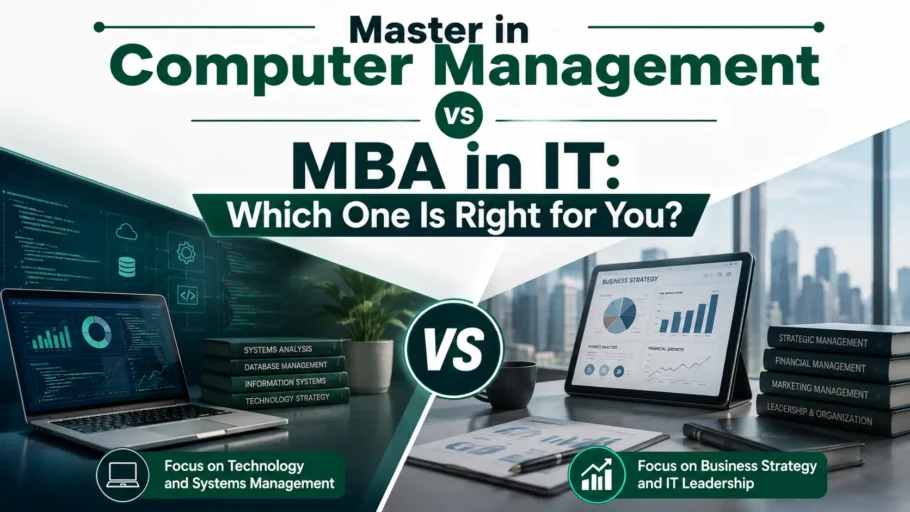
Choosing the right postgraduate degree can shape the direction of your entire career. For students and professionals who want to work at the intersection of technology and business, two options often come up: a Master in Computer Management and an MBA in IT. Both are respected credentials, but they serve different purposes, attract different types of learners, and lead to different career paths.
This guide breaks down everything you need to know so you can make a confident, informed decision.
What Is a Master in Computer Management?
A Master in Computer Management is a postgraduate degree that focuses on the technical and managerial aspects of computer systems, software, data, and IT infrastructure. It prepares graduates to manage technology teams, oversee digital systems, and make decisions that align IT operations with business goals.
This degree is popular in countries like the United States, Canada, India, Australia, and parts of Europe. It typically combines coursework in computer science fundamentals, project management, systems analysis, database management, and organizational behavior.
The program is designed for people who want to stay close to technology while also developing the leadership and management skills needed to rise into senior roles.
What Is an MBA in IT?
An MBA in IT, also referred to as MBA IT Management, is a business administration degree with a specialization in information technology. It is rooted in core MBA subjects such as finance, marketing, strategy, and operations, but includes technology-focused electives and concentrations.
The MBA in Information Technology is ideal for professionals who want to move into executive or strategic roles where the primary focus is business growth, organizational leadership, and using technology as a competitive tool rather than managing it at a technical level.
Programs offering MBA IT Management are widely available across business schools in the UK, USA, Germany, Singapore, Australia, and many other countries.
Core Curriculum Comparison
Understanding what you will actually study in each program is one of the most practical ways to decide which degree fits your goals.
| Subject Area | Master in Computer Management | MBA in IT |
|---|---|---|
| Computer Systems and Architecture | Yes, in depth | Basic or none |
| Database Management | Yes | Sometimes as elective |
| Business Strategy | Introductory | Core subject |
| Financial Management | Limited | Core subject |
| IT Project Management | Yes, core | Yes, from business angle |
| Software Development Concepts | Yes | Rarely |
| Marketing and Sales | Rarely | Core subject |
| Organizational Leadership | Yes | Yes, emphasized |
| Data Analytics | Yes | Sometimes |
| Entrepreneurship | Optional | Common elective |
Who Should Choose Each Program?
Choose a Master in Computer Management if you:
- Have a background in computer science, IT, or engineering
- Want to manage technical teams or IT departments
- Prefer working closer to systems, software, or data
- Are interested in roles like IT Director, Systems Manager, or Technology Consultant
- Want a degree that bridges technical expertise with management skills
Choose an MBA in IT if you:
- Come from a business, finance, or non-technical background
- Want to reach C-suite roles like CTO, CIO, or VP of Technology
- Are more interested in strategy, business development, and leadership
- Plan to work in consulting, entrepreneurship, or corporate management
- Want a globally recognized business credential with a technology focus
Career Opportunities After Each Degree
Both degrees open doors to rewarding careers, but the types of roles you qualify for can differ significantly.
| Career Role | Master in Computer Management | MBA in IT |
|---|---|---|
| IT Manager | Strong fit | Possible |
| Chief Information Officer (CIO) | With experience | Strong fit |
| Technology Consultant | Yes | Yes |
| Systems Analyst | Yes | Limited |
| Product Manager | Yes | Yes |
| Business Analyst | Yes | Strong fit |
| Chief Technology Officer (CTO) | With experience | Strong fit |
| IT Project Manager | Strong fit | Yes |
| Digital Transformation Manager | Yes | Strong fit |
| Entrepreneur / Tech Startup Founder | Possible | Strong fit |
Global Salary Expectations
Salaries vary widely depending on country, industry, and experience level. Below is a general overview of what graduates can expect globally.
| Country | Master in Computer Management (Avg. Annual Salary) | MBA in IT (Avg. Annual Salary) |
|---|---|---|
| United States | $85,000 to $120,000 | $100,000 to $150,000 |
| United Kingdom | £45,000 to £75,000 | £55,000 to £90,000 |
| Canada | CAD 70,000 to CAD 110,000 | CAD 85,000 to CAD 130,000 |
| Australia | AUD 80,000 to AUD 120,000 | AUD 95,000 to AUD 140,000 |
| India | INR 8 LPA to INR 20 LPA | INR 12 LPA to INR 30 LPA |
| Germany | EUR 55,000 to EUR 85,000 | EUR 65,000 to EUR 100,000 |
| Singapore | SGD 60,000 to SGD 100,000 | SGD 75,000 to SGD 120,000 |
Note: These figures are estimates based on industry trends and may vary based on employer, specialization, and individual experience.
MBA IT Management graduates tend to earn slightly higher salaries at senior levels, largely because they move into executive and strategic roles. However, Master in Computer Management graduates can close that gap by moving into specialized or high-demand technical leadership roles.
Duration and Program Format
Both degrees are typically completed in one to two years for full-time students. Many universities around the world also offer part-time and online options, which is especially helpful for working professionals.
A Master in Computer Management often runs for about 18 months to 2 years and may include a capstone project or thesis. MBA in Information Technology programs, particularly one-year accelerated formats popular in Europe and Asia, can be completed in 12 months.
Online and hybrid formats have grown significantly since 2020, making both degrees accessible to students in countries without strong local programs.
Top Countries to Study Each Degree
Master in Computer Management:
- United States (Arizona State University, Northeastern University)
- India (Symbiosis, NMIMS, and several state universities)
- Canada (various polytechnic and university programs)
- Australia (several Group of Eight universities offer related programs)
MBA in IT:
- United Kingdom (Warwick, Manchester, Imperial College)
- United States (MIT Sloan, Carnegie Mellon, University of Texas)
- Germany (ESMT Berlin, Mannheim Business School)
- Singapore (NUS Business School, Nanyang Business School)
- India (IIMs, ISB, SP Jain)
Which Degree Has Better Global Recognition?
When it comes to global brand recognition, the MBA in IT generally carries stronger recognition across industries, especially in business and finance-heavy markets. The MBA is one of the most universally understood degrees in the professional world, and adding an IT specialization makes it highly relevant in the current digital economy.
That said, a Master in Computer Management is gaining recognition, particularly in technology-driven markets like the US, Canada, and parts of Asia. Employers in the tech sector often value the technical depth it provides, which an MBA may not fully deliver.
If you are aiming for a global career across multiple countries and industries, MBA IT Management may open more doors. If you want deep expertise in a technology-heavy environment, a Master in Computer Management offers a stronger foundation.
Cost of Each Degree
Tuition costs vary significantly by country and institution type. In general, MBA programs at top business schools tend to cost more than Master in Computer Management programs, but the difference narrows when comparing mid-tier schools.
In the United States, an MBA at a top school can range from $60,000 to over $150,000. A Master in Computer Management at the same tier may range from $30,000 to $70,000. In countries like India and parts of Southeast Asia, both degrees are considerably more affordable.
Scholarships, assistantships, and employer sponsorship programs are available for both degrees worldwide.
Final Verdict: Which One Is Right for You?
There is no single correct answer because the right choice depends entirely on your background, goals, and the kind of professional you want to become.
If you are a tech-first person who wants to manage systems, lead IT teams, and stay grounded in how technology actually works, a Master in Computer Management is likely the better path.
If you are someone who wants to climb into the boardroom, lead business transformations, or build companies, MBA in IT is the degree that will carry you there faster.
Both degrees are valuable, globally relevant, and increasingly in demand as organizations worldwide continue to invest in digital transformation. The key is to choose the one that aligns with who you are and where you want to go.
Frequently Asked Questions
- Is a Master in Computer Management better than an MBA in IT?
Neither is universally better. A Master in Computer Management suits those who want technical leadership roles, while an MBA in Information Technology is better for those aiming at executive or strategic business positions. - Can I do an MBA in IT without a technical background?
Yes. MBA IT Management programs are designed to welcome students from all academic backgrounds, including business, arts, and science. - Which degree has better job prospects globally?
Both have strong prospects. MBA in Information Technology tends to lead to higher-paying executive roles, while a Master in Computer Management opens doors in IT operations and technical management. - How long does each program take?
Most programs take between one and two years. Accelerated one-year formats are available, particularly for MBA programs in Europe and Asia. - Are online options available for both degrees?
Yes. Reputable universities across the globe offer online and hybrid formats for both degrees, making them accessible to international students and working professionals.