
If you are a Class 12 student in India planning to pursue BBA, BCA, B.Com, BHM, or Integrated MBA, you have probably come across the term UGAT while researching entrance exams. UGAT is one of the most recognised undergraduate entrance tests in the country, opening doors to admission across a wide network of colleges and universities. This article covers everything you need to know about UGAT, including its full form, who conducts it, eligibility criteria, syllabus, exam pattern, application process, fees, top accepting colleges, and how it compares with other popular entrance exams. By the end, you will have a complete picture of what UGAT is and how to prepare for it.
What is UGAT? (UGAT Full Form)
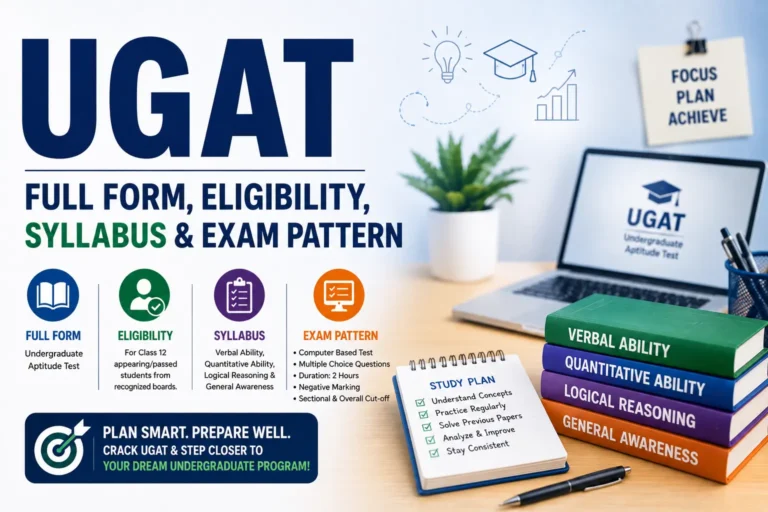
UGAT stands for Under Graduate Aptitude Test. It is a national level entrance examination designed to assess a candidate’s readiness for undergraduate management and allied programmes. The test evaluates core aptitude areas such as English language skills, numerical ability, logical reasoning, and general awareness, giving colleges a standardised way to judge applicants from different educational boards and states.
UGAT primarily serves as an admission gateway for programmes like BBA, BCA, B.Com, BHM, and Integrated MBA (IMBA). Rather than relying purely on Class 12 marks, participating institutions use UGAT scores to shortlist candidates who show strong aptitude and readiness for professional undergraduate study. This makes Under Graduate Aptitude Test particularly useful for students who want to pursue a career in management, commerce, or hospitality right after school.
Since the test focuses on foundational skills rather than subject-specific memorisation, Under Graduate Aptitude Test tends to reward consistent aptitude building over rote learning, which is one reason it remains a popular choice among students applying to management-oriented UG courses across India.
Who Conducts UGAT and Why It Matters
UGAT is conducted by the All India Management Association (AIMA), a body with decades of experience in developing and administering management-related assessments in India. AIMA is a well established, non-profit, apex body for management education and development, and it works closely with universities, business schools, and industry bodies across the country.
The fact that UGAT is backed by AIMA matters for a few reasons. First, it means the exam follows a consistent, standardised format that colleges across India can trust when evaluating applicants. Second, AIMA’s long track record in the education and testing space adds credibility to the scores, which is why a large number of institutions across different states accept UGAT results for admission. Third, because AIMA administers the exam centrally, students from any part of India can appear for it without depending on state-specific quotas or regional entrance systems.
For a student, this translates into wider reach. A single Under Graduate Aptitude Test score can be used to apply to multiple colleges and universities, saving the time and cost of appearing for several separate entrance tests.
UGAT Eligibility Criteria
Before applying, candidates should check whether they meet the basic eligibility requirements set by AIMA for UGAT.
- Educational qualification: Candidates must have passed Class 12 (10+2) from a recognised board with a minimum of 50% aggregate marks. Students who are currently appearing for their Class 12 board exams can also apply provisionally.
- Age limit: There is no upper age limit to appear for UGAT, which makes it accessible to students regardless of when they completed their schooling.
- Nationality requirement: Applicants must be Indian citizens to be eligible for Under Graduate Aptitude Test.
These criteria are fairly stable and rarely change from year to year, so they can be treated as a reliable baseline while planning your application timeline.
UGAT Syllabus (Section-Wise)
The UGAT syllabus is divided into four core sections for most programmes, with two additional sections for BHM aspirants. Here is a breakdown of what each section typically covers.
- English Language
This section tests grammar, vocabulary, sentence correction, reading comprehension, and the ability to understand written passages. It checks how well a candidate can interpret meaning and communicate in written English, which is an essential skill for any management-related course. - Numerical and Data Analysis
This section evaluates basic mathematical concepts including arithmetic, percentages, ratios, and data interpretation. Questions often involve analysing tables, charts, and numerical patterns, testing a candidate’s ability to work with quantitative information under time pressure. - Reasoning and Intelligence
This section measures logical thinking, pattern recognition, and analytical ability. It includes puzzles, series completion, coding-decoding, and questions that assess how a candidate approaches problem solving. - General Knowledge
This section covers current affairs, business awareness, and general static knowledge. It is designed to check how aware a candidate is of the world around them, which is considered valuable for students entering management and commerce fields.
For BHM (Bachelor of Hotel Management) aspirants, two additional sections are included, Service Aptitude and Scientific Aptitude, which assess suitability for hospitality-focused roles.
UGAT Exam Pattern
Understanding the UGAT exam pattern helps candidates plan their time and preparation strategy more effectively. The table below summarises the key details for the two main exam variants.
| Particulars | UGAT for BBA, BCA, B.Com, IMBA | UGAT for BHM |
|---|---|---|
| Mode of Exam | Offline, paper-based test | Offline, paper-based test |
| Total Questions | 130 objective-type MCQs | 180 objective-type MCQs |
| Number of Sections | 4 sections | 6 sections |
| Duration | 2 hours (120 minutes) | 3 hours (180 minutes) |
On the marking scheme, candidates are generally awarded marks for each correct answer, with a small negative marking deduction for incorrect responses. Since the exact marking values can be revised by AIMA from one exam cycle to the next, it is best to confirm the current year’s marking scheme on the official AIMA UGAT website before appearing for the test.
Courses You Can Get Into Through UGAT
A UGAT score opens the door to several undergraduate programmes across management, commerce, computer applications, and hospitality streams.
- BBA (Bachelor of Business Administration): A three-year programme focused on business fundamentals, useful for students aiming for careers in management, marketing, HR, or entrepreneurship.
- BCA (Bachelor of Computer Applications): A three-year programme centred on computer science and software fundamentals, suited to students interested in IT and software development careers.
- B.Com (Bachelor of Commerce): A three-year programme covering accounting, finance, taxation, and economics, ideal for students planning careers in finance, banking, or further studies like CA and CS.
- BHM (Bachelor of Hotel Management): A three or four-year programme preparing students for careers in hospitality, hotel operations, and tourism management.
- Integrated MBA (IMBA): A five-year integrated programme combining undergraduate study with an MBA, allowing students to complete both degrees without appearing for a separate MBA entrance exam later.
UGAT Application Process (Step-by-Step)
Applying for UGAT involves a straightforward online process. Here is how it generally works.
- Visit the official AIMA UGAT website and locate the current year’s registration link.
- Choose the option to create a fresh login as a new candidate.
- Enter basic details such as your name, date of birth, and email ID to generate your login credentials.
- Log in again using your registered email ID and date of birth.
- Select the application form and fill in details including your preferred exam city, address, mobile number, and academic qualifications.
- Upload a scanned photograph and signature as per the specified size and format guidelines.
- Make the application fee payment through the available online modes.
- Review all entered details carefully and submit the completed application form.
Once submitted, candidates should keep a copy of the confirmation and regularly check the official website for updates regarding the admit card and exam city allotment.
UGAT Exam Fees and Payment Modes
The UGAT application fee has historically been around Rs. 750, though this amount can be revised by AIMA from year to year, so candidates should always verify the current fee on the official AIMA website before applying.
Candidates can typically pay the fee using one of the following modes.
| Payment Mode | Description | Availability |
|---|---|---|
| Credit or Debit Card | Online payment using an ATM-enabled card | Available during online registration |
| Net Banking | Direct payment through the candidate’s bank account | Available during online registration |
| Demand Draft (DD) | Draft made in favour of All India Management Association (AIMA), payable at Delhi | Used for offline or postal submission, where applicable |
Top Colleges and Universities Accepting UGAT Scores
UGAT scores are accepted by a wide network of colleges and universities across India for admission into BBA, BCA, B.Com, BHM, and IMBA programmes. While the exact list of participating institutions can change each year, some of the well known categories of colleges that have historically accepted UGAT scores include private management institutes, university-affiliated business schools, and hospitality management colleges spread across major cities in India.
Because the list of accepting institutions is updated annually by AIMA, it is a good practice to check the latest official list published on the AIMA UGAT website before finalising your college preferences. If you have already shortlisted a college, it is also worth confirming directly with the admissions office that they are accepting Under Graduate Aptitude Test scores for the current academic year.
UGAT vs Other UG Entrance Exams (CUET, SET, IPMAT, etc.)
Students preparing for undergraduate admissions in India often compare UGAT with other popular entrance exams. Here is how UGAT stacks up against a few well known alternatives.
| Exam | Conducting Body | Courses Covered |
|---|---|---|
| UGAT | All India Management Association (AIMA) | BBA, BCA, B.Com, BHM, Integrated MBA |
| CUET | National Testing Agency (NTA) | Undergraduate admissions across central and participating universities |
| SET | Symbiosis International University | BBA, BA, B.Sc., and other Symbiosis undergraduate programmes |
| IPMAT | IIM Indore, IIM Rohtak, and other participating IIMs | Integrated Programme in Management (IPM) |
How to Prepare for UGAT (Quick Tips)
A focused, section-wise preparation strategy tends to work best for UGAT since the exam tests aptitude across distinct areas.
For the English Language section, build a habit of daily reading, whether newspapers, editorials, or short articles, and revise grammar rules regularly. For Numerical and Data Analysis, practice basic arithmetic and data interpretation questions daily to improve speed and accuracy. For Reasoning and Intelligence, solve puzzles, series, and coding-decoding problems consistently to sharpen logical thinking. For General Knowledge, follow current affairs regularly through news apps or a daily newspaper, and revise static GK topics periodically.
Time management is equally important given the fixed duration of the exam. Practising with mock tests and previous year papers under timed conditions helps candidates get comfortable with the pace required to attempt all sections within the given time limit. Since Under Graduate Aptitude Test does not require deep subject expertise, steady practice over a few months is usually enough to build the aptitude and speed needed to perform well.
UGAT FAQs
- What is the full form of UGAT?
UGAT stands for Under Graduate Aptitude Test, a national level entrance exam conducted by AIMA for admission to undergraduate management and allied programmes. - Is UGAT a difficult exam?
Under Graduate Aptitude Test is generally considered moderate in difficulty. It tests basic aptitude rather than advanced subject knowledge, so consistent practice usually helps candidates perform well. - How many times can a candidate attempt UGAT?
Under Graduate Aptitude Test is conducted once a year, and candidates can appear for it as long as they meet the eligibility criteria for that particular exam cycle. - Is UGAT conducted online or offline?
UGAT has typically been conducted as an offline, paper-based test. Candidates should check the official notification for the current year’s exam mode before applying. - Which colleges accept UGAT scores?
A wide range of private colleges, university-affiliated business schools, and hospitality institutes across India accept Under Graduate Aptitude Test scores. The exact list is updated annually on the official AIMA UGAT website. - Is there negative marking in UGAT?
Negative marking policies for Under Graduate Aptitude Test can vary by exam cycle. Candidates should confirm the current year’s marking scheme through the official AIMA notification before the exam. - Which courses can I apply for using a UGAT score?
UGAT scores are accepted for BBA, BCA, B.Com, BHM, and Integrated MBA programmes across participating institutions.
Conclusion
UGAT remains a reliable entry point for students in India looking to pursue undergraduate programmes in management, commerce, computer applications, and hospitality. With AIMA’s credibility behind it, a straightforward application process, and a wide network of accepting colleges, Under Graduate Aptitude Test offers a practical path for Class 12 graduates who want more options beyond their board exam scores alone. As with any entrance exam, the details around fees, exam pattern, and accepting colleges can be updated each year, so candidates should always cross-check the latest information on the official AIMA UGAT website before applying. With focused preparation and timely application, Under Graduate Aptitude Test can be a strong stepping stone toward a rewarding undergraduate career.