
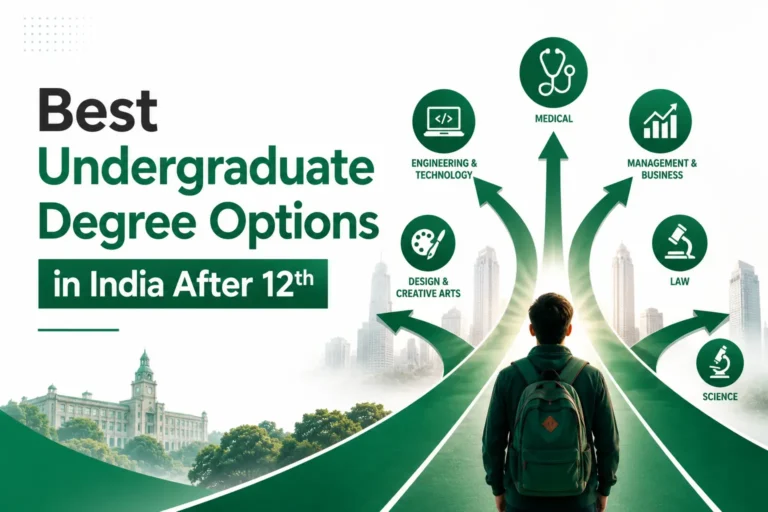
Finishing 12th grade is exciting, but it also brings one of the biggest decisions of your academic life: choosing the right undergraduate degree. With hundreds of courses, colleges, and career paths available in India, it is easy to feel overwhelmed. Should you go for a traditional B.A., B.Com, or B.Sc? Or is a professional course like B.Tech or BBA a better fit for your goals?
This blog breaks down everything you need to know about choosing an undergraduate degree in India, including the different types of courses, how your 12th stream affects your options, costs, eligibility, career scope, and common mistakes to avoid. By the end, you will have a clear roadmap to pick a path that matches your interests, budget, and future career plans.
What Is an Undergraduate Degree? (And Why It Still Matters)
An undergraduate degree is the first level of higher education a student pursues after completing 12th grade or its equivalent. In India, these programs typically last three to four years, depending on the field of study, and are offered by universities, colleges, and autonomous institutions across the country.
Despite the rise of skill based certifications and online learning, this qualification still matters for several reasons. Most government jobs, higher studies such as M.A., M.Sc., M.Tech, or MBA, and many private sector roles require at least a graduate level qualification as a minimum criterion. It also provides structured learning, exposure to faculty and peers, internships, and campus placements that are harder to access through informal learning alone.
In short, a college degree is not just a piece of paper. It is a foundation that shapes your career direction, opens doors to further education, and builds essential life skills.
How Your 12th Stream Affects Your Undergraduate Degree Choice
Your 12th stream (Science, Commerce, or Arts) plays a major role in determining which degree options are available to you, although it does not always limit you completely.
| 12th Stream | Common Course Options | Typical Career Direction |
|---|---|---|
| Science (PCM) | B.Tech, B.Sc (Physics/Chemistry/Mathematics), B.Arch, BCA | Engineering, Information Technology (IT), Architecture |
| Science (PCB) | MBBS, BDS, B.Sc (Biology/Biotechnology), B.Pharm, BAMS | Medicine, Healthcare, Life Sciences, Research |
| Commerce | B.Com, BBA, B.Com (Hons), BMS | Finance, Business Management, Accounting, Banking |
| Arts / Humanities | BA (English, History, Psychology, Political Science, etc.), BFA, BJMC | Civil Services, Media, Journalism, Design, Education, Social Sciences |
Types of Undergraduate Degrees Available in India
India offers a wide variety of options at the graduate level, broadly classified into the following categories:
| Degree Category | Examples | Best Suited For |
|---|---|---|
| General Degrees | B.A., B.Sc., B.Com | Students Seeking Flexibility and Broad Subject Exposure Across Multiple Disciplines |
| Professional Degrees | B.Tech, B.Arch, MBBS, B.Pharm, LLB | Students with Clear Career Goals Who Are Prepared for Competitive Entrance Examinations and Professional Training |
| Skill-Based Degrees | BBA, BCA, BMS, BJMC | Students Looking to Develop Industry-Relevant Skills and Improve Employability Early in Their Academic Journey |
| Honours Degrees | B.A. (Hons), B.Sc. (Hons), B.Com (Hons) | Students Interested in Deeper Specialisation, Advanced Coursework, and Stronger Preparation for Higher Studies or Research |
Best Undergraduate Degrees in India by Career Field
If you already have a career direction in mind, here are some of the best options aligned to popular fields in India.
| Career Field | Recommended Course | Average Course Duration |
|---|---|---|
| Engineering and Technology | B.Tech / B.E. | 4 Years |
| Medicine and Healthcare | MBBS, BDS, B.Pharm | 4 to 5.5 Years |
| Business and Management | BBA, B.Com (Hons), BMS | 3 Years |
| Law | BA LLB / BBA LLB (Integrated Programme) | 5 Years |
| Design and Architecture | B.Arch, B.Des | 4 to 5 Years |
| Media and Journalism | BJMC, BA in Mass Communication | 3 Years |
| Computer Applications | BCA | 3 Years |
| Civil Services Preparation | BA (Political Science, History, Economics, Public Administration, etc.) | 3 Years |
How to Choose the Right Undergraduate Degree Based on Your Interests
Choosing the right undergraduate degree is not just about job prospects. It is also about long term satisfaction with your daily work and learning. Here are a few practical ways to narrow down your choice:
- List subjects you genuinely enjoy, not just ones you are good at under exam pressure
- Talk to seniors or professionals already working in fields you are considering
- Try free online courses or short workshops in 2-3 potential fields before committing
- Consider your personality, since people oriented students often thrive in management or media degrees, while analytical students may prefer engineering or science based undergraduate degrees
- Think about flexibility, since some undergraduate degrees like B.A. or B.Com allow easier shifts into different postgraduate fields later
There is no universally best undergraduate degree, only the one that best matches your strengths, interests, and goals.
Undergraduate Degree vs Diploma: Which One Is Right for You?
Many 12th pass students also consider diploma courses as an alternative to a full undergraduate degree. Here is a quick comparison:
| Factor | Undergraduate Degree | Diploma |
|---|---|---|
| Duration | 3 to 4 Years | 1 to 3 Years |
| Recognition | Widely Recognised for Higher Studies and Government Jobs | Primarily Recognised for Specific Technical or Vocational Roles |
| Higher Studies | Eligible for Most Postgraduate Programmes | Limited Options Unless Followed by a Degree |
| Focus | Broader Academic and Theoretical Foundation | Practical, Job-Specific Skills |
| Best For | Students Seeking Long-Term Career Growth, Professional Careers, or Further Education | Students Seeking Faster Entry into the Workforce and Skill-Based Employment |
Government vs Private Colleges: Where to Pursue Your Undergraduate Degree
| Factor | Government Colleges | Private Colleges |
|---|---|---|
| Fees | Significantly Lower | Higher, Sometimes 5–10× More Expensive |
| Admission | Highly Competitive, Usually Merit- or Entrance-Based | Comparatively Easier, Though Top Private Institutions Remain Competitive |
| Infrastructure | Varies Widely; Top Institutions Offer Excellent Facilities | Often Modern, Well-Maintained Campuses and Facilities |
| Reputation | Strong for Established Institutions such as University of Delhi, Jawaharlal Nehru University, and Banaras Hindu University | Strong for Reputed Private Universities with Industry Partnerships and Global Collaborations |
| Scholarships | More Government Scholarship Schemes Available | Merit-Based and Need-Based Scholarships Vary by Institution |
Online vs Offline Undergraduate Degree: Which Suits You Better?
With UGC approved online undergraduate degree programs becoming more common in India, students now have more flexibility than before.
| Factor | Offline Mode | Online Mode |
|---|---|---|
| Campus Experience | Full Access to Laboratories, Libraries, Clubs, Events, Faculty Interaction, and Peer Networking | Limited or No Physical Interaction; Learning Takes Place Primarily Through Digital Platforms |
| Flexibility | Fixed Class Schedule with Regular Attendance Requirements | Highly Flexible; Suitable for Working Professionals and Students with Family or Other Commitments |
| Cost | Generally Higher Due to Campus Infrastructure, Facilities, and Related Expenses | Usually More Affordable with Lower Ancillary Costs |
| Best For | Students Seeking a Traditional College Experience and In-Person Learning Environment | Students Balancing Work, Family Responsibilities, or Other Commitments While Pursuing Higher Educati |
Undergraduate Degree Eligibility Criteria You Should Know
While exact eligibility varies by college and course, most undergraduate degree programs in India share these common requirements:
- Successful completion of 12th grade from a recognised board
- Minimum aggregate marks, often 45-60%, varying by college and course
- Specific subject requirements, such as PCM for B.Tech or PCB for MBBS
- Entrance exam scores for professional undergraduate degrees, such as JEE for engineering, NEET for medical courses, or CLAT for law
- Age limits for certain professional courses like medicine
Always check the official prospectus of your target college, since eligibility criteria can change from year to year.
Undergraduate Degree Cost in India: What to Expect
Undergraduate degree costs in India vary enormously depending on the type of course and institution.
| Type of Institution | Approximate Annual Fees |
|---|---|
| Government Colleges (General Degree Programmes) | Rs. 5,000 – Rs. 25,000 |
| Government Colleges (Professional Degree Programmes) | Rs. 50,000 – Rs. 1,50,000 |
| Private Colleges (General Degree Programmes) | Rs. 30,000 – Rs. 1,00,000 |
| Private Colleges (Professional Degree Programmes) | Rs. 1,50,000 – Rs. 10,00,000+ |
Duration and Structure of Undergraduate Programs in India
Most undergraduate degree programs in India follow a semester based structure, typically split as follows:
- General Degrees (B.A., B.Sc., B.Com): 3 years, 6 semesters
- Professional Degrees (B.Tech, B.Arch): 4-5 years, 8-10 semesters
- Medical Degrees (MBBS, BDS): 4.5-5.5 years including internship
- Law Degrees (Integrated): 5 years, 10 semesters
Under the National Education Policy, many universities are also introducing a 4 year undergraduate degree with multiple exit options, allowing students to receive a certificate, diploma, or full degree depending on how many years they complete.
Top Skills Employers Look for After an Undergraduate Degree
Completing an undergraduate degree is only part of the equation. Employers in India increasingly value the following skills alongside your degree:
- Communication and presentation skills
- Basic digital literacy and familiarity with relevant software
- Problem solving and analytical thinking
- Internship or practical project experience
- Adaptability and willingness to learn new tools
Building these skills during your undergraduate degree, through internships, projects, or extracurricular activities, can significantly improve your employability after graduation.
Scope and Career Growth After Completing an Undergraduate Degree
An undergraduate degree opens multiple pathways depending on your field:
- Direct Employment: Many B.Tech, BBA, BCA, and B.Com graduates enter the workforce directly through campus placements
- Higher Studies: M.A., M.Sc., M.Tech, MBA, or specialised master’s programs in India or abroad
- Competitive Exams: UPSC, banking exams, SSC, and state level government exams often require only an undergraduate degree as the base qualification
- Entrepreneurship: Many undergraduate degree holders, especially from BBA or B.Tech backgrounds, go on to start their own ventures
The career scope after an undergraduate degree largely depends on the field chosen, the skills developed alongside academics, and how proactively a student seeks internships and networking opportunities during college.
Common Mistakes Students Make While Choosing an Undergraduate Degree
- Choosing a degree based on peer pressure rather than personal interest
- Ignoring the importance of college reputation and focusing only on the course name
- Not researching career outcomes before committing to a professional undergraduate degree
- Overlooking financial planning, leading to stress later in the course
- Picking a stream mismatched undergraduate degree without checking eligibility properly
- Underestimating the value of internships and skill building during the degree
Avoiding these mistakes early can save years of dissatisfaction and help students make the most of their undergraduate degree.
FAQs About Undergraduate Degrees in India
- What is the minimum eligibility for an undergraduate degree in India?
Most undergraduate degree programs require successful completion of 12th grade with minimum aggregate marks set by the respective college or university. - Which is the best undergraduate degree after 12th Science?
It depends on your interest. B.Tech suits students interested in technology, while MBBS or B.Pharma suit those interested in healthcare and biology. - Can a Commerce student switch to an Arts undergraduate degree?
Yes, most Arts undergraduate degree programs accept students from Commerce or Science streams, although some specialised Arts courses may have specific requirements. - Is an online undergraduate degree valid for government jobs in India?
Yes, as long as the online undergraduate degree is from a UGC approved institution, it holds the same validity as a regular degree for most government job applications. - How long does an undergraduate degree take in India?
Most general undergraduate degrees take three years, while professional degrees like B.Tech, B.Arch, or MBBS take four to five and a half years.
Conclusion
Choosing the right undergraduate degree after 12th is a decision that shapes the next several years of your academic and professional life, but it does not have to be stressful. By understanding the different types of undergraduate degrees, evaluating your interests and stream, comparing costs and college options, and being aware of common mistakes, you can make a confident, well informed choice.
Take your time, research thoroughly, and choose an undergraduate degree that aligns with both your passion and your long term career goals. The right decision today can set the foundation for a fulfilling and successful career tomorrow.