
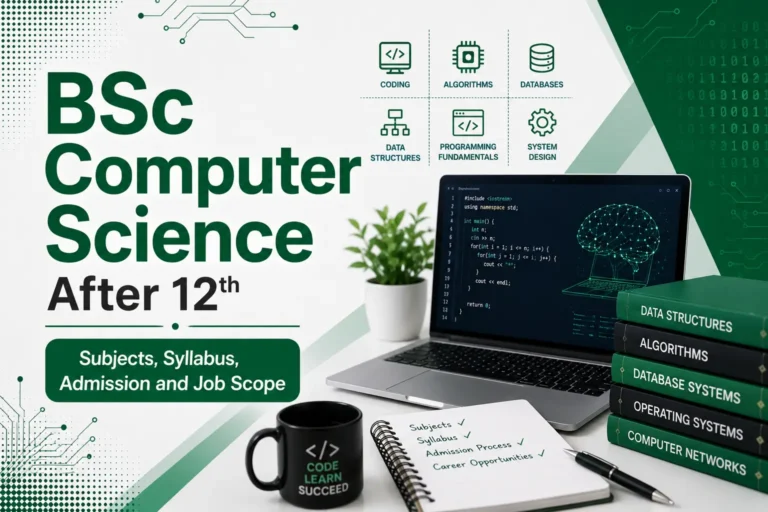
If you have just passed your 12th and are wondering whether BSc Computer Science is the right path for you, this guide covers everything you need to make a confident decision. From subjects and syllabus to admission, top colleges, and job scope, this article breaks it all down in simple language for Indian students.
If you are looking for a course that is affordable, career-oriented, and widely available across India, BSc Computer Science checks all those boxes. Whether you want to land a job at a top IT company, build your own startup, or pursue higher studies like MCA or MSc, this degree gives you a strong foundation to move in any of those directions.
What is BSc Computer Science?
BSc Computer Science is a three-year undergraduate degree that teaches you the fundamentals of computing, programming, and software development. It is one of the most popular science stream courses in India and is offered by hundreds of colleges and universities across the country.
The degree is spread across six semesters. Each semester builds on the previous one, starting from basic programming and mathematics in the first year and moving toward advanced topics like artificial intelligence, networking, and software engineering in the final year.
What makes this course a strong choice is its balance of theory and practical training. You learn through classroom sessions, lab work, mini projects, and a final year project that adds real value to your resume. Compared to BTech, BSc Computer Science is much more affordable, making it accessible for students from all backgrounds.
Eligibility Criteria for BSc Computer Science After 12th
The eligibility requirements for BSc Computer Science are simple and most science stream students qualify easily.
You must have passed Class 12 from a recognised board such as CBSE, ICSE, or any State Board. Most colleges require a minimum of 50 to 60 percent aggregate marks. Mathematics is a mandatory subject in 12th for most institutions. Some colleges accept Commerce or Arts students who studied Mathematics, but this varies by university. Students from reserved categories usually get a 5 percent relaxation in minimum marks at government colleges.
BSc Computer Science Admission Process in India
The admission process differs based on the type of college you are applying to. Here is how it works across different institutions in India.
Government and central universities admit students based on Class 12 merit or entrance exams. Private colleges often offer direct admission on the basis of 12th marks. Deemed universities typically have their own entrance test and interview rounds.
Key entrance exams to know:
CUET is the primary exam for central universities like Delhi University, BHU, and Hyderabad Central University. IPU CET is for colleges under Indraprastha University in Delhi. NPAT is conducted by NMIMS for undergraduate science programmes. Christ University and Symbiosis hold their own entrance tests and personal interviews.
Applications usually open between March and May. Admissions are completed by July or August. Keep your Class 12 marksheet, transfer certificate, and category certificate ready before the process begins.
BSc Computer Science Subjects
One of the most searched topics by students planning to take this course is the complete list of BSc Computer Science subjects. Knowing what you will study helps you understand whether this programme matches your interests and career goals.
The subjects cover a mix of core computer science, mathematics, and practical skills. Here is what you will study across the three years:
Programming in C and C++ forms the base in the first year and introduces you to the logic of writing code. Data Structures and Algorithms is one of the most critical subjects and is directly tested in job interviews at every major IT company. Database Management Systems teaches you how to store, manage, and retrieve data using SQL.
Computer Networks explains how devices communicate over the internet and private networks. Operating Systems covers how a computer manages memory, processes, and hardware resources. Software Engineering teaches you how to plan and build large software projects systematically.
Web Technologies introduces HTML, CSS, and JavaScript for building websites and web applications. Discrete Mathematics and Statistics build your logical thinking and problem-solving ability. Computer Organisation and Architecture explains how a computer works at the hardware level. Artificial Intelligence and Machine Learning are covered in the final year and are among the most relevant subjects for today’s job market.
BSc Computer Science Syllabus
The BSc Computer Science syllabus is divided into six semesters across three years. Here is a year-wise overview of the key topics covered.
| Year | Semester | Key Topics Covered |
|---|---|---|
| First Year | Sem 1 and Sem 2 | C Programming, Mathematics, Digital Electronics, Problem Solving Techniques |
| Second Year | Sem 3 and Sem 4 | Data Structures, DBMS, Java, Computer Networks, Operating Systems |
| Third Year | Sem 5 and Sem 6 | Software Engineering, AI and ML, Web Development, Project Work, Electives |
Top Colleges for BSc Computer Science in India
Choosing the right college plays a big role in your learning experience and placement opportunities. Here are some of the top colleges in India offering BSc Computer Science.
| College Name | Location | Type | Approximate Annual Fees |
|---|---|---|---|
| St. Stephen’s College | Delhi | Government Aided | Rs 20,000 to Rs 40,000 |
| Loyola College | Chennai | Private Aided | Rs 30,000 to Rs 60,000 |
| Christ University | Bangalore | Deemed | Rs 80,000 to Rs 1,20,000 |
| Fergusson College | Pune | Government Aided | Rs 15,000 to Rs 35,000 |
| Hansraj College | Delhi | Government Aided | Rs 20,000 to Rs 45,000 |
| Presidency College | Kolkata | Government | Rs 10,000 to Rs 25,000 |
| Symbiosis College of Arts and Commerce | Pune | Private | Rs 60,000 to Rs 90,000 |
BSc Computer Science Job Scope in India
The job scope after BSc Computer Science in India is strong, especially if you build practical skills alongside your degree. The Indian IT industry is one of the largest employers in the country and continues to hire fresh graduates across multiple roles.
Companies like TCS, Infosys, Wipro, HCL, and Tech Mahindra regularly recruit BSc Computer Science graduates for entry-level positions. Startups in Bangalore, Hyderabad, Pune, and Delhi NCR are also active recruiters of fresh tech graduates.
Here are the most common job roles and average starting salaries for BSc Computer Science graduates in India.
| Job Role | Industry | Average Starting Salary Per Year |
|---|---|---|
| Software Developer | IT and Software | Rs 3,00,000 to Rs 5,00,000 |
| Web Developer | IT and Digital | Rs 2,50,000 to Rs 4,50,000 |
| Data Analyst | IT and Analytics | Rs 3,50,000 to Rs 6,00,000 |
| System Administrator | IT Infrastructure | Rs 2,80,000 to Rs 4,00,000 |
| Junior Python Developer | Product and Services | Rs 3,00,000 to Rs 5,50,000 |
| Network Engineer | Telecom and IT | Rs 2,80,000 to Rs 4,50,000 |
| Technical Support Engineer | IT Services | Rs 2,50,000 to Rs 3,80,000 |
BSc Computer Science vs BCA vs BTech: Which One Should You Choose?
Many students are confused between these three popular courses. Here is a simple side-by-side comparison to help you decide.
| Factor | BSc Computer Science | BCA | BTech CSE |
|---|---|---|---|
| Duration | 3 Years | 3 Years | 4 Years |
| Stream Required | Science with Maths | Open in many colleges | Science with PCM |
| Average Annual Fees | Rs 20,000 to Rs 1,00,000 | Rs 30,000 to Rs 1,50,000 | Rs 80,000 to Rs 4,00,000 |
| Focus | Theory plus Practical | Application and Programming | Engineering and Core CS |
| Higher Studies Options | MCA, MSc, MBA | MCA, MBA | MTech, MBA, MS Abroad |
| Industry Recognition | Good | Good | Highest |
Higher Studies After BSc Computer Science
Completing BSc Computer Science does not have to be the end of your education. Higher studies can significantly boost your career growth and earning potential.
MCA is a two-year postgraduate programme now considered equivalent to MTech at many universities and is one of the most popular choices after BSc Computer Science. MSc Computer Science is ideal for students who want to go deeper into research or academic careers. MBA in IT or Systems suits those who want to move into management and leadership roles. Certifications in AWS, Google Cloud, Data Science, or Cybersecurity are also excellent options for quickly improving your market value without spending years in a full-time programme.
Many BSc Computer Science graduates also appear for government exams like SSC CGL, IBPS PO, and State PSC exams, as computer science graduates are eligible for a wide range of such opportunities.
Is BSc Computer Science Worth It in India?
Yes, BSc Computer Science is absolutely worth it in India, provided you choose the right college and invest time in building real skills during the three years.
The degree alone will not guarantee a high-paying job. But combined with strong programming skills, internships, personal projects, and relevant certifications, it opens up a wide range of career opportunities in one of the fastest-growing industries in the country.
The cost-to-value ratio of BSc Computer Science, especially from a government or reputed aided college, is one of the best among all undergraduate programmes available after 12th in India.
Final Thoughts
BSc Computer Science after 12th is a practical, affordable, and career-ready choice for students who have a genuine interest in technology. With a well-structured syllabus, multiple admission routes, and strong job scope in the Indian IT industry, this degree continues to be one of the most relevant undergraduate programmes for science stream students.
Focus on your fundamentals, build projects, complete internships, and keep learning beyond the classroom. That combination is what turns a BSc Computer Science degree into a genuinely rewarding and well-paying career.