
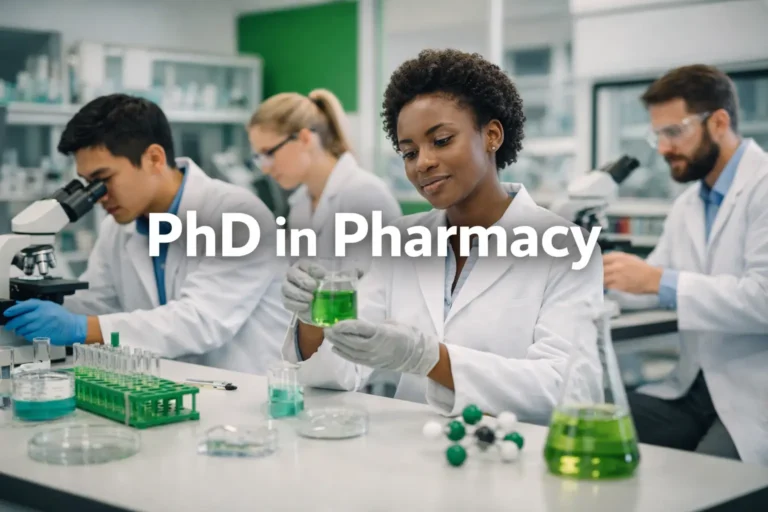
A PhD in Pharmacy is the highest academic qualification in pharmaceutical sciences, designed for students who want to specialize in research, drug development, clinical studies, or academic teaching. This degree focuses on generating new knowledge in areas such as pharmacology, pharmaceutics, and medicinal chemistry.
Unlike a Doctor in Pharmacy program, which is primarily practice-based and prepares students for clinical roles, a PhD in Pharmacy emphasizes research, innovation, and scientific contribution. Students work closely with faculty mentors, conduct independent research, and often publish findings in peer-reviewed journals.
For international students, a PhD in Pharmacy offers opportunities to work on global healthcare challenges, access advanced laboratories, and build careers in academia, industry, or regulatory bodies.
Key Highlights
- A PhD in Pharmacy is a research-focused doctoral degree
- Duration typically ranges from 3 to 5 years depending on the country
- Requires a master’s degree in pharmacy or a related field in most cases
- Offers careers in research, academia, pharmaceuticals, and healthcare policy
- Available in countries like the USA, UK, Canada, Australia, and Europe
- Often includes funding options such as scholarships or stipends
What Is a PhD in Pharmacy?
A PhD in Pharmacy is a doctoral-level program that trains students to conduct advanced research in pharmaceutical sciences. It involves coursework, laboratory research, and a dissertation based on original findings.
Students in this program explore topics such as drug formulation, pharmacokinetics, clinical trials, and pharmaceutical policy. The goal is to contribute new insights that can improve patient care, drug safety, and healthcare systems.
A Doctor in Pharmacy degree, often referred to as PharmD, is a professional doctorate focused on clinical practice. In contrast, a PhD prepares students for roles that involve research and teaching rather than direct patient care.
PhD in Pharmacy vs Doctor in Pharmacy
Understanding the difference between these two degrees is essential for choosing the right academic path.
| Feature | PhD in Pharmacy | Doctor in Pharmacy |
|---|---|---|
| Focus | Research and innovation | Clinical practice |
| Career Path | Academia, R&D, industry | Pharmacist, clinical roles |
| Duration | 3 to 5 years | 4 to 6 years |
| Entry Requirement | Master’s degree (varies) | High school or bachelor’s |
| Outcome | Dissertation and publications | Clinical training and licensing |
Why Study a PhD in Pharmacy?
Research Opportunities
Students gain access to advanced laboratories and work on real-world healthcare challenges such as drug resistance, vaccine development, and personalized medicine.
Global Career Prospects
Graduates can work in multinational pharmaceutical companies, universities, or government agencies.
Academic Advancement
A PhD is often required for teaching positions at universities and for leading independent research projects.
Contribution to Healthcare
Research conducted during a PhD can directly impact patient outcomes and public health policies.
Popular Specializations in PhD in Pharmacy
Students can choose from a wide range of specializations depending on their interests:
- Pharmacology
- Pharmaceutics
- Medicinal Chemistry
- Clinical Pharmacy
- Pharmaceutical Biotechnology
- Toxicology
- Pharmacokinetics
The availability of specializations may vary by university.
Eligibility Criteria for PhD in Pharmacy
Requirements vary by country and institution, but generally include:
- A master’s degree in pharmacy or a related field
- Strong academic record
- Research proposal
- English language proficiency test such as IELTS or TOEFL
- Letters of recommendation
- Statement of purpose
Some universities may also require an interview or entrance exam.
Admission Process for International Students
The application process typically involves:
- Selecting a research area and identifying potential supervisors
- Preparing academic documents and research proposal
- Submitting an online application
- Attending interviews if required
- Receiving an offer and applying for a student visa
Deadlines and procedures vary by university and country.
Top Countries Offering PhD in Pharmacy
USA
The USA is known for its research-intensive programs and funding opportunities.
Popular universities include:
- University of California system
- University of Michigan
- University of North Carolina
Programs often include full funding and teaching assistantships.
UK
The UK offers structured doctoral programs with shorter durations.
Popular universities include:
- University of Oxford
- University of Cambridge
- University College London
Research is often completed within a focused timeframe.
Canada
Canada provides high-quality education with research funding options.
Popular universities include:
- University of Toronto
- University of British Columbia
- McGill University
Students benefit from strong industry connections.
Australia
Australia is known for its research facilities and international student support.
Popular universities include:
- University of Sydney
- Monash University
- University of Melbourne
Programs often include scholarships for international students.
Europe
Many European countries offer affordable or tuition-free PhD programs.
Popular destinations include:
- Germany
- Netherlands
- Sweden
Programs may be research-based and conducted in English.
Cost of Studying PhD in Pharmacy
Costs vary widely depending on the country and university.
| Country | Tuition Fees | Funding Availability |
|---|---|---|
| USA | High | Widely available |
| UK | Moderate to high | Available |
| Canada | Moderate | Available |
| Australia | Moderate to high | Available |
| Europe | Low to moderate | Often funded |
Career Opportunities After PhD in Pharmacy
Graduates can pursue diverse roles across industries:
- Research Scientist
- University Professor
- Clinical Research Associate
- Regulatory Affairs Specialist
- Pharmaceutical Consultant
- Drug Safety Officer
Salary Expectations
Salaries vary by role, experience, and location.
| Job Role | Average Salary Range |
|---|---|
| Research Scientist | Moderate to high |
| Professor | Moderate |
| Industry Specialist | High |
| Regulatory Expert | Moderate to high |
Skills Developed During a PhD in Pharmacy
Students gain both technical and transferable skills:
- Advanced research and analytical skills
- Scientific writing and publishing
- Problem-solving and critical thinking
- Project management
- Communication and collaboration
How to Choose the Right University
Consider the following factors:
- Research facilities and labs
- Faculty expertise
- Funding opportunities
- Location and cost of living
- Industry connections
It is important to align your research interests with the university’s strengths.
Frequently Asked Questions
- Is a PhD in Pharmacy worth it?
A PhD in Pharmacy is valuable for students interested in research, academia, or leadership roles in the pharmaceutical industry. - Can I pursue a PhD in Pharmacy after a bachelor’s degree?
In some countries, this is possible, but most programs require a master’s degree. - What is the difference between PharmD and PhD in Pharmacy?
A Doctor in Pharmacy focuses on clinical practice, while a PhD focuses on research and academic work. - How long does it take to complete a PhD in Pharmacy?
The duration usually ranges from 3 to 5 years depending on the country and research progress. - Are PhD programs funded?
Many universities offer funding through scholarships, fellowships, or assistantships.
Conclusion
A PhD in Pharmacy is an advanced academic pathway for students who want to contribute to scientific discovery and improve global healthcare systems. It offers opportunities to specialize in cutting-edge research areas and work with leading experts in the field.
For international students, this degree opens doors to global careers, research funding, and academic excellence. Choosing between a PhD in Pharmacy and a Doctor in Pharmacy depends on your career goals, whether you aim to work in research or clinical practice.
By understanding the structure, requirements, and opportunities associated with this program, students can make informed decisions and plan a successful academic journey in pharmaceutical sciences.