
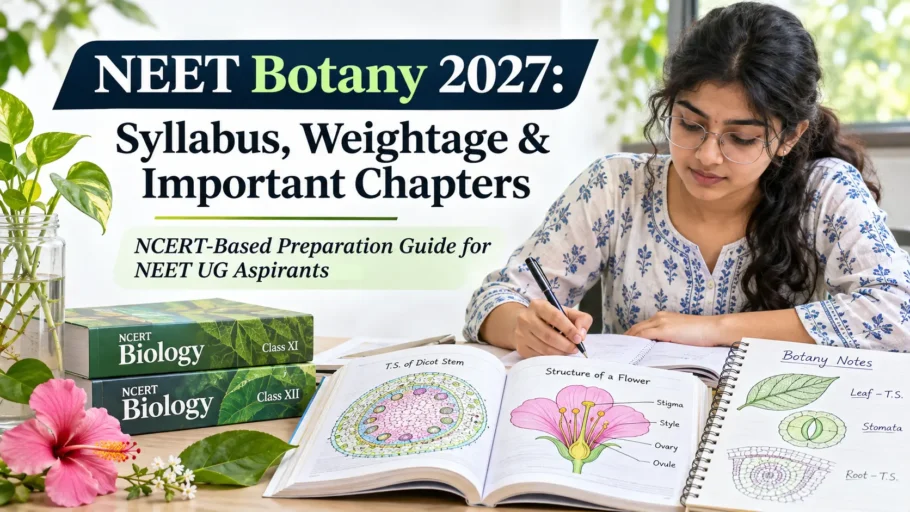
Introduction to NEET Botany 2027
Preparing for NEET UG 2027 requires a strong understanding of Biology, particularly the concepts covered in NEET Botany. From plant classification and physiology to genetics and reproduction, Botany covers several important topics that can significantly influence a student’s performance in India’s medical entrance examination.
The NEET Botany syllabus primarily draws from NCERT Class 11 and 12 Biology textbooks. Understanding the syllabus, identifying important chapters and analysing previous-year question trends can help aspirants organise their preparation effectively. However, students should focus on the complete prescribed syllabus rather than studying only frequently tested topics.
This comprehensive guide covers the NEET Botany 2027 syllabus, chapter-wise weightage, important topics, recommended books and preparation strategies. It is designed for Class 11 and 12 students, first-time NEET aspirants and repeat candidates preparing for medical admission in India.
What Is Botany in NEET UG?
NEET Botany refers to the plant-related and associated Biology topics covered in the National Eligibility cum Entrance Test (Undergraduate). These include plant diversity, morphology, anatomy, physiology, reproduction, genetics, biotechnology and ecology. General Biology chapters, particularly genetics and cell biology, are also commonly grouped under Botany in coaching materials.
Botany and Zoology are frequently treated as separate preparation categories. However, the official NEET examination assesses both within the Biology section. Students should therefore follow the complete Biology syllabus while using Botany-specific resources to organise their preparation.
NEET Botany Exam Pattern 2027
The following table presents the Biology examination pattern based on NEET UG 2026. The final NEET 2027 pattern should be verified when NTA releases its official information bulletin.
| Particulars | Details | Important Notes |
|---|---|---|
| Examination | NEET UG 2027 | National medical entrance examination |
| Subject | Biology | Includes Botany and Zoology |
| Biology questions | 90 | Based on NEET 2026 pattern |
| Biology marks | 360 | Half of the total examination marks |
| Question format | Multiple-choice questions | Single correct answer |
| Marking scheme | +4 correct, -1 incorrect | Subject to 2027 confirmation |
| Syllabus | NMC-prescribed syllabus | Covers Class 11 and 12 concepts |
NEET Botany Syllabus 2027: Complete Overview
The NEET Botany syllabus includes concepts introduced in Class 11 and developed further in Class 12. Class 11 establishes the foundation through plant classification, structural organisation, cell biology and plant physiology. Class 12 covers advanced topics, including reproduction, genetics, biotechnology and ecology.
Understanding how these chapters connect helps students build conceptual clarity and plan revision effectively. The following overview uses the officially published NEET UG 2026 syllabus as the preparation baseline. Aspirants should check the NMC and NTA websites for any changes applicable to NEET Botany 2027.
NEET Botany Class 11 Syllabus
Class 11 Botany establishes the foundation for understanding plant structures, biological functions and essential life processes. Students should pay particular attention to scientific terminology, classification systems, diagrams and relationships between biological concepts.
| Unit / Chapter | Important Topics | Preparation Focus |
|---|---|---|
| Diversity in Living World | Classification, taxonomy, plant kingdom | NCERT examples and characteristics |
| Structural Organisation | Morphology and anatomy of flowering plants | Diagrams and terminology |
| Cell Structure and Function | Cell organelles, biomolecules, cell division | Concepts and comparisons |
| Plant Physiology | Photosynthesis, respiration, plant growth | Processes and pathways |
NEET Botany Class 12 Syllabus
Class 12 introduces more detailed biological mechanisms. Genetics, molecular biology and biotechnology require students to understand processes, sequences and applications rather than memorising definitions alone.
| Unit / Chapter | Important Topics | Preparation Focus |
|---|---|---|
| Sexual Reproduction in Flowering Plants | Pollination, fertilisation, seed formation | Diagrams and processes |
| Principles of Inheritance and Variation | Mendelian laws, genetic crosses | Genetics problem-solving |
| Molecular Basis of Inheritance | DNA, RNA, replication, transcription | Molecular mechanisms |
| Biotechnology | Principles, techniques and applications | Processes and examples |
| Ecology | Populations, ecosystems, biodiversity | NCERT concepts and terminology |
NEET Botany Chapter-Wise Weightage 2027
Understanding NEET Botany chapter-wise weightage helps aspirants identify topics that have appeared frequently in previous examinations. Such analysis is useful for allocating revision time, selecting practice questions and identifying chapters that require additional attention.
However, the National Testing Agency does not prescribe fixed question counts for individual Botany chapters. Weightage estimates depend on the examination years analysed and how questions are classified. Therefore, previous-year figures should be treated as preparation indicators rather than guaranteed NEET 2027 question distributions.
NEET Botany Chapter-Wise Weightage Based on Previous Years
The following table presents selected findings from an independent analysis of NEET papers conducted between 2021 and 2025. Percentages refer to the analysis’s Botany grouping rather than the entire Biology paper.
| Botany Chapter | Average Questions Per Year | Estimated Weightage |
|---|---|---|
| Molecular Basis of Inheritance | 7 | 15% |
| Principles of Inheritance and Variation | 4 | 9% |
| Cell Cycle and Cell Division | 4 | 8% |
| Plant Kingdom | Approximately 3 | 7% |
| Sexual Reproduction in Flowering Plants | 3 | 6% |
| Cell: The Unit of Life | Approximately 3 | 6% |
| Plant Growth and Development | Approximately 3 | 6% |
These historical trends suggest that genetics, cell biology and plant reproduction deserve focused revision. Nevertheless, a balanced NEET Botany preparation strategy should cover every prescribed topic because the distribution of questions can change between examinations.
Most Important Chapters for NEET Botany 2027
Identifying the most important chapters for NEET Botany helps students prioritise topics during preparation and revision. Previous-year questions, conceptual importance, syllabus coverage and individual weaknesses should all influence study priorities.
Chapters involving molecular genetics, cell division, plant reproduction and plant physiology deserve careful attention. Many of these topics connect with other Biology concepts, making them useful for both direct and application-based questions.
High-Priority NEET Botany Chapters
| Chapter | Important Concepts | Preparation Priority |
|---|---|---|
| Molecular Basis of Inheritance | DNA replication, transcription, translation | High |
| Principles of Inheritance and Variation | Mendelian laws, genetic crosses | High |
| Cell Cycle and Cell Division | Mitosis, meiosis, cell cycle | High |
| Sexual Reproduction in Flowering Plants | Pollination, fertilisation | High |
| Plant Kingdom | Classification, plant groups | High |
| Photosynthesis in Higher Plants | Light reactions, Calvin cycle | High |
| Morphology of Flowering Plants | Floral structures, plant families | High |
A practical approach is to complete foundational topics first, practise high-priority chapters regularly and allocate additional time to weak areas. This ensures NEET Botany preparation remains comprehensive instead of depending entirely on historical weightage.
Easy, Moderate and Difficult Chapters in NEET Botany
The difficulty of NEET Botany chapters depends on a student’s conceptual understanding, familiarity with scientific terminology and ability to apply biological principles. Some topics appear straightforward because they involve definitions and descriptions, while others require an understanding of complex mechanisms.
Students should classify chapters according to their individual strengths rather than assuming that the same topics will be easy or difficult for everyone.
| Difficulty Level | Example Chapters | Recommended Approach |
|---|---|---|
| Relatively Easy | Selected ecology and classification topics | NCERT reading and regular revision |
| Moderate | Morphology and anatomy of flowering plants | Diagrams and MCQ practice |
| Challenging | Molecular biology and plant physiology | Concept-building and regular tests |
Regardless of difficulty, students should avoid skipping prescribed chapters. Completing easier topics efficiently can create additional preparation time for challenging NEET Botany concepts.
How to Prepare for NEET Botany 2027 Using NCERT
NCERT Biology textbooks provide an essential foundation for NEET Botany preparation. Their explanations, scientific terminology, examples and diagrams cover concepts relevant to the entrance examination.
A structured NCERT-based approach can help students strengthen fundamentals, understand interconnected topics and recognise mistakes during practice.
Read NCERT Biology Line by Line
Students should read each chapter carefully, paying attention to definitions, scientific names, examples and important statements. Rather than highlighting every paragraph, identify information that explains a concept or distinguishes similar biological structures.
After completing a chapter, revise its major points without immediately consulting the textbook. This encourages active recall and helps determine whether the concepts have been understood.
Focus on NCERT Diagrams and Tables
Diagrams are especially useful for understanding plant anatomy, reproduction and cell division. Students should practise identifying labelled structures, understanding their functions and connecting illustrations with accompanying explanations.
NCERT tables also contain important comparisons. Revising them regularly can improve accuracy in statement-based and concept-comparison questions.
Solve Previous-Year NEET Botany Questions
Previous-year questions help aspirants understand how Biology concepts have been tested. Students should solve questions chapter-wise after completing the corresponding NCERT content.
Incorrect answers should be reviewed carefully. Maintaining a record of confusing concepts, repeated mistakes and unfamiliar terminology can make subsequent NEET Botany revision more productive.
NEET Botany 2027 Preparation Strategy
An effective NEET Botany study plan should combine syllabus completion, regular revision, chapter-wise question practice and mock tests. Students should establish achievable daily targets instead of attempting to finish multiple difficult chapters without understanding them properly.
Preparation should also remain balanced with Physics, Chemistry and Zoology. Allocating a consistent study period to Botany can help maintain progress without neglecting other examination subjects.
Daily and Weekly NEET Botany Study Plan
| Day | Study Activity | Recommended Focus |
|---|---|---|
| Monday | Read an NCERT chapter | Build conceptual understanding |
| Tuesday | Revise diagrams and notes | Strengthen visual learning |
| Wednesday | Solve chapter-wise MCQs | Improve question-solving accuracy |
| Thursday | Study difficult concepts | Address weak areas |
| Friday | Practise previous-year questions | Understand examination trends |
| Saturday | Revise completed chapters | Improve long-term retention |
| Sunday | Attempt tests and analyse mistakes | Evaluate preparation progress |
Consistency matters more than studying for unusually long hours occasionally. A realistic routine that includes regular assessment is generally more sustainable.
Best Books for NEET Botany 2027 Preparation
Selecting appropriate books can make NEET Botany preparation more organised. NCERT Class 11 and 12 Biology textbooks should form the foundation, while additional resources can support question practice and revision.
Students should avoid collecting too many books covering identical topics. Completing a limited number of reliable resources thoroughly is usually more productive than switching between several materials.
| Book / Resource | Best For | Recommendation |
|---|---|---|
| NCERT Biology Class 11 | Foundational biological concepts | Essential |
| NCERT Biology Class 12 | Genetics, reproduction, biotechnology | Essential |
| NEET Biology Previous-Year Question Book | Understanding examination questions | Highly recommended |
| NCERT-Based Biology MCQ Book | Chapter-wise question practice | Supplementary |
How to Score High Marks in NEET Botany 2027
Scoring well in NEET Botany requires conceptual clarity, regular practice and careful revision. Students should focus on improving accuracy rather than attempting to memorise every detail without understanding its relevance.
A practical strategy involves strengthening NCERT fundamentals, identifying weak chapters and developing confidence through regular testing.
Focus on NCERT-Based Questions
Practise questions based on NCERT definitions, examples, diagrams and biological processes. Understanding the context of important statements can help students answer both straightforward and application-based questions.
Revise Important Chapters Regularly
Create a revision schedule that includes previously completed topics. Frequently revisiting genetics, cell biology, reproduction and plant physiology can reduce forgetting and improve conceptual retention.
Practise MCQs and Analyse Mistakes
Solve timed MCQ sets to develop accuracy and examination confidence. After each test, review incorrect answers and identify whether mistakes resulted from conceptual confusion, careless reading or insufficient revision.
Reducing repeated errors is an important part of improving overall Biology performance.
Common Mistakes to Avoid During NEET Botany Preparation
One common mistake in NEET Botany preparation is relying entirely on memorisation without understanding biological processes. This approach can make application-based questions more difficult, particularly in genetics, molecular biology and plant physiology.
Another mistake is ignoring NCERT diagrams, tables and examples. These elements explain important relationships and should be included in regular revision.
Students should also avoid studying from too many resources, postponing previous-year question practice and skipping mock-test analysis. Focusing exclusively on historically high-weightage chapters can leave important syllabus gaps.
A better approach is to complete the prescribed syllabus, maintain concise revision notes and consistently practise questions.
Frequently Asked Questions About NEET Botany 2027
1. Is NCERT enough for NEET Botany 2027?
NCERT Class 11 and 12 Biology textbooks provide an essential foundation for NEET Botany preparation. However, students should also practise previous-year questions, chapter-wise MCQs and mock tests to improve conceptual application, accuracy and examination readiness.
2. Which chapters are most important for NEET Botany?
Important NEET Botany chapters include Molecular Basis of Inheritance, Principles of Inheritance and Variation, Cell Cycle and Cell Division, Plant Kingdom and Sexual Reproduction in Flowering Plants. Students should also prepare the remaining prescribed chapters thoroughly.
3. Is NEET Botany easier than Zoology?
The relative difficulty of Botany and Zoology depends on individual strengths. Students comfortable with classification, diagrams and plant physiology may find Botany manageable, while others may prefer Zoology. Both require consistent preparation and NCERT-based revision.
4. How can I prepare for NEET Botany in 3 months?
Begin by identifying incomplete chapters and weak concepts. Create a realistic study schedule, revise NCERT daily and practise chapter-wise MCQs. During the final weeks, concentrate on previous-year questions, mock tests and frequently repeated mistakes.
5. How many questions come from Botany in NEET UG?
NEET UG 2026 included 90 Biology questions covering Botany and Zoology together. There was no officially fixed question distribution between these categories. Students preparing for NEET Botany 2027 should verify the latest examination pattern through NTA.
Conclusion
NEET Botany 2027 preparation becomes more manageable when students understand the syllabus, identify important chapters and follow a consistent revision strategy. NCERT Class 11 and 12 Biology textbooks should remain central to preparation, supported by previous-year questions and regular mock tests.
Although chapter-wise weightage can help students plan their studies, it should not replace complete syllabus coverage. Building conceptual clarity, practising diagrams and analysing mistakes are equally important.
With disciplined preparation, realistic study targets and regular revision, aspirants can strengthen their NEET Botany knowledge and approach NEET UG 2027 with greater confidence.