
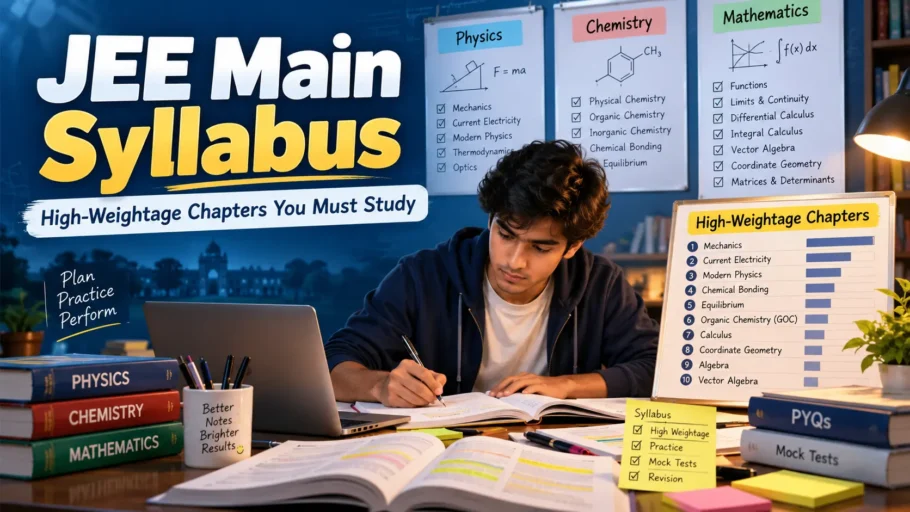
Preparing for JEE Main becomes much easier when you know exactly what needs to be studied and which chapters deserve more attention. The JEE Main syllabus covers Physics, Chemistry and Mathematics, with topics drawn largely from concepts studied in Classes 11 and 12. Instead of treating every chapter equally from the beginning, students can plan their preparation around the complete syllabus while giving additional time to chapters that have appeared frequently in previous papers.
This guide covers the subject-wise JEE syllabus, important chapters, high-weightage areas and a practical order in which students can prepare them. The high-weightage recommendations are based on recent JEE Main papers and previous-year trends. NTA does not officially assign a fixed chapter-wise weightage, so students should use these priorities for planning rather than skipping the remaining syllabus. Recent 2026 paper analysis and multi-year trends show recurring importance for areas such as Optics, Current Electricity, Modern Physics, Coordination Compounds, Chemical Bonding, Calculus, Coordinate Geometry, Vectors and 3D Geometry.
JEE Main Syllabus Overview
The JEE Main syllabus for Paper 1 is divided into Physics, Chemistry and Mathematics. A strong preparation plan should cover all three subjects because questions can come from any unit included in the official syllabus.
The current official syllabus is published by the National Testing Agency on the JEE Main website. Students preparing for an upcoming attempt should always compare their study plan with the latest official syllabus when NTA releases it.
| Subject | Main Areas Covered | Preparation Focus |
|---|---|---|
| Physics | Mechanics, Electricity, Magnetism, Optics, Thermodynamics, Modern Physics | Concepts, formulas and numerical practice |
| Chemistry | Physical, Organic and Inorganic Chemistry | NCERT concepts, reactions, formulas and application |
| Mathematics | Algebra, Calculus, Coordinate Geometry, Trigonometry, Vectors and 3D | Problem solving, formulas and repeated practice |
JEE Main Physics Syllabus
The Physics portion of the JEE Main syllabus includes topics from mechanics, heat and thermodynamics, electricity and magnetism, optics, modern physics and experimental skills. Physics can become highly scoring when students understand the core concepts and practise enough numerical questions.
A useful way to organise the Physics JEE syllabus is to separate the topics broadly according to the concepts normally studied in Classes 11 and 12.
| Level | Major Physics Topics | Main Skills Required |
|---|---|---|
| Class 11 Focus | Units and Measurements, Kinematics, Laws of Motion, Work Energy and Power, Rotational Motion, Gravitation, Properties of Solids and Liquids, Thermodynamics, Kinetic Theory, Oscillations and Waves | Concept building, diagrams, formulas and mechanics-based numericals |
| Class 12 Focus | Electrostatics, Current Electricity, Magnetism, Electromagnetic Induction, Alternating Current, Electromagnetic Waves, Optics, Dual Nature, Atoms and Nuclei, Electronic Devices | Formula application, circuits, optics, graphs and numerical solving |
| Across Both | Experimental Skills and measurement-based concepts | Observation, units, errors and practical understanding |
While working through the Physics JEE Main syllabus, solve chapter-wise previous-year questions immediately after completing each topic. This helps identify the type of questions repeatedly asked from the chapter.
High-Weightage Chapters in JEE Main Physics
Recent paper analysis shows that certain Physics chapters appear more frequently than others. In 2026 question distribution, Optics, Electrostatics, Current Electricity, Rotational Motion and Oscillations and Waves were among the recurring areas, while broader multi-year analysis also highlights Modern Physics and semiconductors as important topics.
Students should therefore give additional revision and PYQ practice to these parts of the JEE Main syllabus.
| Physics Chapter | Importance Based on Recent Trends | Study Priority |
|---|---|---|
| Modern Physics | Frequently repeated concepts | Must Study |
| Current Electricity | Regular numerical questions | Must Study |
| Electrostatics | Consistently important | Must Study |
| Ray Optics | Strong recent question presence | Must Study |
| Thermodynamics | Regular conceptual and numerical questions | High |
| Rotational Motion | Important part of Mechanics | High |
| Electronic Devices / Semiconductors | Often formula and concept based | High |
| Oscillations and Waves | Frequently represented | High |
| Laws of Motion | Foundation for Mechanics | High |
Electrostatics should include electric field, potential, capacitors and related numerical problems. For Ray Optics, students should revise mirrors, lenses, refraction and optical instruments.
Do not interpret this table as permission to remove other Physics chapters from your JEE syllabus preparation. High-weightage chapters should receive more revision time, but complete syllabus coverage remains the safer approach.
JEE Main Chemistry Syllabus
Chemistry in the JEE Main syllabus can be organised into Physical Chemistry, Organic Chemistry and Inorganic Chemistry. Studying these three parts separately makes revision much easier because each requires a different preparation method.
| Chemistry Area | Major Topics | Best Preparation Method |
|---|---|---|
| Physical Chemistry | Basic Concepts, Atomic Structure, Thermodynamics, Equilibrium, Redox and Electrochemistry, Solutions, Chemical Kinetics | Formula revision and numerical practice |
| Organic Chemistry | Basic Principles of Organic Chemistry, Hydrocarbons, Compounds Containing Halogens, Oxygen and Nitrogen, Biomolecules | Reaction mechanisms, conversions and NCERT revision |
| Inorganic Chemistry | Periodic Table, Chemical Bonding, p-Block, d- and f-Block, Coordination Compounds | NCERT-based revision, trends and factual recall |
For Inorganic Chemistry, repeated revision is especially important. Students covering the Chemistry JEE syllabus should keep NCERT close because many questions test standard concepts, reactions and factual details.
High-Weightage Chapters in JEE Main Chemistry
Recent question-paper analysis shows strong representation from Coordination Compounds, Chemical Thermodynamics, Equilibrium, Hydrocarbons, Redox and Electrochemistry, Chemical Bonding and fundamental Organic Chemistry. Coordination Compounds was particularly prominent in the 2026 chapter distribution, while multi-year analysis continues to highlight Chemical Bonding and General Organic Chemistry.
| Chemistry Chapter | Why It Matters | Study Priority |
|---|---|---|
| Chemical Bonding | Core Inorganic concepts and recurring questions | Must Study |
| Coordination Compounds | Strong recent paper presence | Must Study |
| Chemical Thermodynamics | Important Physical Chemistry topic | High |
| Equilibrium | Regular conceptual and numerical questions | High |
| Redox and Electrochemistry | Frequently tested calculations | High |
| Solutions | Formula-based and scoring with practice | High |
| General Organic Chemistry | Foundation for most Organic Chemistry | Must Study |
| Hydrocarbons | Important Organic Chemistry unit | High |
| Biomolecules | Often direct and revision-friendly | High |
| Periodic Table and p-Block | Important Inorganic concepts | High |
For Physical Chemistry, create a formula sheet and practise calculations chapter by chapter. For Organic Chemistry, build reaction maps instead of memorising isolated reactions. For Inorganic Chemistry, frequent short revisions are usually more effective than reading an entire chapter once and leaving it untouched for weeks.
JEE Main Mathematics Syllabus
Mathematics is often considered time-intensive because knowing a concept is not enough. Students need speed, accuracy and familiarity with different question patterns.
The Mathematics JEE Main syllabus can be divided into five broad areas.
| Mathematics Area | Major Chapters | Main Preparation Focus |
|---|---|---|
| Algebra | Complex Numbers, Quadratic Equations, Matrices, Determinants, Sequence and Series, Binomial Theorem, Permutations and Combinations, Probability | Formulas and repeated problem practice |
| Calculus | Limits, Continuity, Differentiability, Applications of Derivatives, Integral Calculus, Differential Equations | Concept clarity and extensive practice |
| Coordinate Geometry | Straight Lines, Circles and Conic Sections | Standard equations and problem solving |
| Trigonometry | Trigonometric Functions and Identities | Formula recall and transformations |
| Vectors and 3D Geometry | Vector Algebra and Three-Dimensional Geometry | Formula application and visual understanding |
High-Weightage Chapters in JEE Main Mathematics
Recent JEE Main papers have shown significant representation from Calculus, Coordinate Geometry, Matrices and Determinants, Vector Algebra, 3D Geometry, Sequence and Series, Probability and Complex Numbers. Analysis of 2026 papers found Calculus, Vector and 3D Geometry, and Algebra to be major contributors to the Mathematics paper.
| Mathematics Chapter | Importance Based on Trends | Study Priority |
|---|---|---|
| Calculus | One of the largest areas in Mathematics | Must Study |
| Matrices and Determinants | Frequently asked and relatively structured | Must Study |
| Coordinate Geometry | Strong question presence | Must Study |
| Vector Algebra | Important and often manageable with practice | High |
| 3D Geometry | Frequently paired with Vector concepts | High |
| Sequence and Series | Regular Algebra topic | High |
| Probability | Important scoring area with practice | High |
| Complex Numbers | Common Algebra chapter | High |
| Binomial Theorem | Repeated in previous papers | High |
Matrices, Determinants, Vectors and 3D Geometry can be useful chapters for students looking to build reliable scoring areas within the Mathematics JEE Main syllabus. Coordinate Geometry also deserves extensive PYQ practice because questions can come from straight lines, circles, parabola, ellipse and hyperbola.
Most Important JEE Main Chapters Overall
Students with limited preparation time often ask which chapters in the JEE Main syllabus deserve attention first. There is no guaranteed set of chapters from which questions must appear, but past-paper trends can help establish priorities.
| Subject | Chapters to Prioritize | Why Prioritize Them |
|---|---|---|
| Physics | Modern Physics, Current Electricity, Electrostatics, Optics, Rotational Motion | Strong recurring presence across recent papers |
| Chemistry | Chemical Bonding, Coordination Compounds, General Organic Chemistry, Thermodynamics, Equilibrium | Important foundation plus repeated questions |
| Mathematics | Calculus, Coordinate Geometry, Matrices and Determinants, Vectors, 3D Geometry | Major contributors in recent papers |
Recent trend analyses consistently identify Modern Physics, Current Electricity and Ray Optics in Physics, Coordination Compounds, Chemical Bonding and General Organic Chemistry in Chemistry, and Vectors, 3D Geometry, Matrices and Calculus in Mathematics as important recurring areas.
Students should use these chapters to decide where to spend additional revision time, not as a replacement for the full JEE syllabus.
Class 11 vs Class 12 Syllabus: What to Prioritize
Students should not approach the JEE Main syllabus by deciding that one class is important and the other can be ignored. Both Class 11 and Class 12 concepts contribute significantly to the exam, and many advanced topics depend on foundations developed earlier.
Class 11 Mechanics, Thermodynamics, Chemical Bonding, Equilibrium, Sequence and Series, Complex Numbers and basic Organic Chemistry can support later chapters. Class 12 brings important areas such as Current Electricity, Electrostatics, Optics, Coordination Compounds, Electrochemistry, Calculus, Vectors and 3D Geometry.
If you are weak in Class 11, do not restart every chapter from zero without prioritisation. First repair the foundational topics required for high-priority chapters, then expand coverage. Your JEE syllabus plan should ultimately include both classes, while allocating more time to chapters where your concepts or question-solving ability are weaker.
Which JEE Main Chapters Should You Study First?
If you have limited time, your study order matters almost as much as the number of hours you study. Start with chapters that combine strong question trends with a reasonable chance of becoming accurate scoring areas.
A practical order for the JEE Main syllabus is:
- Complete high-priority chapters that you already understand reasonably well. These can produce faster score improvement because you mainly need revision and PYQ practice.
- Move to important chapters that form the foundation for other topics. Chemical Bonding, General Organic Chemistry, basic Calculus concepts and core Mechanics fall into this category.
- Complete medium-priority chapters where the learning time is manageable. These can help increase syllabus coverage without consuming an excessive amount of preparation time.
- Work on difficult chapters strategically. If a chapter requires a large amount of time and your basics are extremely weak, strengthen higher-return chapters first and return to it later.
- Do not permanently skip low-priority topics. Once the major part of the JEE syllabus is under control, use shorter revision sessions to increase overall coverage.
How to Prepare the JEE Main Syllabus Efficiently
A good preparation strategy should convert syllabus coverage into actual question-solving ability. Simply marking chapters as completed does not mean they are exam-ready.
- Use NCERT properly for Chemistry – For the Chemistry portion of the JEE Main syllabus, NCERT should be a major part of preparation, particularly for Inorganic Chemistry and many direct conceptual areas. Read carefully, revise important statements and connect them with PYQs.
- Solve PYQs chapter-wise – After completing a chapter, solve previous-year JEE Main questions from that topic. This shows which concepts are repeatedly tested and whether you can apply what you studied. Recent NTA question papers are also available through the official JEE Main site. JEE Main
- Revise formulas every day – Physics, Physical Chemistry and Mathematics contain a large number of formulas. Maintain separate short formula sheets and revise them regularly. Formula revision becomes especially valuable once most of the JEE syllabus has been covered.
- Take mock tests after major syllabus coverage – Do not wait for perfect preparation before starting tests. Once you have completed a meaningful portion of the JEE Main syllabus, begin sectional tests and gradually move to full-length mocks.
After each test, classify mistakes into concept errors, calculation errors, forgotten formulas, wrong question selection and time-management problems. - Track weak chapters – Create a simple three-level tracker: strong, needs revision and weak. Update it after PYQs and mock tests. A chapter you have read but cannot solve questions from should not be marked completed.
This approach makes JEE syllabus preparation measurable rather than based only on the number of study hours.
JEE Main Syllabus Checklist
Use this checklist while preparing to make sure syllabus completion includes revision and practice, not just reading.
| Checklist Item | Target | Status |
|---|---|---|
| Physics syllabus completed | All planned chapters studied and practised | ☐ |
| Chemistry NCERT revised | Important chapters revised multiple times | ☐ |
| Mathematics high-weightage chapters completed | Concepts plus PYQs completed | ☐ |
| Chapter-wise previous-year questions solved | Physics, Chemistry and Mathematics | ☐ |
| Formula sheets prepared | Physics, Physical Chemistry and Maths | ☐ |
| Weak chapters identified | Based on tests and PYQs | ☐ |
| Weak chapters revised | Concepts corrected and retested | ☐ |
| Sectional tests attempted | Subject-wise practice completed | ☐ |
| Full mock tests attempted | Exam-level practice started | ☐ |
| Final JEE Main syllabus revision completed | Entire prepared syllabus revised | ☐ |
FAQs
- Which chapters have the highest weightage in JEE Main?
There is no official fixed chapter-wise weightage announced by NTA. However, previous-paper analysis shows recurring importance for chapters such as Optics, Current Electricity, Electrostatics and Modern Physics in Physics; Coordination Compounds, Chemical Bonding, General Organic Chemistry and Thermodynamics in Chemistry; and Calculus, Coordinate Geometry, Matrices, Vectors and 3D Geometry in Mathematics. Students should use these trends to prioritise the JEE Main syllabus without ignoring the remaining chapters. - Is the JEE Main syllabus the same as NCERT?
The JEE Main syllabus has substantial overlap with concepts studied in Classes 11 and 12, but students should always follow the official NTA syllabus rather than assuming every NCERT topic is automatically included or excluded. NCERT is particularly useful for Chemistry, while Physics and Mathematics usually require significant additional numerical and problem-solving practice. - Is Class 11 or Class 12 more important for JEE Main?
Both are important. The JEE syllabus includes major concepts associated with both Class 11 and Class 12. Class 11 provides important foundations such as Mechanics, Thermodynamics, Chemical Bonding and basic Algebra, while Class 12 contains several major areas including Electrostatics, Current Electricity, Optics, Coordination Chemistry, Calculus, Vectors and 3D Geometry. - Can I skip low-weightage chapters in JEE Main?
Skipping chapters completely is risky because NTA does not guarantee a fixed chapter-wise distribution. Students who have limited time can prioritise high-weightage chapters first, but they should gradually increase coverage of the complete JEE Main syllabus. Even a chapter that had fewer questions in previous years can appear more prominently in another attempt. - Is NCERT enough for JEE Main Chemistry?
NCERT is extremely important for Chemistry and should form a strong base for preparation, especially for Inorganic Chemistry and many conceptual questions. However, completing the Chemistry JEE Main syllabus effectively also requires previous-year questions, numerical practice for Physical Chemistry and reaction-based practice for Organic Chemistry. - Which Maths chapters are most important for JEE Main?
Calculus, Coordinate Geometry, Matrices and Determinants, Vector Algebra, 3D Geometry, Sequence and Series, Probability and Complex Numbers are among the areas students should prioritise. Recent JEE Main paper analysis showed substantial contribution from Calculus, Algebra, Coordinate Geometry and Vector and 3D topics.
Students should still work toward completing the broader Mathematics JEE syllabus, since question distribution can change across sessions and years. - Which Physics chapters are easiest to score from in JEE Main?
There is no single set of chapters that will be easiest for every student. However, many aspirants find chapters such as Modern Physics, Electronic Devices, Current Electricity and selected Optics topics manageable once their formulas and concepts are clear. Recent trend analysis also shows repeated questions from several of these areas.
For better results, students should combine these scoring opportunities with consistent preparation across the complete Physics JEE Main syllabus.