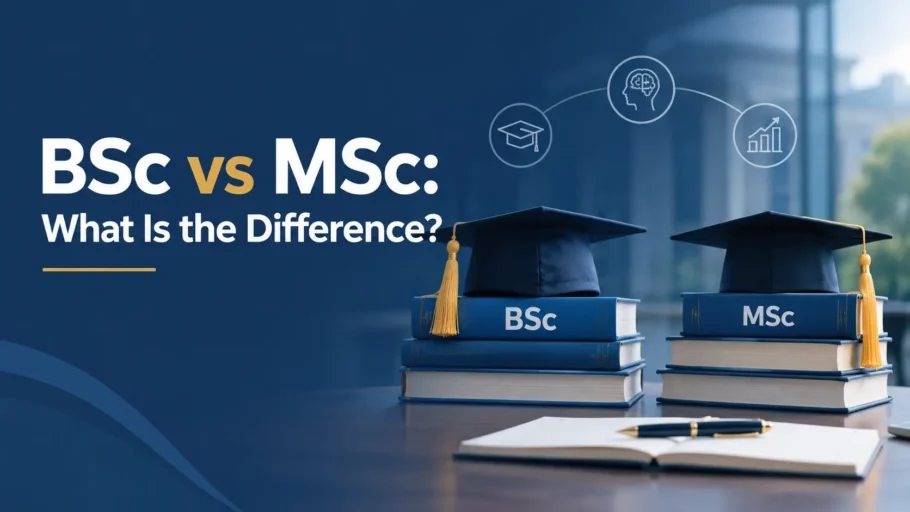
Choosing the right science degree can influence your academic journey, career direction, and opportunities for further study. Two qualifications that students commonly compare are BSc and MSc. Although both are science-related degrees, they represent different stages of higher education and have different academic purposes.
BSc stands for Bachelor of Science, while MSc stands for Master of Science. A BSc is generally an undergraduate qualification that students pursue after completing secondary education. An MSc is generally a postgraduate qualification that students pursue after completing a bachelor’s degree.
The difference between these degrees goes beyond their names. They can differ in admission requirements, course content, duration, specialization, research opportunities, costs, and career pathways. The way these degrees are structured can also vary from one country and university to another.
This guide explains the major differences between a BSc and MSc and explores what students should consider when choosing a science program, whether they plan to study locally or internationally.
What Is a BSc Degree?
A BSc degree, or Bachelor of Science degree, is an undergraduate qualification that provides students with foundational knowledge in science, technology, mathematics, and related disciplines.
Students generally begin a BSc after completing secondary education or an equivalent qualification. Depending on the university and country, students may choose a broad science program or specialize in a particular subject.
Common BSc subjects include:
- Computer Science
- Biology
- Chemistry
- Physics
- Mathematics
- Environmental Science
- Biotechnology
- Information Technology
- Statistics
- Data Science
The curriculum of a BSc usually combines theoretical learning with practical education. Depending on the subject, students may attend lectures, laboratory sessions, tutorials, workshops, fieldwork, and practical training.
For example, a BSc in chemistry may involve extensive laboratory work, while a BSc in computer science may emphasize programming, software development, algorithms, and databases.
The duration of a BSc depends on the country’s higher education system and the university. Many full-time programs take three to four years, although some programs can have different durations.
Who Can Apply for a BSc?
Students generally need to complete secondary education or an equivalent qualification before applying for a BSc. Universities can establish their own academic requirements, including minimum grades and prerequisite subjects.
For example, a physics program may require mathematics and physics, while a biotechnology program may require biology or chemistry. Computer science programs may require mathematics, computing, or related subjects depending on the curriculum.
International students may also need to provide proof of language proficiency if the program is taught in a language that is not their first language.
Because admission criteria vary, students should check the requirements of individual universities before applying.
What Is an MSc Degree?
An MSc, or Master of Science, is a postgraduate qualification that provides advanced and specialized knowledge in a scientific, technical, mathematical, or interdisciplinary field.
Students generally pursue an MSc after completing a bachelor’s degree. The undergraduate degree may need to be relevant to the intended area of postgraduate study.
For example, a graduate with a BSc in computer science might pursue an MSc in artificial intelligence, data science, cybersecurity, software engineering, or another related discipline.
Popular MSc specializations include:
- Computer Science
- Data Science
- Artificial Intelligence
- Biotechnology
- Environmental Science
- Chemistry
- Physics
- Mathematics
- Statistics
- Information Technology
An MSc can involve advanced coursework, laboratory work, seminars, technical projects, internships, and research. Depending on the program, students may complete a dissertation, thesis, capstone project, or independent research project.
An MSc commonly takes one to two years of full-time study, although the duration varies between countries, universities, and study formats.
Who Can Apply for an MSc?
Applicants generally need a bachelor’s degree or an equivalent qualification. Some MSc programs accept students from several related academic backgrounds, while others require a specific undergraduate subject.
For example, an MSc in data science may require previous coursework in mathematics, statistics, computer science, engineering, or another quantitative field.
Universities may also request academic transcripts, recommendation letters, a statement of purpose, a CV, proof of language proficiency, or relevant professional experience.
Students should review the specific admission requirements for each MSc program because completing a bachelor’s degree does not necessarily make an applicant eligible for every postgraduate specialization.
BSc vs MSc: Key Differences at a Glance
The main distinction between a BSc and MSc is their position in the higher education system. A BSc is generally an undergraduate qualification, while an MSc is generally a postgraduate qualification.
| Factor | BSc | MSc |
|---|---|---|
| Degree level | Undergraduate | Postgraduate |
| Full form | Bachelor of Science | Master of Science |
| Typical entry | Secondary education | Bachelor’s degree |
| Typical duration | 3 to 4 years | 1 to 2 years |
| Study focus | Foundational and broad knowledge | Advanced and specialized knowledge |
| Research | Varies by program | Often more research-focused |
| Typical career stage | Graduate and entry-level roles | Specialist and advanced roles |
A student may complete a BSc and then enter the workforce, continue into an MSc, or pursue another form of postgraduate education. Similarly, an MSc graduate may continue toward doctoral study or move into a specialized professional role.
BSc vs MSc: Difference in Course Content
Course content is one of the most important differences between these two degrees.
A BSc generally focuses on establishing a strong foundation in a particular discipline. Students may study several related topics before developing a deeper interest in a specific area.
For example, a BSc in biology might include genetics, ecology, microbiology, cell biology, biochemistry, and evolutionary biology. A BSc in computer science could include programming, algorithms, databases, operating systems, networks, and software development.
An MSc generally moves toward advanced and specialized study. Students are more likely to focus on a particular area of their discipline and explore complex theories, applications, techniques, and current developments.
Practical learning can be important in both degrees. However, postgraduate students may work with more advanced laboratory techniques, analytical tools, research methods, or professional technologies.
Research is also often more prominent at MSc level. Depending on the university, students may complete a research dissertation, thesis, capstone project, or independent study.
In simple terms, a BSc can establish the foundation, while an MSc can help students develop deeper specialization.
BSc vs MSc: Admission Requirements
Admission requirements depend on the country, university, subject, and program.
For a BSc, applicants generally need to have completed secondary education or an equivalent qualification. Universities may specify minimum grades and particular prerequisite subjects.
For an MSc, applicants generally need a bachelor’s degree or an equivalent qualification. Some universities may specify a minimum grade or require previous study in a related field.
Academic Requirements
Subject prerequisites can be particularly important for specialized science programs.
A university may require mathematics for certain physics, computer science, engineering, or data-related programs. Similarly, biology or chemistry may be required for some life science and biotechnology degrees.
For MSc admission, universities may examine the applicant’s undergraduate coursework to determine whether they have the necessary academic foundation.
English-Language Requirements
International students applying to English-taught programs may need to demonstrate English-language proficiency.
Universities can accept different language tests and establish their own minimum requirements. Some students may be exempt based on their previous education or other qualifying circumstances.
Entrance Exams and Additional Requirements
Certain institutions or programs may require entrance examinations, interviews, portfolios, personal statements, recommendations, or other documents.
There is no single global admission system for either BSc or MSc programs. Requirements should therefore be checked directly with the university.
BSc vs MSc: Duration and Study Format
The duration of a BSc and MSc can vary considerably between countries.
A BSc commonly takes three to four years of full-time study. However, some programs may include foundation periods, placements, internships, or other components that affect the total duration.
An MSc commonly takes one to two years of full-time study. Part-time programs can take longer because students complete their coursework over a longer period.
Students may find both BSc and MSc programs in several formats.
| Study Format | BSc | MSc |
|---|---|---|
| Full-time | Widely available | Widely available |
| Part-time | Available at selected institutions | Common at selected institutions |
| Online | Available in many subjects | Available in many subjects |
| Hybrid | Available | Available |
| Research-based | Available in selected programs | Common in research-oriented programs |
| Industry placement | Available in selected programs | Available in selected programs |
However, practical science programs may require access to laboratories, field facilities, specialist equipment, or in-person instruction. Students should therefore examine the delivery method carefully before enrolling.
Popular BSc and MSc Specializations
Science and technology encompass many disciplines, giving students a broad range of options at both undergraduate and postgraduate levels.
The exact specializations available depend on the university and country.
| Specialization | Common BSc Focus | Common MSc Focus |
|---|---|---|
| Computer Science | Programming, algorithms, databases, software development | AI, cybersecurity, machine learning, advanced computing |
| Biology | Genetics, ecology, microbiology, cell biology | Molecular biology, genetics, biotechnology, research |
| Chemistry | Organic, inorganic, analytical and physical chemistry | Advanced chemistry, materials science, analytical research |
| Physics | Mechanics, electromagnetism, thermodynamics, quantum physics | Astrophysics, materials science, theoretical or applied physics |
| Mathematics | Calculus, algebra, probability, statistics | Applied mathematics, mathematical modeling, advanced statistics |
| Data Science | Statistics, programming, data analysis | Machine learning, predictive analytics, advanced data analysis |
| Environmental Science | Ecology, climate, conservation, natural resources | Climate science, environmental management, sustainability |
| Biotechnology | Biology, biochemistry, genetics, laboratory techniques | Molecular biotechnology, bioinformatics, pharmaceutical biotechnology |
| Information Technology | Networking, databases, IT systems, software | Cybersecurity, cloud computing, information systems |
BSc and MSc Specializations by Career Area
Students can also compare specializations according to the type of work they may want to pursue. A degree specialization does not guarantee a specific career, but it can help students develop relevant academic knowledge and technical skills.
| Career Area | Relevant BSc Subjects | Relevant MSc Subjects |
|---|---|---|
| Technology | Computer Science, Information Technology | AI, Data Science, Cybersecurity |
| Scientific Research | Biology, Chemistry, Physics | Molecular Biology, Chemistry, Physics |
| Data and Analytics | Mathematics, Statistics, Data Science | Data Science, Statistics, Applied Mathematics |
| Environment | Environmental Science, Biology | Environmental Management, Climate Science |
| Biotechnology | Biotechnology, Biology, Biochemistry | Biotechnology, Bioinformatics, Molecular Biology |
| Software and Computing | Computer Science, IT | Software Engineering, Computer Science, AI |
| Laboratory Science | Chemistry, Biology, Biotechnology | Analytical Chemistry, Molecular Science, Biotechnology |
How to Choose a BSc or MSc Specialization
The choice of specialization depends on academic interests, previous education, career plans, and the requirements of the target university or profession.
For a BSc, students may prefer a broader subject that allows them to explore different areas before deciding on further specialization.
At MSc level, students generally have an opportunity to focus more closely on a specific field.
For example, a student could follow a pathway such as:
BSc in Computer Science → MSc in Data Science → Data and Analytics Career
Another possible pathway is:
BSc in Biology → MSc in Biotechnology → Research or Biotechnology Career
These are examples rather than fixed pathways. Universities can have different admission requirements and available specializations.
BSc vs MSc: Tuition Fees and Study Costs
The cost of studying for a BSc or MSc varies significantly across countries and institutions.
Tuition fees can depend on the university, subject, program length, location, and whether the student is classified as a domestic or international student.
Students should consider the total cost rather than tuition alone. Other expenses may include:
- Accommodation
- Food
- Transportation
- Health insurance
- Books and study materials
- Student fees
- Laboratory expenses
- Visa-related expenses
- Travel
Public universities can have different fee structures from private universities, and international students may pay different rates from domestic students.
An MSc may have higher annual tuition at some institutions, but its shorter duration can affect the total cost of study.
Factors That Affect BSc and MSc Costs
| Cost Factor | BSc | MSc |
|---|---|---|
| Tuition | Depends on country, university and subject | Depends on university and specialization |
| Program length | Often 3 to 4 years | Often 1 to 2 years |
| Accommodation | Depends on study destination | Depends on study destination |
| Learning materials | Textbooks, software and equipment | Specialized materials and research resources |
| Laboratory costs | May apply to science programs | May apply, particularly in research programs |
| Scholarships | University and external options | University, external and research funding |
| Living expenses | Food, housing, transport and insurance | Food, housing, transport and insurance |
Scholarships and Financial Aid
Scholarships can help reduce the cost of higher education. Funding opportunities may come from universities, governments, nonprofit organizations, research institutions, or external organizations.
MSc students may also find funding linked to research projects or academic departments, particularly in research-intensive subjects.
Students should check eligibility conditions carefully because scholarships can differ in terms of academic requirements, nationality, subject, financial need, and application deadlines.
BSc vs MSc: Career Opportunities
Career opportunities after a BSc or MSc depend on the subject studied, location, employer, professional experience, and additional skills or qualifications.
Career Opportunities After a BSc
A BSc can prepare graduates for entry-level and graduate roles across science, technology, research support, business, environmental services, and other industries.
Depending on their specialization, graduates may pursue roles related to:
- Laboratory work
- Data analysis
- Software development
- Technical services
- Environmental monitoring
- Quality control
- Research assistance
- Information technology
Some regulated professions may require additional qualifications, certifications, or professional registration.
A BSc can also provide a foundation for postgraduate study. Graduates may progress into an MSc or another relevant postgraduate qualification.
Career Opportunities After an MSc
An MSc can provide advanced knowledge that may be relevant to specialist and technical positions.
Depending on the specialization, graduates may work in areas such as:
- Data science
- Scientific research
- Artificial intelligence
- Biotechnology
- Environmental analysis
- Advanced computing
- Laboratory science
- Quantitative analysis
An MSc can also support students interested in research or further academic study. Some graduates may eventually pursue a PhD.
However, an MSc does not automatically result in a specific job or salary. Employment outcomes depend on factors such as field of study, work experience, location, employer requirements, and individual skills.
Can You Study an MSc After a BSc?
Yes, the BSc to MSc pathway is common across many higher education systems.
A student may complete a relevant BSc and then apply for an MSc in the same subject or a closely related discipline.
For example:
BSc in Mathematics → MSc in Data Science
BSc in Biology → MSc in Biotechnology
BSc in Computer Science → MSc in Artificial Intelligence
However, universities establish their own admission requirements. Some MSc programs accept applicants from multiple academic backgrounds, while others require specific undergraduate subjects.
Before applying, students should check:
- Required bachelor’s qualification
- Minimum academic grades
- Prerequisite subjects
- Language requirements
- Work experience requirements, if applicable
- Required application documents
- Entrance examinations or interviews
- Application deadlines
In some cases, students can move from one discipline into a related MSc. For example, a mathematics graduate may be eligible for selected data science programs. However, eligibility depends on the curriculum and requirements of the individual university.
BSc vs MSc for International Students
International students have additional factors to consider when comparing BSc and MSc programs.
The structure of higher education differs between countries. A bachelor’s degree may take three years in one country and four years in another, while master’s programs can vary from one to two years or more.
Students should understand how their previous qualifications compare with the requirements of their intended university.
BSc vs MSc Considerations for International Students
| Factor | BSc Considerations | MSc Considerations |
|---|---|---|
| Entry qualification | Secondary education or equivalent | Bachelor’s degree or equivalent |
| Language | Proof of language proficiency may apply | Proof of language proficiency may apply |
| Recognition | Important for international admission | Important for postgraduate admission |
| Duration | Often 3 to 4 years | Often 1 to 2 years |
| Visa | Depends on destination country | Depends on destination country |
| Credit transfer | May apply between institutions | Previous academic qualifications are assessed |
| Costs | Tuition and living expenses | Tuition and living expenses |
| Scholarships | University and external funding | University, external and research funding |
Recognition and Accreditation
Recognition and accreditation are particularly important when studying abroad.
Students should determine whether the university and program are appropriately recognized in the country where they intend to study or work.
This can be especially important for regulated professions, further academic study, and international employment.
Language Requirements
International students may need to demonstrate proficiency in the language used for teaching.
English-taught programs may require an accepted English-language proficiency test, although exemptions can apply in certain circumstances.
Qualification Equivalency
Students moving between education systems may need to have their qualifications evaluated.
Qualification equivalency can help universities determine whether an applicant’s previous education meets their admission requirements.
Credit systems can also differ internationally, so students transferring between institutions should ask how previous coursework will be evaluated.
BSc and MSc Degree Rankings: What Should Students Look For?
University rankings can provide useful information when comparing higher education institutions, but students should understand what different ranking systems actually measure.
Overall university rankings can consider factors such as academic reputation, research activity, citations, international engagement, faculty indicators, or other measures.
Subject-specific rankings can be particularly useful for students comparing science programs. A university’s overall position does not necessarily represent the quality or suitability of every individual BSc or MSc program.
When researching degree rankings, students can consider the following factors:
| Ranking or Selection Factor | Why It Matters | What Students Can Check |
|---|---|---|
| Overall university ranking | Provides a broad institutional comparison | Ranking methodology and indicators |
| Subject ranking | Focuses on a specific academic discipline | Performance in the intended subject |
| Research reputation | Relevant for research-oriented study | Publications, research centers and faculty |
| Graduate outcomes | Provides information about post-study pathways | Employment or further-study data |
| Accreditation | Supports recognition of the program | Relevant accreditation bodies |
| Faculty | Can influence teaching and research opportunities | Faculty expertise and qualifications |
| Facilities | Important for practical science education | Laboratories, libraries and technical facilities |
| International reputation | Relevant for globally mobile students | International partnerships and student support |
| Cost | Helps evaluate overall affordability | Tuition, living costs and available funding |
Rankings should therefore be considered alongside other factors.
For example, students should compare curriculum, teaching format, specialization, research opportunities, costs, location, and admission requirements rather than selecting a program based only on its position in a ranking table.
BSc vs MSc: Which Degree Comes First?
In the typical academic pathway, a BSc comes before an MSc.
A simplified pathway is:
Secondary Education → BSc → MSc → PhD, Research or Professional Career
A BSc generally provides undergraduate-level education and can prepare students for employment or postgraduate study.
After completing a relevant bachelor’s degree, students may apply for an MSc to develop advanced knowledge or specialize in a particular area.
Not every student needs to follow the same pathway. Some graduates begin working after a BSc, while others continue directly into postgraduate education. Professionals may also return to education later to complete an MSc.
Frequently Asked Questions About BSc and MSc
- Is BSc higher than MSc?
No. They are qualifications at different academic levels. A BSc is generally an undergraduate degree, while an MSc is generally a postgraduate degree. - Can I do MSc after BSc?
Yes. A BSc is a common pathway to an MSc. However, the BSc subject and other admission requirements may need to match the requirements of the intended MSc program. - How many years is a BSc?
A BSc commonly takes three to four years of full-time study, although the duration varies by country, institution, and program. - How many years is an MSc?
An MSc commonly takes one to two years of full-time study. Part-time study can take longer. - Is MSc harder than BSc?
An MSc generally involves more advanced and specialized material than an undergraduate degree. However, the academic demands depend on the subject, institution, program structure, and individual student. - Can I study MSc without BSc?
Many MSc programs require a relevant bachelor’s degree. However, admission policies differ, and some universities may recognize alternative qualifications or backgrounds for selected programs. - Which subjects are available in BSc and MSc?
Common subjects include computer science, biology, chemistry, physics, mathematics, environmental science, biotechnology, data science, statistics, and information technology. The exact options depend on the university. - Are BSc and MSc degrees recognized internationally?
Recognition depends on the university, program, accreditation, country, and purpose for which the qualification is being evaluated. Students should verify recognition requirements before enrolling. - What can I do after an MSc?
An MSc can support specialist employment, research opportunities, professional development, or further academic study. Career options depend on the subject, experience, location, and employer requirements.
BSc vs MSc: Which Degree Is Right for You?
The choice between a BSc and MSc depends largely on your current academic level and future plans.
A BSc is generally the appropriate starting point for students seeking an undergraduate science qualification after secondary education. It can provide foundational knowledge and practical skills while creating opportunities for employment or further education.
An MSc is generally designed for students who already have a bachelor’s qualification and want to develop more advanced or specialized knowledge.
Before selecting a program, consider:
- Your current academic qualification
- Your preferred subject
- Your long-term career interests
- Your interest in research
- Desired specialization
- Program duration
- Tuition and living costs
- Scholarship opportunities
- Study destination
- Online or on-campus format
- Accreditation and recognition
- University facilities
- Admission requirements
International students should also consider visa requirements, language requirements, qualification recognition, accommodation, and the overall cost of living in their chosen destination.
There is no single pathway that suits every student. The most appropriate option depends on your academic background and the qualifications required for your intended career or further study.
Conclusion: Understanding the Difference Between BSc and MSc
The key difference between a BSc and MSc is their level and purpose within higher education.
A Bachelor of Science degree is generally an undergraduate qualification that develops foundational knowledge and skills in a science or technology-related field. A Master of Science degree is generally a postgraduate qualification that provides more advanced and specialized education.
A BSc commonly takes three to four years, while an MSc often takes one to two years, although program structures vary around the world. Both degrees can include theoretical study, practical learning, projects, and research.
For students comparing programs internationally, factors such as admission requirements, accreditation, degree recognition, tuition fees, living costs, curriculum, specialization, career opportunities, and university rankings should all be considered.
A typical academic pathway is secondary education to BSc to MSc, followed by employment, research, or further academic study. However, students can take different routes depending on their qualifications and goals.
Understanding the differences between a BSc and MSc allows students to evaluate programs more effectively and choose an academic pathway that aligns with their education, interests, budget, and future plans.