
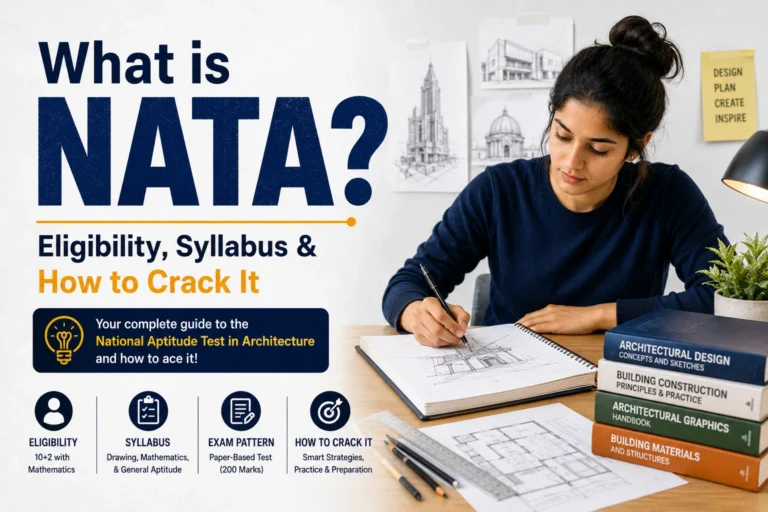
If you are dreaming of a career in architecture in India, NATA is likely the first major hurdle standing between you and a B.Arch seat. Every year, lakhs of students appear for this exam, yet many still enter the process without a clear idea of what it actually tests or how to prepare for it. This guide breaks down everything you need to know about NATA, from eligibility and syllabus to a practical, month-by-month preparation plan. Whether you are just starting to research the exam or are already deep into your prep, this article will help you understand exactly what NATA expects from you and how to meet that expectation with confidence.
What is NATA?
NATA stands for the National Aptitude Test in Architecture. It is one of the most important entrance exams for students who want to pursue a Bachelor of Architecture, or B.Arch, degree in India. Unlike many other entrance tests that focus purely on theoretical knowledge, NATA is designed to measure a candidate’s natural aptitude for architecture, including drawing skills, visual perception, spatial reasoning, and logical thinking.
NATA Full Form and Conducting Body Explained
The full form of NATA is the National Aptitude Test in Architecture. It is conducted by the Council of Architecture, commonly known as COA, which is the statutory body responsible for regulating architecture education in India. The Council of Architecture designs NATA specifically to assess whether a candidate has the cognitive and creative skills required for architectural studies. Because COA is a recognised regulatory authority, scores from NATA are accepted by hundreds of architecture colleges across the country.
Why NATA is Required for B.Arch Admission in India
Most architecture colleges in India, including many government and private institutions, require a valid NATA score for admission to their B.Arch programs. This is because architecture is a field that blends art, engineering, and design thinking, and a written exam alone cannot capture whether someone has the visual and spatial reasoning skills needed to succeed in this profession. NATA fills that gap by testing drawing ability, observation skills, and logical reasoning together, giving colleges a more complete picture of a candidate’s potential. In fact, for many institutes, National Aptitude Test in Architecture is used alongside or instead of other entrance exams, making it a near mandatory step for anyone serious about studying architecture in India.
NATA Eligibility Criteria
Before you start preparing, it helps to confirm that you actually meet the basic requirements to appear for NATA. The eligibility criteria are fairly straightforward, but there are a few specific conditions worth knowing in detail.
Educational Qualification Required
To be eligible for NATA, a candidate must have passed the 10+2 examination, or an equivalent examination, from a recognised board. Students from any stream can apply, but there are subject specific conditions depending on when they completed their schooling, so it is worth double checking the exact requirement for your batch on the official National Aptitude Test in Architecture website.
Minimum Marks Needed in Class 12
Candidates generally need to have secured a minimum aggregate percentage in their 10+2 examination to be eligible for NATA. This requirement can vary slightly depending on the category a candidate belongs to, with relaxations often available for reserved categories as per government norms. It is a good practice to verify the exact percentage criteria each year, since minor changes are sometimes introduced by the Council of Architecture.
Age Limit (if any) and Other Conditions
Historically, NATA has not enforced a strict upper age limit for candidates, which makes it accessible to students from varied academic backgrounds, including those who may be applying a year or two after completing school. However, candidates should always confirm the latest conditions directly from the official NATA notification, since eligibility rules can be updated from one admission cycle to the next.
How Many Times Can You Attempt NATA
One of the more student friendly aspects of NATA is that it allows multiple attempts within the same academic year. This gives candidates a genuine opportunity to improve their scores if their first attempt does not go as planned. The exact number of permitted attempts has varied over recent years, so candidates should check the current year’s official guidelines, but the flexible, multi attempt structure remains a consistent feature of how National Aptitude Test in Architecture is designed.
Documents Required for NATA Registration
Having your documents ready before registration begins can save you from last minute stress. Here is a quick checklist of what you typically need.
| Document Type | Purpose | Format Usually Required |
|---|---|---|
| Class 10 and 12 Mark Sheets | Proof of educational qualification | Scanned copy in PDF or JPEG format |
| Passport-Size Photograph | Identity verification and use on the admit card | JPEG, according to prescribed size and dimension guidelines |
| Signature Scan | Application authentication | JPEG, according to prescribed size and dimension guidelines |
| Category Certificate | Proof of eligibility for reserved-category benefits | PDF, if applicable |
| Valid ID Proof | Identity verification at the examination centre | Aadhaar card, passport, or another accepted government-issued ID |
| Domicile Certificate | Proof of state residency for applicable state-quota seats | PDF, if applicable |
NATA Syllabus
The NATA syllabus is built around two broad skill sets, drawing and creative ability on one side, and mathematical and logical reasoning on the other. Understanding this split is key to structuring your preparation effectively.
Part A: Drawing and Composition Topics
This part of the syllabus focuses on your ability to visualise and represent objects, spaces, and scenes on paper. Common topics include object drawing, memory drawing, transformation of 2D shapes into 3D forms, perspective drawing, and composition using shapes and colours. Candidates are also tested on their sense of proportion, scale, and shading technique.
Part B: Mathematics, General Aptitude & Reasoning
This section evaluates a candidate’s mathematical foundation along with visual and logical reasoning. Topics typically include algebra, geometry, trigonometry, mensuration, and coordinate geometry from a mathematics standpoint, along with visual reasoning questions that test pattern recognition, spatial relationships, and general awareness of architecture and design.
Weightage of Each Section
| Section | Focus Area | Approximate Weightage |
|---|---|---|
| Part A: Drawing | Visualization, composition, and sketching | Around 40–50% |
| Part B: Mathematics | Algebra, geometry, and mensuration | Around 25–30% |
| Part B: General Aptitude & Reasoning | Visual reasoning, logical thinking, and general knowledge/awareness | Around 25–30% |
NATA Exam Pattern (Quick Overview)
While the syllabus tells you what to study, the exam pattern tells you how it will be tested. Here is a quick snapshot.
Exam Duration and Mode
NATA is generally conducted in two parts, combining an offline drawing test with a computer based objective test. The total duration typically runs close to three hours, split roughly in half between the drawing section and the objective section. In recent years, the exam format has moved toward a more digital, session based structure, so it is worth checking the current mode before your exam date.
Marking Scheme
The marking scheme awards points for correct answers in the objective section, while the drawing section is evaluated based on creativity, proportion, and technical execution rather than simple right or wrong scoring. There is no elaborate negative marking system for most sections, but candidates should always confirm the exact scoring rules mentioned in the official brochure for the year they are appearing.
Best Books and Resources to Prepare for NATA
Having the right study material makes a significant difference in how efficiently you prepare. Here are some resources that consistently help NATA aspirants.
- A Complete Self Study Guide for B.Arch Entrance Examinations by PK Mishra, useful for both drawing and aptitude sections
- NATA and B.Arch Study Materials by various coaching institutes, often bundled with sample papers
- Art of Freehand Sketching for NATA and JEE for improving drawing speed and accuracy
- NCERT Mathematics textbooks for Classes 11 and 12, especially for geometry and mensuration
- Official NATA sample papers and mock tests available on the Council of Architecture website
- Previous year question papers, which help you understand recurring themes in both parts of the exam
Combining book based learning with regular sketching practice tends to work far better than relying on theory alone.
How to Crack NATA: Preparation Strategy
Cracking NATA is less about last minute cramming and more about consistent, structured practice over several months. Here is how to approach it.
A Month-by-Month NATA Preparation Strategy
| Timeframe | Focus Area | Suggested Activity |
|---|---|---|
| Months 1–2 | Building Fundamentals | Strengthen mathematics basics and begin daily sketching practice. |
| Months 3–4 | Skill Development | Focus on perspective drawing, memory drawing, and reasoning-based questions. |
| Month 5 | Full-Length Practice | Start attempting complete mock tests under timed conditions. |
| Month 6 | Revision & Refinement | Review weak areas, revise important formulas, and improve drawing speed and accuracy. |
| Final 2 Weeks | Exam Readiness | Solve previous-year papers and prioritize time management and exam strategy. |
Tips to Improve Drawing and Visual Reasoning Skills for NATA
Improving your drawing ability for NATA takes regular, deliberate practice rather than occasional effort. Try sketching everyday objects from memory to strengthen observation skills, and practice converting 2D shapes into 3D forms to build spatial thinking. Working on shading and proportion daily, even for just twenty to thirty minutes, compounds significantly over a few months. For visual reasoning, practising pattern based puzzles and spatial rotation questions regularly helps sharpen the specific reasoning style that NATA tests.
Mock Tests and Previous Year Papers
Attempting full length mock tests under timed, exam like conditions is one of the most effective ways to prepare for NATA. It helps you understand pacing, identify weak sections, and build the mental stamina needed for the actual exam day. Previous year papers are equally valuable because they reveal recurring question patterns and give you a realistic sense of difficulty level across both parts of the exam.
Common Mistakes Students Make While Preparing for NATA
Many students focus heavily on mathematics while neglecting drawing practice, even though the drawing section carries substantial weightage in NATA. Others practice drawing without paying attention to proportion, shading, or composition, which are all separately evaluated. A common mistake is also skipping timed practice altogether and only studying concepts, which leaves candidates unprepared for the pressure of completing tasks within strict time limits on exam day.
How NATA Score Affects B.Arch Admission in India
Once you receive your NATA score, it becomes a key input in the counselling and admission process for B.Arch programs across India. Most colleges use your NATA score, sometimes combined with Class 12 marks, to prepare a merit list for seat allotment. Higher scores generally translate into a wider choice of colleges and better chances of securing a seat in your preferred institution.
During counselling, candidates typically fill in college and course preferences based on their rank, and seats are allotted through multiple rounds depending on availability and category based reservations. Because National Aptitude Test in Architecture plays such a central role in this process, understanding how your score converts into admission opportunities can help you set realistic target scores well before the exam.
List of Top Colleges in India Accepting NATA Scores
NATA scores are accepted by a wide range of institutions across India, spanning both government and private colleges. Here is a representative regional overview rather than a ranked list, since rankings can shift each year.
| Region | Government Institutions | Private Institutions |
|---|---|---|
| North India | School of Planning and Architecture, Delhi | Amity University, Noida |
| South India | Anna University, Chennai | Manipal Institute of Technology |
| West India | Sardar Vallabhbhai National Institute of Technology, Surat | MIT School of Architecture, Pune |
| East India | Indian Institute of Engineering Science and Technology, Shibpur | KIIT School of Architecture, Bhubaneswar |
| Central India | Maulana Azad National Institute of Technology, Bhopal | Vellore Institute of Technology campuses |
NATA vs JEE Main Paper 2 (Quick Comparison)
Students often confuse NATA with JEE Main Paper 2, since both are used for architecture related admissions in India. Here is how they differ.
| Parameter | NATA | JEE Main Paper 2 |
|---|---|---|
| Conducting Body | Council of Architecture (CoA) | National Testing Agency (NTA) |
| Primary Focus | Drawing, architectural aptitude, and reasoning | Mathematics, aptitude, and drawing |
| Accepted By | Most state and private architecture colleges and other participating institutions | IITs offering architecture and select central institutions, subject to current admission rules |
| Attempt Frequency | Multiple attempts may be allowed, subject to the current year’s rules | Usually conducted in specified sessions during the year |
Frequently Asked Questions (FAQs)
- Is NATA hard to crack?
NATA is challenging but very manageable with consistent practice. Since it tests aptitude rather than pure memorisation, students who practice drawing and reasoning regularly tend to find it approachable over time. - Can a student without a Maths background appear for NATA?
Eligibility requirements for NATA typically expect certain subject combinations at the 10+2 level, so students without a mathematics background should carefully check the official eligibility criteria before applying, as requirements can vary by admission cycle. - How many times can NATA be attempted?
NATA allows candidates to appear more than once within an academic year, giving them a chance to improve their score. The exact number of attempts should be confirmed from the latest official notification. - Is coaching necessary for NATA?
Coaching is not mandatory for NATA, and many students succeed through self study using books, official sample papers, and consistent sketching practice. However, structured coaching can help some students stay disciplined and get expert feedback on their drawing skills. - Does NATA score expire?
NATA scores are generally valid for the admission cycle of the year in which the exam is taken. If you plan to apply in a future year, you will likely need to appear for NATA again, so always confirm the validity period for the specific admission year you are targeting.
Conclusion
NATA is more than just another entrance exam. It is a genuine test of how well you can think, observe, and create as a future architect. By understanding the eligibility criteria, mastering the syllabus, and following a structured preparation strategy, you put yourself in a strong position to perform well. Start early, practice consistently, and treat every mock test and sketch as a step toward building the skills that will define your journey in architecture, both in National Aptitude Test in Architecture and well beyond it.