
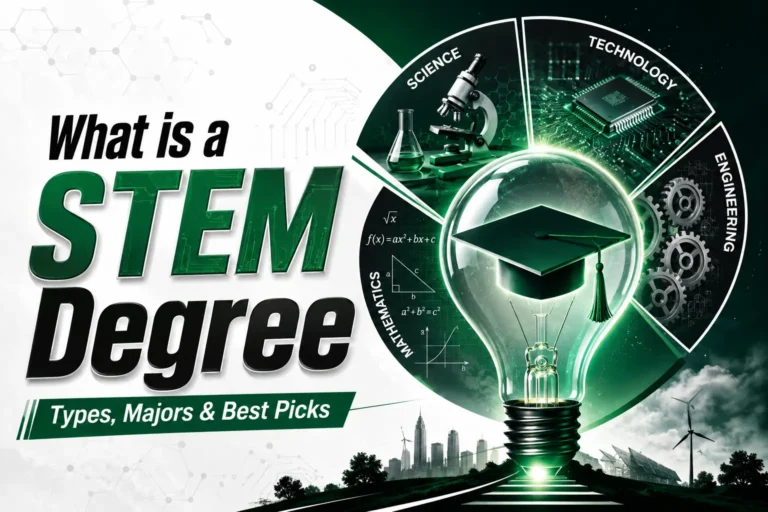
Every year, millions of students around the world face the same big question: which degree will actually lead somewhere? The answer, for a growing number of people, is a STEM degree. Whether you are fresh out of high school, considering a career change, or looking to upskill in a competitive job market, a STEM degree continues to be one of the most powerful academic choices you can make. According to the World Economic Forum, over 75% of the fastest-growing jobs globally require STEM-related skills. That number alone tells you everything about the direction the world is heading.
This blog breaks down what a STEM degree truly is, the different types available, the most popular majors, and the best STEM degrees worth pursuing for long-term career success anywhere in the world.
What Is a STEM Degree?
A STEM degree is an academic qualification earned in one of four core disciplines: Science, Technology, Engineering, or Mathematics. The term STEM was popularized to group these fields together because they share a common foundation of analytical thinking, problem-solving, and data-driven reasoning.
Unlike humanities or liberal arts degrees that focus on interpretation, culture, and communication, a STEM degree is largely rooted in logic, research, and technical application. It trains students to understand how the world works at a fundamental level and then apply that understanding to solve real problems, build systems, develop medicines, design infrastructure, and drive innovation.
A STEM degree can be earned at multiple academic levels, from a two-year associate degree to a doctoral program. It is offered at universities and colleges worldwide, and increasingly, through fully online platforms that make it accessible to students in every corner of the globe.
What makes a STEM degree stand out globally is its universality. Whether you study in Germany, Canada, India, Japan, or Brazil, the core principles of engineering or computer science remain the same. This makes STEM graduates among the most mobile and employable professionals in the world.
Types of STEM Degrees
Understanding the different types of STEM degrees helps you plan your academic journey more effectively. There are three main ways to categorize them.
By Education Level
Associate Degree in STEM
Typically a two-year program, this is a great entry point for students who want to enter the workforce quickly or use it as a stepping stone to a full bachelor’s degree. Common in fields like computer technology, environmental science, and applied mathematics.
Bachelor’s Degree in STEM
The most common STEM degree worldwide, usually completed in three to four years depending on the country. It provides deep foundational knowledge and opens doors to professional roles across all STEM industries.
Master’s Degree in STEM
A postgraduate qualification that deepens specialization. Ideal for those looking to move into advanced research, management roles, or highly technical positions. Typically takes one to two years after a bachelor’s degree.
PhD or Doctoral STEM Degree
The highest academic qualification in any STEM field. Best suited for those interested in research, academia, or leading innovation at the highest level. Duration varies widely, usually between three and six years.
By Study Mode
On-Campus STEM Degrees
The traditional format, offering hands-on lab experience, direct mentorship, and a structured learning environment. Best for fields like chemistry, biology, and engineering where physical lab work is essential.
Online STEM Degrees
Rapidly growing in popularity, online STEM degrees now offer the same academic rigor as on-campus programs. Ideal for working professionals or those in regions without access to top universities.
Hybrid STEM Programs
A blend of online coursework and in-person sessions. Increasingly common and flexible, making STEM education accessible to a broader global audience.
By Duration
| Study Type | Typical Duration |
|---|---|
| Associate Degree | 1.5 to 2 years |
| Bachelor’s Degree | 3 to 4 years |
| Master’s Degree | 1 to 2 years |
| PhD / Doctorate | 3 to 6 years |
| Online Accelerated Programs | 1 to 3 years |
The 4 Core Fields of a STEM Degree
Every STEM degree falls within one of these four pillars. Here is what each one covers.
Science
Science degrees explore the natural world through observation, experimentation, and theory. This includes disciplines like biology, chemistry, physics, neuroscience, and environmental science. Science graduates work in healthcare, pharmaceuticals, environmental protection, research institutions, and education systems worldwide.
Technology
Technology degrees focus on computing, digital systems, and information infrastructure. Programs include computer science, information technology, cybersecurity, artificial intelligence, and software engineering. This is one of the most in-demand STEM fields globally, with technology professionals needed across every single industry.
Engineering
Engineering degrees teach students how to design, build, and optimize systems and structures. Specializations include civil engineering, mechanical engineering, electrical engineering, chemical engineering, and aerospace engineering. Engineers are the backbone of global infrastructure, manufacturing, energy, and transportation.
Mathematics
Mathematics degrees develop advanced quantitative reasoning and analytical skills. This includes applied mathematics, statistics, actuarial science, and data analytics. Math graduates are highly valued in finance, insurance, technology, government, and academia around the world.
Most Popular STEM Majors Worldwide
With hundreds of STEM majors to choose from, it helps to know which ones are consistently in demand across global job markets. Here are the most popular STEM majors pursued by students worldwide.
| STEM Major | Core Focus Area | Industries It Feeds Into |
|---|---|---|
| Computer Science | Programming, algorithms, software | Tech, finance, healthcare, retail |
| Data Science and AI | Data analysis, machine learning | Every major industry globally |
| Mechanical Engineering | Design, manufacturing, mechanics | Automotive, aerospace, energy |
| Electrical Engineering | Circuits, power systems, electronics | Telecoms, energy, robotics |
| Biomedical Science | Biology meets medicine and tech | Healthcare, research, pharma |
| Environmental Science | Ecosystems, climate, sustainability | Government, NGOs, energy |
| Mathematics and Statistics | Quantitative analysis, modeling | Finance, insurance, tech |
| Cybersecurity | Digital protection, threat analysis | Government, banking, tech |
| Chemical Engineering | Chemical processes, materials | Oil and gas, pharma, food |
| Aerospace Engineering | Aircraft, spacecraft, propulsion | Defense, aviation, space |
Best STEM Specializations to Choose Within Your Degree
Picking a STEM degree is only the first decision. The second, and equally important one, is choosing the right specialization. A specialization is the focused area of study you pursue within your broader STEM degree. It shapes the specific jobs you qualify for, the salary you can command, and the industries that will be most relevant to your career. Here is a breakdown of the best specializations across the most popular STEM degree fields globally.
Computer Science Specializations
| Specialization | Best For | Career Outcome |
|---|---|---|
| Artificial Intelligence and Machine Learning | Building intelligent systems | AI Engineer, ML Researcher |
| Cybersecurity | Protecting digital infrastructure | Security Analyst, Ethical Hacker |
| Software Engineering | Building apps and platforms | Software Developer, Tech Lead |
| Cloud Computing | Managing large-scale digital infrastructure | Cloud Architect, DevOps Engineer |
| Data Science | Analyzing and interpreting large datasets | Data Scientist, Business Analyst |
| Human–Computer Interaction | Designing user-friendly digital experiences | UX Researcher, Product Designer |
Engineering Specializations
Engineering is another STEM degree field with a wide range of specializations, each feeding into very different industries.
| Specialization | Best For | Career Outcome |
|---|---|---|
| Renewable Energy Engineering | Designing clean energy systems | Energy Engineer, Sustainability Consultant |
| Robotics and Automation | Building intelligent machines | Robotics Engineer, Automation Specialist |
| Biomedical Engineering | Merging healthcare with technology | Medical Device Designer, Clinical Engineer |
| Structural Engineering | Designing buildings and infrastructure | Structural Engineer, Construction Manager |
| Aerospace Engineering | Aircraft and spacecraft design | Aerospace Engineer, Flight Systems Analyst |
| Environmental Engineering | Solving pollution and climate challenges | Environmental Consultant, Water Engineer |
Data Science and Mathematics Specializations
| Specialization | Best For | Career Outcome |
|---|---|---|
| Actuarial Science | Risk modeling for insurance and finance | Actuary, Risk Analyst |
| Bioinformatics | Applying data science to biological research | Bioinformatician, Genomics Researcher |
| Financial Mathematics | Quantitative modeling in banking and investment | Quant Analyst, Financial Modeler |
| Operations Research | Optimizing business and logistics processes | Operations Analyst, Supply Chain Strategist |
| Statistical Modeling | Forecasting and trend analysis | Statistician, Research Scientist |
Science Specializations
| Specialization | Best For | Career Outcome |
|---|---|---|
| Neuroscience | Studying the brain and nervous system | Neuroscientist, Clinical Researcher |
| Quantum Computing | Next-generation computing research | Quantum Engineer, Research Scientist |
| Genetic Engineering | Modifying biological systems at DNA level | Geneticist, Biotech Researcher |
| Climate Science | Understanding and modeling climate systems | Climate Scientist, Policy Advisor |
| Pharmaceutical Science | Drug discovery and development | Pharmacologist, Drug Development Scientist |
| AI Ethics | Studying the societal impact of artificial intelligence | AI Policy Researcher, Ethics Consultant |
Which Specialization Suits Which Career Goal?
Not sure which specialization to pick within your STEM degree? Use this simple matching framework based on what matters most to you.
| Your Priority | Best Specialization Direction |
|---|---|
| Highest salary potential | AI and Machine Learning, Cybersecurity, Cloud Computing, Quantitative Finance |
| Making a health impact | Biomedical Engineering, Neuroscience, Pharmaceutical Science, Bioinformatics |
| Solving climate challenges | Renewable Energy Engineering, Climate Science, Environmental Engineering |
| Working in cutting-edge research | Quantum Computing, Genetic Engineering, AI Ethics, Bioinformatics |
| Building products people use | Software Engineering, Human–Computer Interaction, Robotics |
| Working in finance and business | Actuarial Science, Financial Mathematics, Data Science, Operations Research |
| Government and policy roles | AI Ethics, Climate Science, Environmental Engineering, Statistics |
Best STEM Degrees to Pursue (High Pay and High Demand)
If you are choosing a STEM degree based on career outcomes, salary potential, and global job security, these are the fields that consistently rank at the top across international labor markets.
Computer Science
Computer science remains the most universally in-demand STEM degree on the planet. Software developers, system architects, and AI engineers are needed everywhere. The digital economy is not slowing down, and every business, from startups to multinationals, needs people who can build and manage technology. Average global salaries for computer science graduates range from $70,000 to $130,000 depending on role, experience, and country.
Data Science and Artificial Intelligence
This is arguably the fastest-growing STEM degree field right now. As organizations worldwide collect more data than ever before, professionals who can analyze, interpret, and apply it are in extraordinary demand. Data science and AI skills translate directly across industries including healthcare, finance, e-commerce, logistics, and government. Salaries in this field globally range from $80,000 to $140,000 for experienced professionals.
Electrical Engineering
Electrical engineering is one of the oldest and most versatile STEM degrees in the world. From power grids to consumer electronics to telecommunications infrastructure, electrical engineers keep the modern world running. As the global energy transition accelerates toward renewables, the demand for electrical engineers is increasing in both developed and developing nations.
Biomedical Engineering
Biomedical engineering sits at the intersection of healthcare and technology, designing medical devices, diagnostic tools, prosthetics, and imaging equipment. The global healthcare industry is growing rapidly due to aging populations and increased access to medical care in developing regions, making biomedical engineers highly sought after.
Cybersecurity
As digital systems become more central to global business and government, protecting them has become a top priority. Cybersecurity professionals are in critical shortage worldwide. This STEM degree field offers strong salary growth, high job stability, and the ability to work remotely or across borders easily.
Environmental Science and Engineering
With climate change at the top of the global agenda, environmental scientists and engineers are more important than ever. Whether it is designing clean energy systems, managing water resources, or advising governments on sustainability policy, this STEM degree field offers meaningful work with increasing global demand.
| STEM Degree | Avg. Global Salary Range | Global Demand Level |
|---|---|---|
| Computer Science | $70,000 to $130,000 | Extremely High |
| Data Science and AI | $80,000 to $140,000 | Extremely High |
| Electrical Engineering | $65,000 to $115,000 | Very High |
| Biomedical Engineering | $60,000 to $110,000 | High |
| Cybersecurity | $70,000 to $125,000 | Very High |
| Environmental Science | $50,000 to $90,000 | Growing Rapidly |
Who Should Pursue a STEM Degree?
One of the most common misconceptions about a STEM degree is that it is only for a certain type of person: mathematical prodigies, science obsessives, or tech wizards. That is simply not true.
A STEM degree is a great fit for anyone who:
- Enjoys solving problems and figuring out how things work.
- Is curious about the world and motivated by finding answers.
- Prefers structured thinking, logic, and evidence over guesswork.
- Wants a career that offers strong salary potential and global mobility.
- Is interested in making a tangible impact on society, health, the environment, or technology.
STEM degrees are pursued by people from all walks of life, across all genders, age groups, and cultural backgrounds. Many universities around the world actively work to make STEM education more inclusive and accessible. There are scholarships, grants, and support programs specifically designed for underrepresented groups in STEM.
Career changers, in particular, should not be discouraged. Many universities offer bridging programs, foundation years, and part-time STEM degree options that make it entirely possible to shift into STEM from a non-technical background at any stage of life.
How to Choose the Right STEM Degree
Choosing the right STEM degree is one of the most important decisions you will make. Here is a practical step-by-step approach that works regardless of where you are in the world.
- Step 1: Identify Your Interest Area
Start with what genuinely interests you, whether that is living systems (science), digital systems (technology), physical systems (engineering), or abstract systems (mathematics). Passion and curiosity are better long-term drivers than salary alone. - Step 2: Research Global Job Market Demand
Look at job posting trends in your target region and internationally. Fields like data science, cybersecurity, and software engineering show consistently high demand across all major global markets. - Step 3: Consider the Return on Investment
Weigh the cost of your STEM degree program against expected starting salaries in your chosen field. Many countries offer subsidized STEM education or loan forgiveness programs for in-demand fields. - Step 4: Decide Between Online and On-Campus
If you need flexibility due to work or family commitments, online STEM degree programs from accredited institutions are a strong option. If hands-on lab experience is central to your chosen field, on-campus is the better route. - Step 5: Look at University Rankings and Accreditation
For global career mobility, choose a STEM degree from an institution that is internationally accredited and recognized. QS World Rankings, Times Higher Education, and the Academic Ranking of World Universities are all reliable global references.
STEM Degree vs. Non-STEM Degree
Understanding the key differences between a STEM degree and a non-STEM degree helps you make a more informed decision based on your personal goals and priorities.
| Factor | STEM Degree | Non-STEM Degree |
|---|---|---|
| Average Starting Salary | Higher globally | Moderate |
| Job Market Availability | Very high demand | Varies by field |
| Career Growth Speed | Fast, especially in tech | Slower on average |
| Global Mobility | High across borders | Moderate |
| Skill Transferability | Strong across industries | Often field-specific |
| Difficulty of Study | Generally higher | Generally moderate |
| Creative Flexibility | Strong in design and research roles | High in arts and social fields |
Frequently Asked Questions
- What is the easiest STEM degree to get?
Relative ease depends on your personal strengths, but degrees in environmental science, mathematics with applied focus, and information technology are generally considered more accessible entry points into a STEM degree compared to fields like chemical engineering or theoretical physics. - Which STEM degree pays the most?
Globally, data science, artificial intelligence, computer science, and electrical engineering tend to offer the highest salary ceilings. However, pay also depends heavily on the country, industry, and level of experience. - Is a STEM degree worth it?
For the vast majority of students, yes. A STEM degree consistently delivers higher employability rates, stronger starting salaries, and greater career flexibility compared to most other academic paths. It is one of the strongest long-term investments in your professional future. - Can I do a STEM degree online?
Absolutely. Many globally recognized universities now offer fully accredited online STEM degree programs. Platforms like Coursera, edX, and direct university portals have made online STEM education a credible and respected path. - How long does a STEM degree take?
At the bachelor’s level, most STEM degrees take three to four years. Master’s programs typically take one to two years, and doctoral programs range from three to six years depending on the institution and research requirements. - Is a STEM degree hard?
STEM degrees are rigorous and require strong analytical and problem-solving skills. However, difficulty is highly subjective. With the right support, study strategies, and genuine interest in the subject, students from a wide range of backgrounds successfully complete STEM degree programs every year around the world.
Is a STEM Degree Worth It?
The short answer is yes, and the long answer is almost always yes too. A STEM degree is more than just a qualification. It is a ticket to one of the most dynamic, well-compensated, and globally recognized career paths available in today’s world. From building the artificial intelligence systems shaping the future, to designing renewable energy infrastructure, to protecting critical digital systems from cyber threats, STEM graduates are at the center of the changes that matter most.
The demand for STEM-skilled professionals is not limited to wealthy, high-tech nations. It is a global need, and a STEM degree earned from a credible institution opens doors across continents.
Whether you are at the very beginning of your academic journey or thinking about returning to education later in life, a STEM degree remains one of the smartest, most future-proof choices you can make. Take the time to explore the field that genuinely excites you, research your options, and take the first step. The world has more room for STEM graduates than it has ever had before.