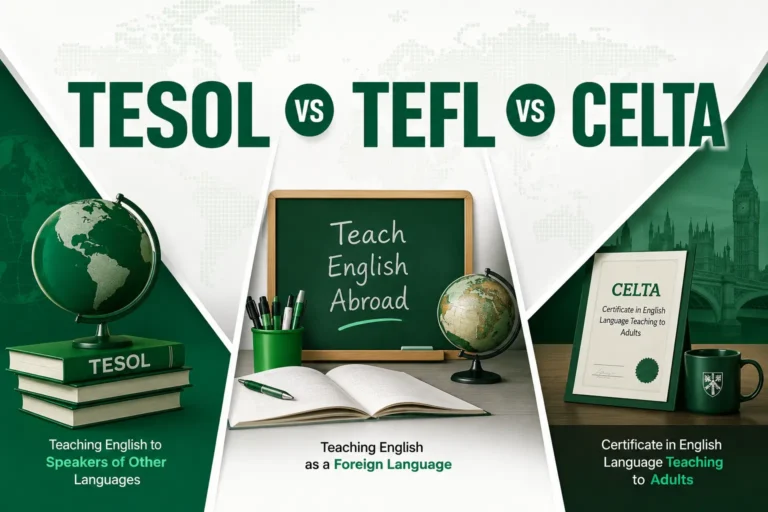
If you have been searching for an English teaching certification, you have probably come across three big names: TESOL, TEFL and CELTA. And if you are like most people, you have walked away more confused than when you started.
What is the actual difference between them? Which one do employers prefer? Does the certificate you choose really affect your salary? And is any of them genuinely worth the time and money?
These are fair questions, and they deserve straight answers.
Whether you are a fresh graduate exploring career options, a working professional looking for a meaningful change, or someone who wants to teach abroad for a year or two, the certification you choose can shape the entire direction of your teaching career. Thousands of aspiring teachers across the United States, United Kingdom, Australia, Canada and beyond ask this exact question every single month.
This article gives you a clear, honest breakdown of all three so you can make a decision that actually works for your goals, your budget and your future.
What Do TESOL, TEFL and CELTA Actually Mean?
Before comparing them, it helps to understand what each one stands for and why the differences between them matter far more than most people realise.
There are three main English teaching certifications you will come across in your research. TESOL is the broadest of the three. It stands for Teaching English to Speakers of Other Languages and covers teaching English to non-native speakers in virtually any context, whether that is in an English-speaking country like the United States or in a country where English is a second or foreign language.
TEFL stands for Teaching English as a Foreign Language. It is more focused than TESOL and is specifically designed for teaching in countries where English is not the everyday language of communication. Think teaching in Japan, Brazil, Turkey, Spain or Vietnam. The emphasis is on helping students learn English as a subject rather than as a language they are immersed in daily.
CELTA stands for Certificate in English Language Teaching to Adults. It sits in a completely different category from the other two. Rather than being a course name used by many providers, it is a specific, standardised qualification awarded exclusively by Cambridge Assessment English. Every single CELTA certificate in the world is backed by the same Cambridge framework, delivered at an approved centre and assessed to the same standard.
Here is the part that trips most people up. TESOL and TEFL are category names as much as they are certifications. Hundreds of course providers around the world offer a TESOL or TEFL certificate, and the quality, depth and credibility of these courses varies enormously. Some are backed by respected universities and include real classroom teaching practice. Others are cheap online courses that can be finished over a weekend and offer very little in terms of actual teaching preparation.
CELTA does not have this problem. Because it is always delivered by a Cambridge-approved centre following a fixed, rigorous syllabus, you always know exactly what you are getting.
TESOL vs TEFL vs CELTA: Key Differences at a Glance
| Feature | TESOL | TEFL | CELTA |
|---|---|---|---|
| Full Form | Teaching English to Speakers of Other Languages | Teaching English as a Foreign Language | Certificate in English Language Teaching to Adults |
| Awarding Body | Various Providers | Various Providers | Cambridge Assessment English |
| Standardisation | Varies by Provider | Varies by Provider | Globally Standardised |
| Duration | 4 Weeks to 1 Year | 4 Weeks to 6 Months | 4 to 5 Weeks (Intensive) |
| Mode | Online or In-Person | Online or In-Person | In-Person or Blended |
| Average Global Cost | USD 200 to USD 1,500 | USD 150 to USD 1,200 | USD 1,500 to USD 2,500 |
| Teaching Practice Included | Sometimes | Sometimes | Always (Minimum 6 Hours) |
| Global Recognition | Moderate to High | Moderate | Very High |
| Best For | Flexible Learners Seeking a Wider Scope of Teaching Opportunities | Teachers Focused on Teaching Abroad | Serious Career-Focused English Language Teachers |
Who Offers These Certifications and Are They Accredited?
This is one of the most important questions to answer before you spend a single penny.
CELTA is only available through Cambridge-approved centres. There are over 300 of these centres spread across more than 60 countries, including the United States, United Kingdom, Australia, South Africa, Singapore and Brazil. Because every centre operates under the same Cambridge framework, the certificate you earn carries identical weight whether you completed it in London, Sydney or Nairobi.
TESOL and TEFL courses, on the other hand, are offered by a vast and varied range of providers. Some of these are genuinely excellent. Reputable universities, established language training organisations and professional bodies offer courses that are rigorous, well-structured and widely respected by employers. Others, however, are low-quality programmes that offer little more than a certificate with no real teaching preparation behind it.
When you are evaluating any TESOL or TEFL provider, look for these specific markers of quality before enrolling:
A minimum of 100 to 120 hours of coursework is essential. Accreditation from a recognised body such as Ofqual in the United Kingdom, an accredited university or a professional organisation adds important credibility. The inclusion of observed teaching practice hours is a strong sign of a serious programme. A transparent assessment process with clear grading criteria also matters.
It is also worth knowing that the TESOL International Association is a respected professional organisation that sets standards for the field and offers its own membership and credentials. Courses affiliated with or endorsed by this organisation tend to be of a higher standard than unaffiliated providers.
Which Certification Is Recognised in Which Countries?
Global recognition varies significantly depending on where you want to teach.
| Country / Region | TESOL Accepted | TEFL Accepted | CELTA Accepted |
|---|---|---|---|
| United Kingdom | Yes | Yes | Highly Preferred |
| United States | Yes | Sometimes | Yes |
| Australia | Yes | Yes | Highly Preferred |
| China | Yes | Yes | Yes |
| Japan | Yes | Yes | Yes |
| Middle East | Yes | Yes | Strongly Preferred |
| Southeast Asia | Yes | Yes | Yes |
| Europe (Non-English Speaking Countries) | Sometimes | Yes | Highly Preferred |
| Latin America | Yes | Yes | Yes |
| Africa | Yes | Yes | Preferred |
TESOL and TEFL certificates from reputable providers are accepted widely, especially across Asia and Latin America. These regions have an enormous demand for English teachers and tend to be more flexible about which specific qualification you hold, as long as it comes from a credible source.
Cost Breakdown: What Are You Actually Paying For?
Cost is often the deciding factor for many people starting out, and it is worth understanding not just the price but what that price actually gets you.
| Certification | Online Cost (Approx.) | In-Person Cost (Approx.) | Duration |
|---|---|---|---|
| TEFL (Standard) | USD 150 to USD 400 | USD 800 to USD 1,200 | 4 to 12 Weeks |
| TESOL (Standard) | USD 200 to USD 600 | USD 900 to USD 1,500 | 4 Weeks to 6 Months |
| CELTA | USD 400 to USD 600 (Blended Format) | USD 1,500 to USD 2,500 | 4 to 5 Weeks |
CELTA costs more upfront, and there is a clear reason for that. It includes mandatory observed teaching practice sessions, detailed written assignments and a standardised grading system that employers around the world trust. You are not just paying for a certificate, you are paying for a qualification that has real, consistent value wherever you choose to use it.
A cheaper TEFL or TESOL course may seem like the smarter financial decision at the start, but it may not open the same doors, particularly at well-paying schools, universities or institutions that have a preferred qualification list.
Here is a practical way to think about it: if a CELTA certificate helps you land a job that pays USD 500 more per month than a role you could access with a basic TEFL certificate, the higher upfront cost pays for itself within a few months.
Online vs In-Person: Which Format Works Best for Each?
The growth of online learning has made all three certifications more accessible than ever before, but the format you choose matters more than people often realise.
Online TEFL and TESOL courses have become extremely popular for good reason. They are flexible, affordable and can be completed around a full-time job or other commitments. A well-structured online course from a reputable provider gives you solid theoretical grounding in language teaching methodology, lesson planning and classroom management.
The significant limitation of many online-only courses, however, is the absence of real teaching practice. If you have never taught before, completing a course without any time in front of actual students leaves a meaningful gap in your preparation. Look specifically for online TEFL or TESOL courses that include a practical teaching component, even if it is supervised online teaching rather than in-person classroom hours.
CELTA takes a different approach entirely. While a blended version is available where the theory is completed online, the observed teaching practice must always be done in person at an approved Cambridge centre. A fully online CELTA does not exist, and that is a deliberate choice. Cambridge considers face-to-face teaching practice to be a non-negotiable part of what makes the qualification credible.
If you are brand new to teaching, in-person or blended learning will prepare you far more thoroughly than a self-paced online course. If you already have classroom experience and need a formal qualification for visa or employer requirements, a strong online TEFL or TESOL course from an accredited provider is a perfectly reasonable option.
Which Certificate Gets You Hired Faster?
This is the question most people really want answered, and the honest answer is that it depends on where you want to teach and at what level.
For premium language schools, British Council positions and university language departments, CELTA is almost always the preferred choice. Employers at this level are looking for candidates who have completed standardised, assessed training with real teaching practice included. Many job postings at this level list CELTA specifically as a required or strongly preferred qualification.
For English teaching roles across Asia, particularly in China, South Korea, Japan, Vietnam and Thailand, a TEFL or TESOL certificate from a reputable provider is usually more than sufficient. The demand for English teachers in these markets is very high, and employers tend to be more flexible about which specific certification you hold, provided it comes from a credible source with a reasonable number of training hours behind it.
For teaching within the United States or Canada, particularly in ESL programmes within schools, community colleges or settlement organisations, TESOL qualifications from accredited universities tend to carry the most weight. These contexts often have specific educational requirements tied to the role.
For online teaching platforms such as VIPKid, iTalki or Preply, most accept any recognised certificate from a legitimate provider. Some platforms do not require formal certification at all, beyond holding a university degree.
Salary Expectations: Does Your Certificate Affect Your Pay?
In many cases, yes it does, and the difference can be significant at the higher end of the market.
| Teaching Context | Average Monthly Salary | Certificate Usually Required |
|---|---|---|
| Online Tutoring Platforms | USD 500 to USD 1,500 | Basic TEFL or TESOL |
| Language Schools in Asia | USD 1,200 to USD 2,500 | Any Recognised Teaching Certificate (TEFL, TESOL, or CELTA) |
| Language Schools in Europe | USD 1,500 to USD 2,800 | CELTA Preferred |
| British Council Positions | USD 2,000 to USD 3,500 | CELTA Required |
| University EFL (English as a Foreign Language) Departments | USD 2,500 to USD 5,000+ | CELTA Plus a Relevant Degree |
| International Schools | USD 3,000 to USD 6,000+ | CELTA Plus Relevant Teaching Experience |
Which Certifcation Is Best for Long-Term Career Growth?
The answer here depends entirely on where you want to be five years from now, not just where you want to start.
If your goal is to spend a year or two teaching English abroad, earn good money, see the world and gain real experience, a solid TEFL or TESOL certificate from a reputable provider will get you there quickly and without a large upfront investment.
If your goal is to build a long-term professional career as an English language teacher, work at respected institutions, move into teacher training or academic management roles, or compete for positions in high-demand markets like Western Europe or the Gulf states, CELTA is a significantly better investment from the start.
If you are considering a Master’s degree in Applied Linguistics, Language Education or a related field further down the line, CELTA provides a much stronger academic foundation. Many universities offering postgraduate programmes in these areas recognise CELTA as prior learning and may give credit toward your studies as a result.
A very common and sensible path that many successful teachers follow is to start with a TEFL or TESOL certificate, spend a year or two in the classroom building real experience, and then complete CELTA once they are fully committed to teaching as a long-term career. This approach manages your initial costs while still giving you access to the most respected qualification in the field when you are ready for it.
Can You Do More Than One? Stacking Certifications Smartly
Absolutely, and many experienced English teachers hold more than one of these qualifications for good reason.
The most practical combination is to begin with an online TEFL or TESOL certificate to get into the classroom as quickly and affordably as possible, then return to complete CELTA once you have confirmed that teaching is genuinely the career path for you. This approach keeps your entry costs low while leaving the door open to the most recognised qualification when you are ready.
Beyond CELTA, some teachers go on to complete DELTA, which stands for Diploma in English Language Teaching to Adults. This is the advanced Cambridge qualification that follows CELTA and is highly respected for senior teaching positions, director of studies roles and teacher training careers.
Pairing any of these teaching certifications with a university degree in English, Linguistics or Education also strengthens your profile considerably. Many of the highest-paying teaching roles, particularly at universities and international schools, require both a recognised degree and a formal teaching qualification to even be considered.
Common Myths About These Certifications Busted
- Myth 1: They all mean the same thing.
They do not. The awarding bodies, quality standards, course depth and recognition levels differ considerably across all three. Understanding these differences is exactly what this article has been walking you through. - Myth 2: You need to be a native English speaker to get certified.
This is completely false. Non-native English speakers successfully complete CELTA, TESOL and TEFL courses every day and go on to build outstanding careers as English teachers around the world. - Myth 3: An online certificate is worthless.
This is not true across the board. A 120-hour online TESOL or TEFL course from an accredited provider that includes observed teaching practice is a legitimate and useful qualification. A 20-hour weekend course with no assessments and no teaching practice is an entirely different matter. - Myth 4: CELTA is only for teaching adults.
While the qualification focuses on adult learners, CELTA-certified teachers are hired to teach teenagers, young adults and mixed-age groups in language schools and institutes across the world. - Myth 5: OOnce you choose one certification you cannot pursue the others.
There are no restrictions whatsoever. You can hold all three qualifications and many experienced teachers do exactly that.
So Which One Should YOU Choose? A Simple Decision Framework
Ask yourself these four questions:
- What is your budget?
If you are working with a limited budget, start with a reputable online TEFL or TESOL course (minimum 120 hours, accredited provider). If you can invest more, go straight for CELTA. - Where do you want to teach?
Asia, Latin America or online? TEFL or TESOL will serve you well. Europe, Middle East, British Council or international schools? CELTA is the smarter investment. - How serious are you about teaching as a long-term career?
Trying it out for a year? TEFL or TESOL. Building a career? CELTA. - Do you have any teaching experience?
Experience plus a solid TESOL or TEFL can open many doors. No experience plus CELTA is an excellent combination because CELTA gives you real classroom hours from day one.
Frequently Asked Questions
- Is TESOL better than TEFL?
Neither is objectively better. TESOL covers a slightly broader range of teaching contexts, while TEFL is more specifically focused on teaching in non-English-speaking countries. The reputation and accreditation of the course provider matters far more than the name of the certification itself. - Is CELTA worth the cost?
For teachers who are serious about building a long-term career, yes. It is recognised by employers across the world, always includes real teaching practice and is consistently preferred by top institutions. The higher upfront cost tends to pay for itself relatively quickly through better job opportunities and stronger starting salaries. - Can I teach in Europe with just a TEFL certificate?
Some schools in Europe accept TEFL certificates from reputable providers, but CELTA is strongly preferred, especially in Western Europe and for any roles connected to the British Council network. - How long does each certification take?
TEFL and TESOL courses range from four weeks to several months depending on the depth of the course and how intensively you study. CELTA is typically completed over four to five intensive weeks. - Do I need a degree to get certified?
Not always for the certificate itself, but many teaching roles, particularly at universities and international schools, require both a recognised degree and a formal teaching qualification as a minimum entry requirement.
Final Thoughts
There is no single winner that works for every person in every situation. The right choice between TESOL, TEFL and CELTA depends entirely on your goals, your budget, your experience level and where you want your career to take you.
What is certain is this: the demand for skilled, qualified English teachers continues to grow year after year across every region of the world. Any properly accredited teaching qualification is better than none. And the investment you make in your certification today will continue to pay dividends throughout your entire career.
Start where you can. Choose the certification that fits your current situation. And keep growing from there.