
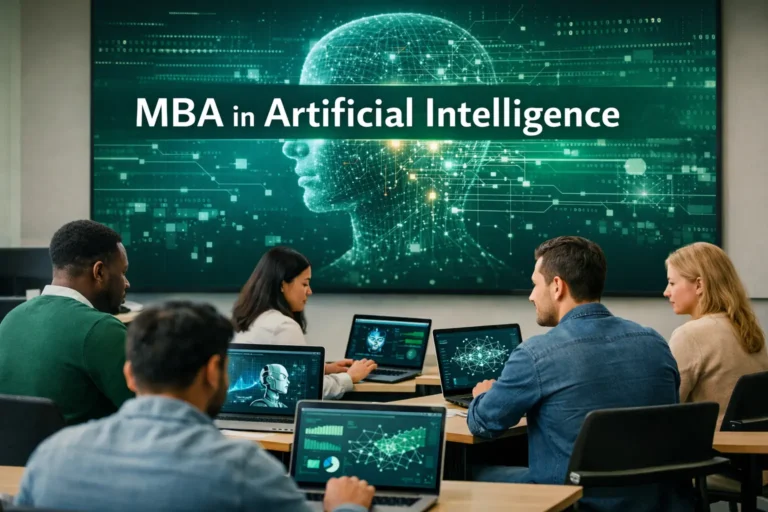
An MBA in Artificial Intelligence is a specialized postgraduate degree that combines core business management education with advanced knowledge of artificial intelligence technologies. It is designed for students who want to understand both strategic decision-making and how AI tools influence modern industries.
In simple terms, an MBA Artificial Intelligence program teaches how to manage businesses in a data-driven world. Students learn subjects like machine learning fundamentals, business analytics, leadership, and digital transformation. This combination helps graduates bridge the gap between technical teams and business leadership.
For international students, an MBA in AI offers a pathway into high-demand roles where understanding both business strategy and emerging technologies is essential. As organizations increasingly adopt AI systems, the demand for professionals who can lead AI-driven initiatives continues to grow.
Key Highlights
- An MBA in Artificial Intelligence combines management education with AI and data analytics
- Suitable for students from business, engineering, or technology backgrounds
- Offered in full-time, part-time, and online formats
- Duration and curriculum vary by university
- Popular study destinations include the USA, UK, Canada, Australia, and Europe
- Career opportunities include AI strategy, consulting, product management, and analytics
What Is an MBA in Artificial Intelligence?
An MBA in Artificial Intelligence is a business degree that integrates artificial intelligence concepts into traditional MBA subjects. Unlike a general MBA, this program focuses on how AI technologies can be applied to solve business problems.
Students typically study:
- Business strategy and leadership
- Data analytics and decision-making
- Machine learning basics
- AI applications in industries such as finance, healthcare, and marketing
The goal is not to train students as software engineers, but to prepare them to manage AI-driven business environments.
Why Study MBA Artificial Intelligence?
Growing Demand for AI-Driven Leadership
Organizations are investing heavily in AI technologies. However, there is a shortage of professionals who can understand both business needs and AI capabilities. This degree helps fill that gap.
Interdisciplinary Skill Development
An MBA in AI combines:
- Strategic thinking
- Technical awareness
- Leadership and communication
This blend is valuable across industries.
Global Career Opportunities
Graduates can work in multinational companies, startups, consulting firms, and technology organizations. The skills are transferable across countries.
Types of MBA in AI Programs
Different universities offer various formats to suit student needs.
Program Formats
| Format | Description | Best For |
|---|---|---|
| Full-Time | On-campus immersive learning | Recent graduates |
| Part-Time | Flexible schedule while working | Working professionals |
| Online MBA | Remote learning with digital resources | International or remote learners |
| Executive MBA | Designed for experienced professionals | Mid to senior-level managers |
MBA in Artificial Intelligence vs Traditional MBA
| Feature | MBA in AI | Traditional MBA |
|---|---|---|
| Focus | Business + AI technologies | General business management |
| Technical Exposure | Moderate | Minimal |
| Career Path | AI strategy, analytics, tech leadership | Finance, marketing, operations |
| Industry Relevance | High in tech-driven sectors | Broad across industries |
Eligibility Requirements
Eligibility criteria vary by university, but generally include:
- A bachelor’s degree in any discipline
- Basic understanding of mathematics or statistics
- Work experience may be preferred for some programs
- English language proficiency for international students
Some universities may also require standardized test scores, though requirements vary.
Top Countries to Study MBA in Artificial Intelligence
United States
The USA offers a wide range of AI-focused MBA programs with strong industry connections.
Examples of universities:
- Massachusetts Institute of Technology
- Stanford University
- Carnegie Mellon University
Programs often emphasize innovation, entrepreneurship, and advanced analytics.
United Kingdom
The UK offers shorter-duration MBA programs with a focus on global business.
Examples include:
- University of Oxford
- Imperial College London
- University of Edinburgh
These programs often integrate AI with business strategy and policy.
Canada
Canada is known for its strong AI research ecosystem.
Examples include:
- University of Toronto
- McGill University
- York University
Programs may focus on data science, AI ethics, and business applications.
Australia
Australia offers flexible and internationally recognized MBA programs.
Examples include:
- University of Melbourne
- Australian National University
- University of Sydney
Courses often include digital transformation and innovation management.
Europe
European institutions provide diverse and globally oriented programs.
Examples include:
- INSEAD
- HEC Paris
- ESADE Business School
Programs may emphasize international business and AI strategy.
Curriculum Overview
While the exact curriculum varies by university, most MBA in AI programs include the following areas:
Core Business Subjects
- Finance and accounting
- Marketing management
- Operations management
- Organizational behavior
AI and Technology Subjects
- Introduction to artificial intelligence
- Machine learning fundamentals
- Business analytics
- Data visualization
Electives
- AI in healthcare
- Fintech and AI
- Digital marketing analytics
Cost of Studying MBA in Artificial Intelligence
Costs vary widely depending on the country and institution.
Tuition Fee Comparison
| Country | Estimated Tuition Range |
|---|---|
| USA | High |
| UK | Moderate to High |
| Canada | Moderate |
| Australia | Moderate to High |
| Europe | Varies by country and school |
Career Opportunities After MBA in AI
Graduates of MBA Artificial Intelligence programs can pursue roles such as:
- AI Product Manager
- Business Analyst
- Data Strategy Consultant
- Digital Transformation Manager
- Technology Consultant
Career Path
| Role | Focus Area |
|---|---|
| AI Product Manager | Product development and strategy |
| Data Analyst | Data insights and reporting |
| AI Consultant | Business solutions using AI |
| Operations Manager | Process optimization |
Skills You Gain
An MBA in Artificial Intelligence helps develop:
- Strategic decision-making
- Data-driven thinking
- Leadership and team management
- Understanding of AI tools and systems
- Communication between technical and non-technical teams
These skills are relevant across industries.
Is MBA in AI Worth It?
The value of an MBA in Artificial Intelligence depends on career goals.
It may be suitable if you:
- Want to work at the intersection of business and technology
- Aim for leadership roles in tech-driven organizations
- Are interested in data-driven decision-making
However, students should carefully evaluate program structure, costs, and career outcomes before applying.
Frequently Asked Questions
- What is the duration of an MBA in Artificial Intelligence?
The duration varies by university. Full-time programs are typically one to two years, while part-time and online options may be more flexible. - Do I need a technical background for MBA in AI?
Not always. Many programs accept students from diverse backgrounds, though basic quantitative skills can be helpful. - Is MBA Artificial Intelligence better than a regular MBA?
It depends on career goals. An MBA in AI is more specialized, while a regular MBA offers broader career options. - Which country is best for studying MBA in AI?
The best country depends on factors such as budget, career goals, and preferred learning environment. The USA, UK, Canada, Australia, and Europe are all strong options. - What jobs can I get after MBA in AI?
Common roles include AI consultant, product manager, business analyst, and digital strategy manager. - Is an online MBA in AI valid?
Yes, if it is offered by an accredited university. Recognition depends on the institution.
Conclusion
An MBA in Artificial Intelligence is an evolving degree that reflects the growing importance of AI in global business. It provides a structured way to understand how emerging technologies influence decision-making, operations, and strategy.
For international students, this program offers exposure to global business environments while building relevant skills for the future workforce. Since program content and outcomes vary by university, it is important to review curriculum details, costs, and career support before making a decision.
Overall, an MBA Artificial Intelligence can be a suitable choice for students who want to combine business leadership with technological awareness in a rapidly changing world.